
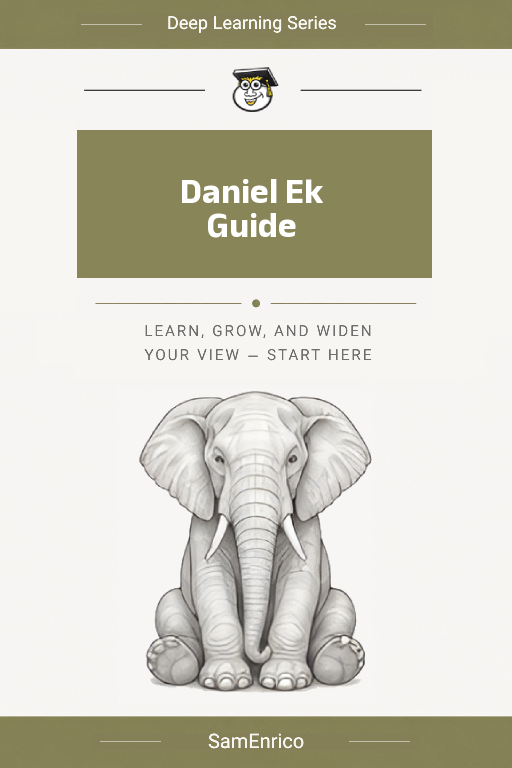
Non-FictionStrategic AtlasAudio Leadership
Daniel Ek Guide eBook
Analyze Spotify CEO focus: podcast investment ROI,
Analyze Spotify CEO focus: podcast investment ROI, audiobooks expansion, music streaming leadership, and margin improvement.
Formats
Free sample
Chapter 1: The 30% Trap...--– Daniel Ek sat alone in his Stockholm apartment in the winter of 2019, staring at a spreadsheet that would change everything. The numbers weren't just bad. They were existential.He had built Spotify into the world's dominant music streaming platform. The company had gone public the previous year. Millions of users were signing up every month.
By every traditional measure of growth, Spotify was winning. Yet the spreadsheet told a different story—one that kept Ek awake at night.The math was brutal. For every dollar Spotify earned, roughly seventy cents flowed out the door to music labels -3-7. Not for servers. Not for salaries.
Not for marketing. Just for the right to play songs. After covering those licensing costs and all other operating expenses, Spotify was left with margins so thin you could practically see through them -1."If 75% of your revenues—under a cost structure directly tied to revenues—is going out in costs to the content rights holders, how are you ever going to make money?" one industry analyst would later ask, articulating the exact problem Ek was trying to solve -3.This was the trap. And Ek was determined to escape it.What he realized that night in Stockholm would fundamentally reshape Spotify's strategy for the next decade. It would lead to billion-dollar bets on podcasts, an audacious invasion of Amazon's audiobook territory, and a complete reimagining of what Spotify could become.
It would also nearly break the company.This is the story of how one CEO diagnosed a fatal flaw in his business model and then spent seven years—and billions of dollars—fixing it. But more importantly, this is the story of what happens when you realize that your core product, the thing that made you famous, might also be the thing holding you back.The Music Industry's Dirty Secret To understand Daniel Ek's dilemma, you have to understand the peculiar economics of the music business. Unlike almost any other digital product, music has stubbornly refused to become cheaper at scale.Think about software. When Microsoft sells another copy of Windows, the cost of producing that copy is essentially zero. The same goes for Netflix streaming another episode, or Google processing another search.
These are businesses with high fixed costs (building the product) and near-zero marginal costs (delivering it to another customer).Music doesn't work that way.Every time someone streams a song on Spotify, the company pays a royalty. Not a fixed annual fee. Not a one-time license. A per-stream, per-user cost that scales linearly with usage. More users mean more streams, which means more royalties.
There's no economy of scale that makes the tenth million stream cheaper than the first -7.This structural reality creates what Ek came to call the "30% Trap." Spotify keeps roughly thirty cents of every dollar of music revenue. The other seventy cents go to rights holders—labels, publishers, collecting societies -7. That thirty percent must cover everything else: engineering, marketing, sales, administration, and the all-important research and development that keeps the platform competitive."That 70% going out the door creates a very different financial profile than virtually any other tech platform," one financial analyst observed in 2023, after reviewing Spotify's quarterly results -3. "After you've paid that, plus your operating costs, there's not much left."The numbers bear this out. In Spotify's first quarter of 2026, the company achieved a gross margin of 33% -5-9.
That's actually quite good by Spotify's historical standards—up from 25.2% in early 2022 -10. But compare that to other tech platforms. Google's gross margins regularly exceed 55%. Facebook's have historically topped 80%. Netflix, which faces its own content licensing costs, has pushed gross margins toward 40%.Spotify was operating with one hand tied behind its back.The Pirate Who Became the Savior Here's the irony that makes Ek's story so compelling: the man who now negotiates with the world's largest record labels grew up pirating their music."I grew up on pirated music," Ek told Freakonomics Radio in 2019.
Like most Swedish teenagers in the early 2000s, he downloaded songs from Napster, Kazaa, and The Pirate Bay. To him, paying fifteen dollars for a CD when you could get the same music for free seemed absurd -1.This background gave Ek a unique perspective when he co-founded Spotify in 2006. He understood something that the music industry was only beginning to grasp: the battle against piracy had already been lost. The question wasn't whether people would access music for free—they already were, in staggering volumes. The question was whether the industry could offer something better."The problem that we were trying to solve was, it needs to feel like you have all your music on your hard drive," Ek explained.
"So if you think about that, that means instantaneous" -1.Spotify's solution was elegant. For a monthly fee (or with advertisements), users could access almost any song ever recorded, instantly, without downloading files or managing storage. It was better than piracy—faster, more reliable, and legal.But here's what the music industry didn't fully appreciate at the time: Ek wasn't just solving the piracy problem. He was building a business that, from day one, had a fundamental conflict baked into its DNA. The more successful Spotify became, the more it paid out in royalties.The Equity Gambit When Ek approached the major record labels in the late 2000s, he had almost no leverage.
He was a twenty-three-year-old Swede with a prototype and a dream. The labels—Universal, Sony, Warner—had spent years watching piracy decimate their revenues. They were desperate but skeptical.So Ek offered them something unprecedented: equity.The major labels were each given between four and six percent of Spotify's shares. Independent labels collectively received another one percent -1. The deal aligned incentives in a way that pure licensing never could.
If Spotify succeeded, the labels would succeed too. They'd get their seventy percent of streaming revenue AND their shares would be worth billions.When Spotify went public in 2018, those stakes paid off spectacularly. But the underlying problem remained. The equity stake was a one-time windfall. The seventy percent royalty was forever."The labels would also get to keep drawing down 70 percent of Spotify's revenues, and distributing it to their artists according to their own royalty formulas," as one analysis noted -1.
That's the deal that Ek couldn't renegotiate.The Specter of the "Loss-Making Unicorn"By 2019, Spotify had been in business for thirteen years. It had hundreds of millions of users. It had gone public and achieved a market cap of over twenty billion dollars. Yet profitability remained elusive.The company could point to occasional quarters in the black, but sustained, reliable profitability seemed always just over the horizon. The pattern was always the same: user growth would drive revenue growth, but royalty costs would rise in lockstep, leaving margins stubbornly flat.Industry analysts began asking uncomfortable questions.
"If Spotify is still making losses after all this time, what exactly is going to change that will flip those losses into substantial profits?" one wrote in 2023 -3.The question stung because Ek didn't have a good answer—at least not one that relied solely on music. He could optimize pricing. He could improve operational efficiency. He…
This is the end of the free sample. Get the eBook to keep going. Buy now
About this book
Details
- Author
- Crabtree Nannie
- Publisher
- SamEnrico
- Language
- English
- Genre
- Non-Fiction, Strategic Atlas, Audio Leadership
- Released
- 2026-05-29
- Pages (approx.)
- 146
- Available as
- eBook, Audiobook

Read better in the ZLOADR app
Your eBooks on your phone or tablet. Sign in with your SamEnrico account and start reading.
More by Crabtree Nannie
 Emetophobia Self HelpCrabtree Nannie$11.99
 The Turning the Mind DBT SkillCrabtree Nannie$11.99
 Kazakhstan Consumer OutlookCrabtree Nannie$11.99
 Affirmations For Chronic Pain GuideCrabtree Nannie$11.99
 Racial Trauma Triggers GuideCrabtree Nannie$11.99
 The Khan's Lightning: Subutai's Unstoppable Cavalry (1200s AD)Crabtree Nannie$11.99
 Understanding Pancreatic CancerCrabtree Nannie$17.99
 Catalog Sales First CampaignCrabtree Nannie$12.99
 Creeping Bent HarvestingCrabtree Nannie$11.99
 10 Ways to Use Cushaw (Recipe Book)Crabtree Nannie$11.99
You may also like
 Hong Kong Handover 1997Dunn Johnnie$11.99
 Zumba For Postnatal Recovery CourseNeal Christian$11.99
 Zumba for BeginnersLadner Nikia$11.99
 YouTube Comment Mining GuideHumes Pandora$12.99
 Worry Box MeditationCarlin Rudy$11.99
 Workplace Stress MeditationNguyen Lynn$11.99
 Workplace Stress and Sleep RepairHawley Ivory$11.99
 Workplace Perfectionism CureDelaney Jeffry$11.99
 Workplace Injustice Anger GuideWallen Isabelle$11.99
 Work Addiction and Burnout LinkGreenwood Ester$11.99
 Women in Yoga and WellnessBeattie Galina$11.99
 Women in Stand Up ComedyChun Evangeline$11.99