
Non-FictionStudent's ShortcutCybersecuritySecurity Careers
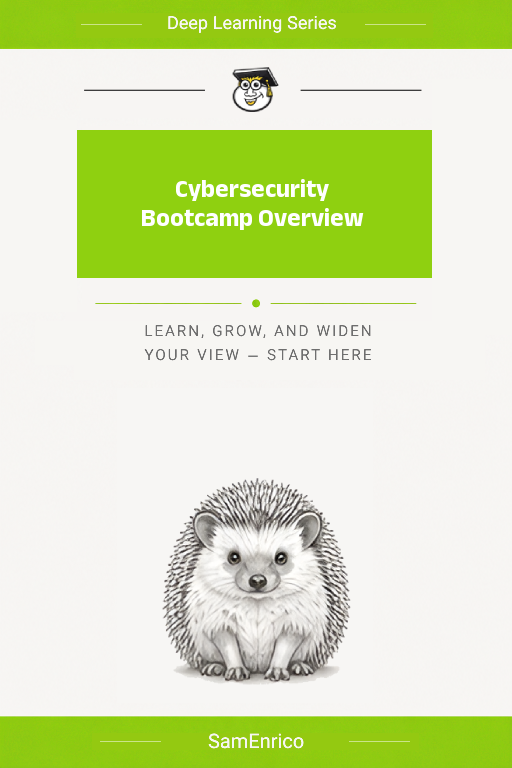
Cybersecurity Bootcamp Overview eBook
Explore bootcamp and degree options for security c
Explore bootcamp and degree options for security careers including certifications that matter more than degrees.
Formats
Free sample
Chapter 1: The Broken Filter...--–- Picture a hiring manager at a mid-sized tech company. She has seventy-three resumes for a single junior security analyst position. Seventeen candidates hold bachelor's degrees in cybersecurity. Nine have master's degrees. Three have doctorates.
She spends an average of seven seconds on each resume before making the "yes" or "no" pile. That is not laziness. That is volume. Now ask yourself: In those seven seconds, what actually proves someone can stop a ransomware attack? The name of the university?
The GPA? Or something else entirely.This book opens with a provocative claim that will take the next twelve chapters to prove: The vast majority of cybersecurity hiring is broken because it filters for the wrong signals. The industry complains about a skills gap while rewarding credential inflation. Bootcamps promise six-figure salaries but often deliver debt and disappointment. Degrees take four years and six figures but leave graduates unable to read a packet capture.
And through all of this noise, a simpler truth has emerged: The certifications that matter most are not the expensive ones. The skills that get you hired are not taught in most classrooms. And the path you choose matters far less than the evidence you build.This chapter dismantles the false binary of "degree versus bootcamp" and introduces the framework that will guide everything that follows. By the time you finish reading these pages, you will stop asking which educational path is "better" and start asking a more useful question: How do I prove I can do the job, regardless of where I learned it?The Great Misalignment: Why 3.5 Million Jobs Stay Empty Let us start with a number that haunts the cybersecurity industry: 3.5 million. That is how many unfilled cybersecurity positions the industry projects by 2025, according to ISC²'s annual workforce study.
It is a staggering figure, often cited in conferences and boardrooms as evidence of a talent shortage. But the number is misleading. The shortage is not a shortage of people. It is a shortage of qualified people – and the definition of "qualified" has become distorted.Consider what actually happens when a company posts a cybersecurity role. A typical job description for a security analyst might list: "Bachelor's degree required, master's preferred.
CISSP or CISM preferred. Five to seven years of experience required." That same job description, when examined closely, describes tasks that a motivated individual could learn in six months: log analysis, SIEM configuration, basic incident response. The requirements have little to do with the actual work. They exist because hiring managers are risk-averse and because HR departments use degrees as cheap filtering mechanisms – a concept called signal theory, which we will return to throughout this book.Here is the painful irony: The same companies that complain about the skills gap often refuse to interview candidates without degrees. The same hiring managers who demand "five years of experience" reject bootcamp graduates who have built fifteen hands-on labs.
The system is not designed to find talent. It is designed to minimize risk for the person doing the hiring. And that risk aversion has created a bizarre reality where the least important credential – a four-year degree that may have included one introductory security course – has become the primary gatekeeper.The data tells a different story. A 2023 study by Burning Glass Institute analyzed millions of job postings and found that only 35% of cybersecurity roles actually required a degree when the job description was stripped of "preferred" language. The other 65% used degrees as a filter despite no evidence that degree holders performed better.
Even more striking: The same study found that candidates with certifications but no degrees were hired at essentially the same rate as degree holders – 78% versus 81% – once they got past the initial resume screen. The problem was never competency. The problem was the screen itself.The T-Shaped Lie (And What Actually Works)You may have heard of the "T-shaped" professional – someone with deep expertise in one area (the vertical bar of the T) and broad knowledge across many areas (the horizontal bar). The concept appears in every cybersecurity career book, including the bestsellers this book synthesizes. It is not wrong.
But it is incomplete.The missing piece is provable competency. You can have the deepest vertical bar in network security and the widest horizontal bar in compliance, governance, and cloud architecture. None of it matters if you cannot show a hiring manager what you have built, broken, or fixed. The cybersecurity industry has shifted, faster than many realize, toward evidence-based hiring. Technical interviews now routinely include live labs.
Candidates are asked to analyze real PCAP files. SOC managers will hand you a Splunk query and ask you to explain what it does.This shift is the single most important trend in cybersecurity hiring today – and it is the reason this book exists. Traditional degrees are not designed for evidence-based hiring. They are designed for transcripts. Bootcamps claim to be designed for evidence-based hiring, but many are not.
And certifications range from hands-on performance exams (excellent) to multiple-choice trivia tests (nearly worthless). Understanding how to navigate this landscape is the difference between sending out two hundred applications and sending out twenty.Here is what the T-shaped model misses: Depth without evidence is invisible. Breadth without proof is irrelevant. A candidate who has built a home lab, documented fifteen incident response scenarios, and earned a practical certification like Blue Team Level 1 will consistently beat a candidate with a master's degree and no portfolio – even in technical interviews conducted by degree-holding hiring managers. We will prove this with real examples throughout the book.The Catch-22: Why Experience Requirements Are a Trap Every aspiring cybersecurity professional encounters the Catch-22: You need experience to get a job.
You need a job to get experience. It is infuriating. It is also, when examined closely, a lie – or at least a half-truth.The Catch-22 exists because employers conflate "experience" with "employment." They are not the same thing. Experience is the set of skills and situations you have navigated. Employment is one way to acquire that experience.
But there are others: home labs, Capture The Flag competitions, bug bounty programs, open-source contributions, and freelance security assessments. These activities produce verifiable experience – evidence that you have done the work, even if no one paid you for it.Here is where traditional education fails. A four-year degree typically offers one structured opportunity to gain experience: the senior-year internship, if you are lucky enough to secure one. Everything before that is theory, exams, and homework assignments that no employer will ever see. A bootcamp, in contrast, is built around projects from week one.
The best bootcamps – the gold-standard programs we will identify in Chapter 3 – have you building a SIEM dashboard by week three and responding to a simulated breach by week eight. That is experience. It is not employment. But it is demonstrable.The catch, of course, is that not all bootcamps deliver on this promise. Some are cash grabs that teach outdated curricula and offer career services that consist of little more than resume templates.
The same goes for degrees: not all are created equal, and some leave graduates with six figures of debt and no practical skills. The framework…
This is the end of the free sample. Get the eBook to keep going. Buy now
About this book
Details
- Author
- Michael Vanna
- Publisher
- SamEnrico
- Language
- English
- Genre
- Non-Fiction, Student's Shortcut, Cybersecurity, Security Careers
- Released
- 2026-05-29
- Pages (approx.)
- 156
- Available as
- eBook, Audiobook

Read better in the ZLOADR app
Your eBooks on your phone or tablet. Sign in with your SamEnrico account and start reading.
More by Michael Vanna
 Anger After Child's DiagnosisMichael Vanna$11.99
 Apology Delivery Anxiety ProtocolMichael Vanna$11.99
 The Emotion Regulation for Teens ManualMichael Vanna$11.99
 Self Hypnosis for Problem SolvingMichael Vanna$11.99
 The Parent Resentment WorkbookMichael Vanna$11.99
 The Fire Walker: A Scientist’s Perilous Quest into the Heart of CotopaxiMichael Vanna$11.99
 The Unlikely Friendship That Changed a Nation: The Story of Mr. Rogers and Koko the GorillaMichael Vanna$11.99
 Information Security ConsultantMichael Vanna$11.99
 African Ecommerce Outlook 2030Michael Vanna$12.99
 Understanding Branchio-oculo-facial Syndrome Hing TypeMichael Vanna$17.99
 How to Become a Scaling Machine OperatorMichael Vanna$11.99
You may also like
 Hong Kong Handover 1997Dunn Johnnie$11.99
 Zumba For Postnatal Recovery CourseNeal Christian$11.99
 Zumba for BeginnersLadner Nikia$11.99
 YouTube Comment Mining GuideHumes Pandora$12.99
 Worry Box MeditationCarlin Rudy$11.99
 Workplace Stress MeditationNguyen Lynn$11.99
 Workplace Stress and Sleep RepairHawley Ivory$11.99
 Workplace Perfectionism CureDelaney Jeffry$11.99
 Workplace Injustice Anger GuideWallen Isabelle$11.99
 Work Addiction and Burnout LinkGreenwood Ester$11.99
 Women in Yoga and WellnessBeattie Galina$11.99
 Women in Stand Up ComedyChun Evangeline$11.99