
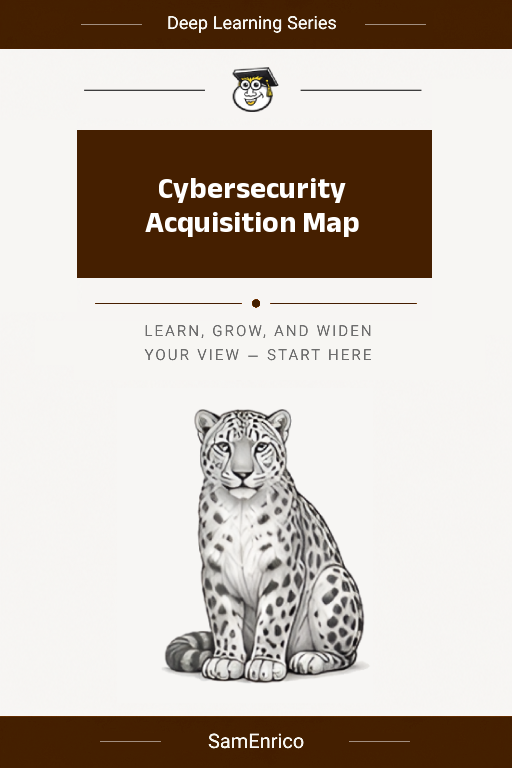
Non-FictionStrategic AtlasCyber M&A
Cybersecurity Acquisition Map eBook
Identify SIEM, XDR, identity, and data security ta
by Land Lavina
Identify SIEM, XDR, identity, and data security targets for CrowdStrike, Palo Alto, Fortinet, and Microsoft.
Formats
Free sample
Chapter 1: The 3:00 AM Alarm--–- The ringing sliced through Alex Chen’s sleep like a scalpel. Not the gentle buzz of his i Phone alarm, but the shrill, insistent shriek of the Pager Duty alert he’d configured for “Critical – Security Incident – Immediate Escalation.” His hand found the phone on the nightstand before his eyes opened, a muscle memory forged over twenty years in cybersecurity. His wife, Mira, stirred beside him, then fell silent again—she had long stopped asking what was wrong. The answer was always the same.Alex squinted at the screen. 3:02 AM.
The alert read:“Falcon XDR: CRITICAL - Suspicious Outbound Traffic Detected - Host: DEV-LAPTOP-0427 - User: Priya Sharma”His heart rate, already elevated, found a new gear. Priya Sharma was a junior developer on the algorithmic trading team. Her laptop had no business sending unusual outbound traffic at three in the morning. He tapped the alert, pulling up the Crowd Strike Falcon console on his phone. The timeline showed a series of curl commands—unusual for a Windows laptop—making HTTPS requests to an IP address geolocated to Moscow.
The volume of data egress was small so far: about 2.3 megabytes. Source code snippets.Alex was already swinging his legs out of bed, padding to his home office in the dark. He pulled up the Splunk SIEM—the $2.7 million “single source of truth” his predecessor had purchased three years ago. He typed a simple query: index=main host=DEV-LAPTOP-0427 sourcetype=Win Event Log:Security | where Event ID==4624.The spinning wheel of death appeared. Splunk was “searching.” Ten seconds.
Twenty. Forty-five seconds. The attack was spreading, and his “enterprise log storage” was still thinking.He switched tabs to Cyber Ark, the Privileged Access Management (PAM) tool that was supposed to secure every service account and admin credential. He searched for Priya’s laptop hostname. Nothing.
The integration between Cyber Ark and Crowd Strike—a custom API connector built by a consultant who had since vanished—had failed to map the endpoint to the identity. Alex had no idea which service accounts had been compromised, or whether the attacker had pivoted laterally using privileged credentials.His phone buzzed again. A second alert: “Falcon XDR: CRITICAL - Lateral Movement Detected - Source: DEV-LAPTOP-0427 - Target: BUILD-SERVER-03”The build server. Where Nexus Financial stored its proprietary trading algorithms. The crown jewels.Alex opened his Slack channel #security-oncall.
He typed: @channel - Major incident. Splunk is useless. Get Marcus on the line. Now.The replies came quickly:Marcus: “I’m on. Looking at Falcon.
Why can’t I see the Cyber Ark logs?”Alex: “Integration broke. Manual correlation. Someone pull the PCAPs from the firewall.”Network-Team-Lead: “Which firewall? We have Palo Alto for cloud, Fortinet for on-prem. The traffic is hitting both.”`Alex closed his eyes.
This was the nightmare. The “best of breed” strategy his predecessor had sold to the board—best-in-class EDR (Crowd Strike), best-in-class SIEM (Splunk), best-in-class PAM (Cyber Ark), best-in-class network security (Fortinet and Palo Alto)—was a house of cards. And a Moscow-based adversary had just sneezed.The Fragmentation Tax What Alex was experiencing at 3:00 AM has a name. Industry analysts call it the “fragmentation tax.” Practitioners call it “why I’m going to die at fifty.”For the past decade, the dominant strategy in cybersecurity was simple: buy the best tool for every job. Buy Crowd Strike for endpoint detection.
Buy Splunk for log aggregation. Buy Cyber Ark for privileged access. Buy Palo Alto for cloud firewalls. Buy Fortinet for on-prem network security. Buy Okta for identity.
Buy Proofpoint for email. Buy Zscaler for web filtering. The list grew longer every year, like a receipt from a grocery store where you only came for milk.The logic was seductive. “Best of breed” meant you weren’t compromising. You weren’t settling for the “good enough” features bundled into a platform.
You were assembling a team of all-stars, each one the Le Bron James of its domain.But Alex had just discovered the dirty secret of all-star teams. They don’t pass the ball.Crowd Strike couldn’t talk to Cyber Ark. Splunk couldn’t query fast enough to matter. Fortinet and Palo Alto logged the same traffic to different consoles. The SOC analysts—Marcus and his team of six—spent 60% of their time manually correlating data across these silos.
They created spreadsheets. They built Python scripts to translate API outputs. They held “integration meetings” that should have been called “why isn’t this working” meetings.The economic cost of fragmentation is staggering. Research firms estimate that organizations with more than ten security point solutions spend an average of 30% of their security budget on integration and maintenance—not on detection, not on response, but on making tools talk to each other. For a company like Nexus Financial, with a 12millionsecuritybudget,thatwas12 million security budget, that was 12millionsecuritybudget,thatwas3.6 million flushed down the drain of API compatibility.But the human cost is worse.
Alex hadn’t slept through the night in months. His SOC team had a turnover rate of 40%—analysts leaving for simpler roles where they only had to learn one console. The “best of breed” strategy was supposed to make him safer. Instead, it was making him exhausted.The Four Engines of Consolidation As Alex waited for Marcus to pull the network packet captures, he realized something. The fragmentation he was experiencing wasn’t accidental.
It was the natural result of a market that had shifted beneath his feet.The four largest cybersecurity vendors—Palo Alto Networks, Microsoft, Crowd Strike, and Fortinet—had spent the last five years executing a quiet coup. They were no longer selling point products. They were selling platforms. And each one had a different theory of how to win.Palo Alto Networks: The Platformization Thesis Palo Alto’s strategy was the most ambitious and the most expensive. CEO Nikesh Arora had declared that the company would become the “Salesforce of cybersecurity”—a single platform that unified network security (Strata), cloud security (Prisma), and security operations (Cortex).
The acquisitions told the story: Evident.io (cloud security), Twistlock (container security), Red Lock (cloud threat detection), Demisto (SOAR), and most recently, the $25 billion purchase of Cyber Ark, the market leader in privileged access management.The goal was breathtaking: own the entire security stack from the network firewall to the cloud workload to the identity layer. Palo Alto was betting that CISOs would pay a premium for a single pane of glass—even if individual components weren’t best-in-class.Microsoft: The Licensing Leverage Microsoft’s strategy was simpler and more insidious. Every organization already paid for Microsoft 365. Every organization already used Windows. Microsoft’s security products—Defender for Endpoint, Defender for Identity, Defender for Cloud, Sentinel SIEM, Purview data protection—were bundled into the E5 license.
For most customers, adding Microsoft security cost nothing incremental because they were already paying for the license.The catch, of course, was that leaving Microsoft meant leaving the license. And replacing Defender with Crowd Strike or Sentinel with Splunk meant adding millions of dollars to the security budget. Microsoft didn’t need to be the best. It just needed to be good enough—and free (or at least, already paid for).Crowd…
This is the end of the free sample. Get the eBook to keep going. Buy now
About this book
Details
- Author
- Land Lavina
- Publisher
- SamEnrico
- Language
- English
- Genre
- Non-Fiction, Strategic Atlas, Cyber M&A
- Released
- 2026-05-30
- Pages (approx.)
- 131
- Available as
- eBook, Audiobook

Read better in the ZLOADR app
Your eBooks on your phone or tablet. Sign in with your SamEnrico account and start reading.
More by Land Lavina
 Multitasking Illusion Recovery HandbookLand Lavina$11.99
 The Musical Memory Sleep GuideLand Lavina$11.99
 India Support Center Cost AnalysisLand Lavina$11.99
 Business School Essay PromptsLand Lavina$11.99
 Divorce and InheritanceLand Lavina$11.99
 The Battle of Changping: Sun Tzu’s Shadow Over the Warring StatesLand Lavina$11.99
 Audience Gravity SystemsLand Lavina$11.99
 Understanding Plague, MeningealLand Lavina$17.99
 QuickBooks Project ProfitabilityLand Lavina$12.99
 How to Start a Ophthalmic Clinic Business (Beginners Guide)Land Lavina$11.99
You may also like
 Hong Kong Handover 1997Dunn Johnnie$11.99
 Zumba For Postnatal Recovery CourseNeal Christian$11.99
 Zumba for BeginnersLadner Nikia$11.99
 YouTube Comment Mining GuideHumes Pandora$12.99
 Worry Box MeditationCarlin Rudy$11.99
 Workplace Stress MeditationNguyen Lynn$11.99
 Workplace Stress and Sleep RepairHawley Ivory$11.99
 Workplace Perfectionism CureDelaney Jeffry$11.99
 Workplace Injustice Anger GuideWallen Isabelle$11.99
 Work Addiction and Burnout LinkGreenwood Ester$11.99
 Women in Yoga and WellnessBeattie Galina$11.99
 Women in Stand Up ComedyChun Evangeline$11.99