
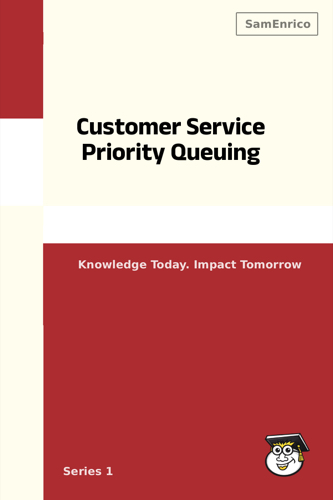
Non-FictionBusiness BriefQueuing
Customer Service Priority Queuing eBook
Triage urgent issues to VIP or escalation queues f
Triage urgent issues to VIP or escalation queues for faster response.
Formats
Free sample
Chapter 1: The Flat Earth Myth--–- In a windowless conference room on the thirty-fourth floor of a glass tower in downtown Austin, a head of customer support named Priya stared at a spreadsheet that had just ruined her Tuesday. The numbers told a simple, brutal story: despite adding three new agents, despite reducing average response time from fourteen minutes to eleven, despite all the training and scripting and morale posters, her churn rate among enterprise customers had climbed 18 percent in six months. Her CEO had circled one number in red marker—$2.4 million in annual recurring revenue lost—and written three words beside it: "Fix this now."The problem was not speed. The problem was the queue.Every single ticket her team received, from a Fortune 500 CEO who could not log in to a free-tier user who wanted to change their email preferences, went into the same bucket. First in, first out.
Fair, her predecessor had called it. Democratic, the head of product had once said. Priya had believed it too, until she pulled the data on which customers had churned and discovered that 73 percent of them had waited more than twenty minutes for a response on a critical issue. Not because they were low priority. Because they had the misfortune of submitting their ticket behind two hundred password resets, newsletter unsubscribes, and "how do I change my avatar" requests.The flat earth of customer service, she realized, was not flat at all.
It was a hill, and her most valuable customers were dying on it while her agents answered questions that could have waited an hour or a day or forever.This chapter dismantles the most seductive and destructive myth in customer service: that treating every customer identically under First-In-First-Out is fair, efficient, or even sane. You will learn why a ten-minute wait for a CEO costs your company more than a ten-hour wait for a free-tier user, how a single unresolved VIP issue can erase the profit from a thousand standard sales, and why the "Cost of Waiting" is the most important metric you are not tracking. By the end of this chapter, you will never look at a queue the same way again.The Seduction of Fairness First-In-First-Out has a powerful emotional appeal. It feels right. It feels just.
The customer who came first should be served first, regardless of who they are or what they want. This is how we teach children to wait in line. This is how deli counters operate. This is how democracy is supposed to work.But customer service is not a deli counter, and your customers are not equally valuable to your business. Ignoring that reality does not make it false.
It makes you inefficient.Consider two customers who submit tickets at exactly the same moment on a Monday morning. Customer A is a software engineer at a mid-sized manufacturing company that pays your firm $120,000 per year. Their API key has expired, and their entire production deployment pipeline has ground to a halt. Every minute that passes costs their company approximately $800 in lost productivity. They are calm on the phone, but their internal Slack channel is on fire.Customer B is a college student using your free tier.
They want to know if you support dark mode. They are not angry. They are not in a rush. They are simply curious.In a FIFO system, these two tickets are treated identically. Whichever arrived first—perhaps by a margin of three seconds—gets answered first.
The other waits. If the dark mode question arrived twelve seconds earlier, the manufacturing company loses production for however long it takes your agent to type "Not yet, but we're working on it!"This is not fair. This is not efficient. This is a failure of imagination dressed up as a commitment to equality.The philosopher John Rawls famously argued that social and economic inequalities should be arranged to benefit the least advantaged. Your customer service queue should do the opposite.
It should benefit the most advantaged—not because they are better people, but because the survival of your business depends on keeping them. Your free-tier users are not paying your salaries. Your enterprise customers are. Your investors do not care about the democratic purity of your ticket routing. They care about net revenue retention.FIFO is not fairness.
FIFO is the absence of thought.The Economics of Waiting To understand why FIFO fails, you must first understand what waiting actually costs. Most support leaders measure response time as a single number—average first response time across all tickets. This number is worse than useless. It is actively misleading because it treats a two-minute wait for a VIP and a two-minute wait for a free user as identical events. They are not.Let me introduce you to the Cost of Waiting framework, which will appear throughout this book.
The formula is deceptively simple:Cost of Waiting = (Minutes Waited) × (Estimated Hourly Value of Customer's Time)The second variable is the key. You cannot calculate it with perfect precision, but you can approximate it well enough to drive decisions. For enterprise customers paying six-figure annual contracts, a reasonable estimate is their annual contract value divided by 2,000 working hours, multiplied by a stress factor of two to account for the cascading impact of downtime on their own customers.Consider a concrete example. A Saa S company called Fin Serv Analytics sells compliance monitoring software to regional banks. Their average enterprise customer pays $250,000 per year.
That is roughly $125 per hour. But when a compliance report fails to generate, that bank cannot complete its regulatory filing. The bank's own cost of that delay—in fines, auditor hours, and executive attention—is easily five to ten times the direct software cost. A conservative estimate puts the customer's true cost of waiting at $500 per hour.Now imagine that customer submits a critical ticket and waits thirty minutes for a response. The Cost of Waiting is 0.5 hours × $500 = $250.
Not catastrophic. But if that happens twice a month, you are imposing $6,000 per year of hidden cost on a customer paying you $250,000. That customer will eventually leave, and they will tell their peers exactly why.Now compare that to a free-tier user who waits the same thirty minutes. Their Cost of Waiting is effectively zero. They are not losing money.
They are not disappointing their own customers. They are simply annoyed. Annoyance matters—it damages brand perception and reduces conversion rates—but it is not economically equivalent to an active production outage at a regulated financial institution.The math is not subtle. A single hour of waiting for a high-value enterprise customer can cost your company more in future churn than a thousand hours of waiting for free users. FIFO ignores this completely.
FIFO treats the bank executive and the dark mode enthusiast as identical units in a single linear queue.This is why Priya's spreadsheet told such a brutal story. Her team was fast—eleven minutes on average. But that average hid a distribution in which VIPs routinely waited twenty to thirty minutes behind a wall of low-value tickets. Her agents were working hard. They were just working on the wrong things in the wrong order.The Tipping Point: How One…
This is the end of the free sample. Get the eBook to keep going. Buy now
About this book
Details
- Author
- Mullen Jayson
- Publisher
- SamEnrico
- Language
- English
- Genre
- Non-Fiction, Business Brief, Queuing
- Released
- 2026-06-09
- Pages (approx.)
- 158
- Available as
- eBook, Audiobook

Read better in the ZLOADR app
Your eBooks on your phone or tablet. Sign in with your SamEnrico account and start reading.
More by Mullen Jayson
 Beginner Breathing MeditationsMullen Jayson$11.99
 Francis First FollowersMullen Jayson$11.99
 Single And Lonely No MoreMullen Jayson$11.99
 The Antidepressant Pain GuideMullen Jayson$11.99
 The Voice of the People: How a Singaporean Editor Defied Censorship and Changed a NationMullen Jayson$11.99
 How to Become a Steak Sauce MakerMullen Jayson$11.99
 Pivot During FundraisingMullen Jayson$12.99
 Project Management MOOC GuideMullen Jayson$12.99
 Learn to Play the Tambou Bas a Yon FasMullen Jayson$11.99
 Algorithmic Information Acoustic Resonance TechnicianMullen Jayson$11.99
You may also like
 Hong Kong Handover 1997Dunn Johnnie$11.99
 Zumba For Postnatal Recovery CourseNeal Christian$11.99
 Zumba for BeginnersLadner Nikia$11.99
 YouTube Comment Mining GuideHumes Pandora$12.99
 Worry Box MeditationCarlin Rudy$11.99
 Workplace Stress MeditationNguyen Lynn$11.99
 Workplace Stress and Sleep RepairHawley Ivory$11.99
 Workplace Perfectionism CureDelaney Jeffry$11.99
 Workplace Injustice Anger GuideWallen Isabelle$11.99
 Work Addiction and Burnout LinkGreenwood Ester$11.99
 Women in Yoga and WellnessBeattie Galina$11.99
 Women in Stand Up ComedyChun Evangeline$11.99