
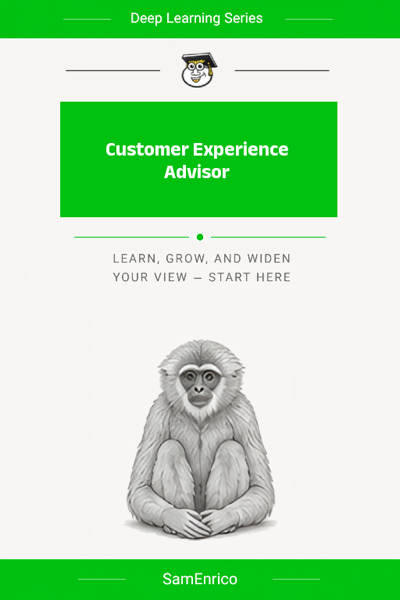
Non-FictionInformativeEducational
Customer Experience Advisor eBook
A Coursebook on Customer Experience Advisor
A Coursebook on Customer Experience Advisor
Formats
Free sample
Chapter 1: The Ticket Trap...--Every day, millions of customer service representatives around the world log into their systems, pull up the next ticket in the queue, and begin typing. They are measured on speed. Their managers watch average handle time like hawks. Their bonuses depend on closing tickets before the clock runs out. They are efficient.
They are productive. They are losing the war for customer loyalty.This is not hyperbole. It is the quiet catastrophe of modern business.For thirty years, companies have invested billions of dollars in customer service technology—ticketing systems, knowledge bases, workforce management software, chatbots, and now artificial intelligence. And yet, according to the Customer Contact Council's research of over 75,000 customers, the vast majority of customer service interactions actually decrease customer loyalty. That is right.
Most customers walk away from a resolved interaction less loyal than before they called.The problem is not the agents. The problem is not the software. The problem is the fundamental assumption underlying almost every customer service operation in the world: the assumption that customer service is about handling tickets.This chapter is about dismantling that assumption. It is about the transformation from ticket-handler to Customer Experience Advisor—a shift that changes not just what you do, but how you think about your role, your customers, and your company's growth. By the end of this chapter, you will understand why traditional customer service is structurally incapable of building loyalty, and you will see the blueprint for a radically different approach.The Quiet Catastrophe: How "Service" Became the Enemy of Loyalty Let us start with a simple question: Why does customer service exist?On the surface, the answer seems obvious.
Customer service exists to help customers when something goes wrong. A product breaks. A bill is confusing. A shipment is late. The customer reaches out, and the service team fixes the problem.
Problem solved. Customer happy. Loyalty secured.This logic is so deeply embedded in business thinking that it is rarely questioned. But the research tells a different story.The Customer Contact Council studied the outcomes of over 75,000 customer service interactions across multiple industries. They tracked not just whether the problem was solved, but whether the customer's loyalty to the company increased, decreased, or stayed the same after the interaction.
The findings were devastating. For interactions that involved a single, simple issue resolved on the first contact, only 9% of customers reported increased loyalty. For interactions that required multiple contacts or transfers, the numbers were even worse—with some categories showing that over 50% of customers became less loyal after contacting support.Let that sink in. The department explicitly designed to help customers is systematically destroying customer loyalty.This is what I call the Ticket Trap. The Ticket Trap is the seductive but destructive belief that customer service is a transaction: a ticket comes in, a ticket goes out, and the job is done.
Metrics like Average Handle Time, First Contact Resolution, and Customer Satisfaction scores reinforce this belief. They measure speed and closure, not relationship and loyalty. They reward the agent who gets the customer off the phone fastest, not the one who makes the customer feel valued.The Ticket Trap has three deadly consequences.First, it trains customers to expect friction. When every interaction is rushed and transactional, customers learn that calling support means waiting, repeating themselves, and fighting against a system that wants them gone. This expectation becomes a self-fulfilling prophecy.
Customers call already frustrated, which makes every interaction harder.Second, it blinds organizations to root causes. When you measure success by closing tickets, you have no incentive to ask why those tickets were created in the first place. A product that breaks constantly generates lots of tickets. A confusing bill generates lots of tickets. A website that does not work generates lots of tickets.
Under the ticket model, all of these are celebrated as "high-volume issues" rather than treated as design failures that need to be eliminated.Third, it burns out employees. The average customer service agent lasts eighteen months in the role. They are measured on speed, monitored constantly, given little decision authority, and expected to absorb the emotional exhaustion of hundreds of angry customers every week. The Ticket Trap treats agents as interchangeable processing units rather than as strategic assets who can drive growth.The result is a system that pleases no one. Customers hate calling.
Agents hate working. And executives cannot understand why their expensive service operation does not seem to be building loyalty.The Experience Economy: Why CX Became a Competitive Weapon To understand why the Ticket Trap is so dangerous today, we need to look at the broader economic shift that has transformed the business landscape over the past twenty-five years.In 1999, business strategists Joseph Pine and James Gilmore published a landmark book called The Experience Economy. Their argument was simple but profound. Throughout economic history, the nature of value has shifted. In the agrarian economy, value came from commodities—raw materials harvested from the earth.
In the industrial economy, value came from goods—manufactured products that transformed those commodities into useful objects. In the service economy, value came from services—activities performed for the benefit of others.But Pine and Gilmore argued that we had entered a new era: the experience economy. In this era, value comes from experiences—memorable events that engage customers in personal, emotional ways. A cup of coffee is a commodity. Brewing it at home is a good.
A barista serving it is a service. But sitting in a beautifully designed coffee shop with curated music, friendly baristas who remember your name, and a loyalty program that rewards your visits—that is an experience. And experiences command premium prices.The experience economy explains why Starbucks can charge four dollars for a cup of coffee that costs twenty cents to produce. It explains why the Ritz-Carlton can charge five hundred dollars for a hotel room that a budget motel would charge eighty dollars for. It explains why Apple customers camp outside stores for product releases.Here is the critical insight for customer experience advisors: In the experience economy, customer service is not a cost center.
It is the primary arena where experiences are created or destroyed.Think about the last time you had a truly memorable customer service interaction—the kind where you hung up the phone and told someone about it. What made it memorable? It was not the speed of the resolution, although speed helped. It was not the accuracy of the answer, although accuracy mattered. What made it memorable was the way the interaction made you feel.
Perhaps you felt heard for the first time after being passed around. Perhaps someone went out of their way to fix a problem they did not cause. Perhaps an agent made a decision that surprised you with its generosity.These moments are not accidents. They are the result of a fundamentally different approach to customer service—one where the goal is not to close tickets but to orchestrate experiences that build emotional connection.The experience economy has made customer experience the single most sustainable competitive differentiator available to most companies. Products can be copied.
Features can be replicated. Prices can be undercut. But a unique, well-orchestrated experience that makes customers feel valued, understood, and…
This is the end of the free sample. Get the eBook to keep going. Buy now
About this book
Details
- Author
- Guzman Jonathon
- Publisher
- SamEnrico
- Language
- English
- Genre
- Non-Fiction, Informative, Educational
- Released
- 2026-05-11
- Pages (approx.)
- 153
- Available as
- eBook, Audiobook

Read better in the ZLOADR app
Your eBooks on your phone or tablet. Sign in with your SamEnrico account and start reading.
More by Guzman Jonathon
 Taxi Driver HostageGuzman Jonathon$11.99
 The Ketzos HaChoshenGuzman Jonathon$11.99
 Aging Muscle Loss Hormone LinkGuzman Jonathon$11.99
 The Dad Stress Resilience GuideGuzman Jonathon$11.99
 Adult Children of Alcoholics GuideGuzman Jonathon$11.99
 The Midnight Courier: A Spy in the Shadows of the Silk RoadGuzman Jonathon$11.99
 The Last Dance of the Ice King: How Wayne Gretzky's 1999 Retirement Shook the NHLGuzman Jonathon$11.99
 Understanding BrachydactylyGuzman Jonathon$17.99
 Figma Remote Design InternGuzman Jonathon$12.99
 Executive Summary Executive PersonasGuzman Jonathon$12.99
 How to Start a Hobby in Jewellery makingGuzman Jonathon$11.99
You may also like
 Hong Kong Handover 1997Dunn Johnnie$11.99
 Zumba For Postnatal Recovery CourseNeal Christian$11.99
 Zumba for BeginnersLadner Nikia$11.99
 YouTube Comment Mining GuideHumes Pandora$12.99
 Worry Box MeditationCarlin Rudy$11.99
 Workplace Stress MeditationNguyen Lynn$11.99
 Workplace Stress and Sleep RepairHawley Ivory$11.99
 Workplace Perfectionism CureDelaney Jeffry$11.99
 Workplace Injustice Anger GuideWallen Isabelle$11.99
 Work Addiction and Burnout LinkGreenwood Ester$11.99
 Women in Yoga and WellnessBeattie Galina$11.99
 Women in Stand Up ComedyChun Evangeline$11.99