
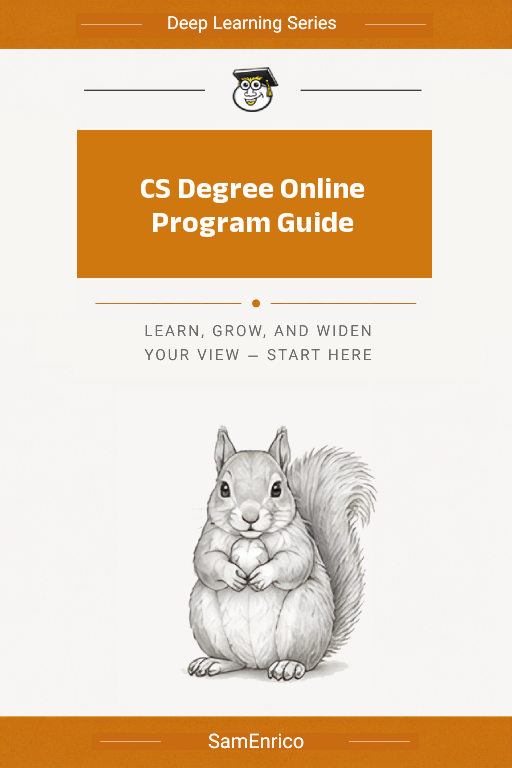
CS Degree Online Program Guide eBook
Compare accredited online CS degrees from Georgia
Compare accredited online CS degrees from Georgia Tech, Arizona State, and University of London.
Formats
Free sample
Chapter 1: The Million-Dollar Question...--You’ve asked yourself some version of it late at night, probably after scrolling through yet another “Learn to Code in Six Months” You Tube ad or reading a Linked In post about a 22-year-old making $350,000 at a company you’ve never heard of.Do I really need a computer science degree?Can’t I just watch some videos, build a portfolio, and skip the four years and the debt?Isn’t college dead?These aren’t lazy questions. They’re survival questions. The cost of traditional higher education has ballooned into a national crisis. Student loan debt in the United States alone now exceeds 1.7trillion.Atraditionalfour−yearcomputersciencedegreefromaprivateuniversitycansetyoubackover1.7 trillion. A traditional four-year computer science degree from a private university can set you back over 1.7trillion.Atraditionalfour−yearcomputersciencedegreefromaprivateuniversitycansetyoubackover200,000 before you’ve written a single line of production code.
Meanwhile, coding bootcamps promise the world for a fraction of the price—typically 10,000to10,000 to 10,000to20,000 for three to six months of intensive training. And then there’s the self-taught path: free You Tube tutorials, Git Hub repositories, and enough caffeine to kill a horse.On the surface, the degree looks like a dinosaur. An expensive, slow-moving dinosaur.But here’s the truth that the You Tubers won’t tell you: the dinosaur is still breathing, and it’s breathing fire.The Great Education Delusion Let me start with a story. I’ll call her Maya.Maya was 28 years old when she decided to change careers. She had a bachelor’s degree in English literature from a respectable state university.
She’d been working as a marketing coordinator for six years, making $52,000 a year in a medium-cost city. She liked her coworkers. She didn’t hate her job. But she was bored in a way that felt existential—like she was watching her own life from outside her body.She heard about coding bootcamps from a friend who’d done one and was now making six figures. The promise was intoxicating: twelve weeks, $15,000, and a job as a software engineer.
No math prerequisites. No admissions committee. No four-year commitment.Maya enrolled. She worked her ass off—sixty, seventy hours a week while still doing her marketing job. She built projects.
She networked. She graduated at the top of her cohort.That was three years ago.Today, Maya is still a marketing coordinator. She’s applied to over four hundred software engineering positions. She’s had thirty-seven first-round interviews. She’s made it to six final rounds.
She’s received zero offers.Why? Because every time she gets to the final round, she’s competing against someone with a computer science degree. Not necessarily a better programmer. Not necessarily someone who has built more impressive projects. Just someone who has that piece of paper.And the hiring manager, faced with two otherwise equal candidates, picks the one with the degree.
Every single time.Maya’s story is not an outlier. According to a 2024 analysis of over 10,000 tech job postings, 78% of software engineering roles at companies with more than 500 employees list a bachelor’s degree in computer science or a related field as a requirement. Not a “nice to have.” A requirement. The same analysis found that bootcamp graduates, on average, receive 60% fewer interview callbacks than degree holders with otherwise identical portfolios.The bootcamp industry has a dirty secret that it doesn’t advertise. Their placement rates, which they trumpet in glossy brochures, count any job as a placement—even if it’s a part-time contract role that ends after three months.
Even if it’s a “technical support specialist” position that pays $18 an hour. Even if the graduate is still working the same job they had before the bootcamp but now also teaches a Saturday coding class.When you strip away the marketing language and look at the actual data, the picture is stark. Three years after graduation, a majority of bootcamp alumni are no longer working as software engineers. They’ve either been laid off from their first junior role and couldn’t find a second, or they never got the first role at all.The degree, by contrast, has staying power.The Data That Will Change Your Mind Before we go any further, let’s look at the numbers. Because this isn’t about emotion or anecdote.
This is about what actually happens to people’s careers and bank accounts.Lifetime earnings: According to a 2023 study by the Georgetown University Center on Education and the Workforce, the average computer science degree holder earns approximately 2.3millionoveraforty−yearcareer.Theaveragebootcampgraduate—includingthosewhosuccessfullytransitionintotech—earnsapproximately2.3 million over a forty-year career. The average bootcamp graduate—including those who successfully transition into tech—earns approximately 2.3millionoveraforty−yearcareer.Theaveragebootcampgraduate—includingthosewhosuccessfullytransitionintotech—earnsapproximately1.6 million. That’s a $700,000 difference. That’s a house. That’s twenty years of retirement contributions.
That’s the difference between retiring at sixty-two and retiring at seventy-two.Promotion rates: A longitudinal study of 15,000 tech workers tracked over eight years found that degree holders were promoted to senior engineer 2.5 times faster than bootcamp graduates. By year five, 68% of degree holders had reached senior or staff-level roles. Only 27% of bootcamp graduates had done the same.Resilience during downturns: During the 2022–2023 tech layoffs, degree holders were laid off at a rate of 8% across the industry. Bootcamp graduates were laid off at a rate of 23%. When companies have to make cuts, they protect the workers who have the credentials that signal long-term investment and foundational knowledge.Visa and immigration: If you’re an international student or worker, the degree is not optional.
The H-1B visa, the TN visa for Canadians and Mexicans, and virtually every other work visa for skilled professionals requires a bachelor’s degree or equivalent work experience. But here’s the catch: “equivalent work experience” is almost never approved for bootcamp graduates. Immigration officers want to see that piece of paper. Without it, your ability to work in the United States, Canada, the United Kingdom, or the European Union is severely limited.The ceiling: The most lucrative roles in technology—machine learning engineer, research scientist, systems architect, technical fellow, CTO—are almost exclusively filled by degree holders. According to a 2024 analysis of executive-level technology positions at Fortune 500 companies, 97% of chief technology officers hold at least a bachelor’s degree in a technical field.
42% hold a master’s or doctorate. Zero hold only a bootcamp certificate.Let me be very clear about what I am not saying.I am not saying that bootcamp graduates cannot be successful. They can. I have met brilliant bootcamp graduates who are doing amazing work. I am not saying that self-taught programmers are inherently less skilled.
Some of the best engineers I know never finished college.What I am saying is that the odds are stacked against you without a degree. And in a world where you are competing against hundreds of other applicants for every job, you want the odds on your side. You want every advantage you can get. You want the credential that opens doors rather than the one that requires you to explain yourself in every single interview.But What About the Cost?I can hear the objection forming in your mind.Okay, fine. The degree has better outcomes.…
This is the end of the free sample. Get the eBook to keep going. Buy now
About this book
Details
- Author
- Samuels Kandice
- Publisher
- SamEnrico
- Language
- English
- Genre
- Non-Fiction, Student's Shortcut, Online Degrees
- Released
- 2026-05-29
- Pages (approx.)
- 148
- Available as
- eBook, Audiobook

Read better in the ZLOADR app
Your eBooks on your phone or tablet. Sign in with your SamEnrico account and start reading.
More by Samuels Kandice
 Spain Green Tax GuideSamuels Kandice$11.99
 Black Women's Leadership Since 1980Samuels Kandice$11.99
 Twelve Step Service RolesSamuels Kandice$11.99
 The Interruption No ScriptSamuels Kandice$11.99
 Bhagwan Ashram Pune IndiaSamuels Kandice$11.99
 Leitner Box System MethodSamuels Kandice$11.99
 Neuroplasticity Mindset HandbookSamuels Kandice$11.99
 Learning Habit GuideSamuels Kandice$11.99
 The Ballad of the Vanishing Twins: A Folk Mystery Across BordersSamuels Kandice$11.99
 Embers of the First Dawn: The Lost Fire Cult of the Black SunSamuels Kandice$11.99
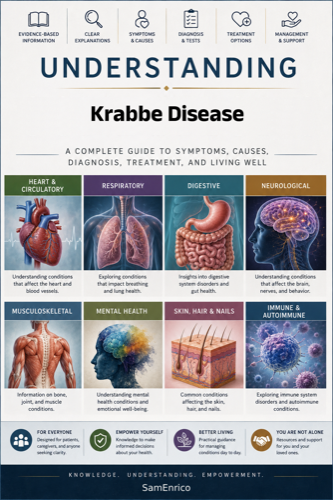 Understanding Krabbe DiseaseSamuels Kandice$11.99
 How to Produce FutonsSamuels Kandice$11.99