
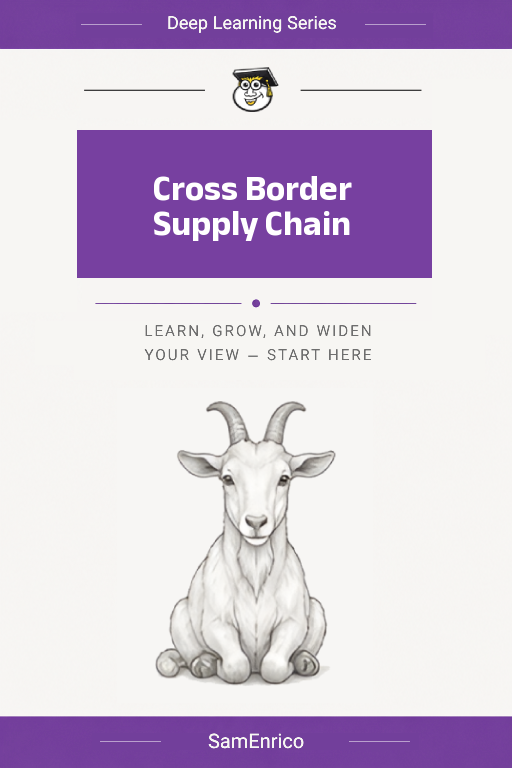
Cross Border Supply Chain eBook
Build international supply chains for franchise ex
by Coble Booker
Build international supply chains for franchise expansion across borders. Source local suppliers while maintaining brand standards and quality consistency.
Formats
Free sample
Chapter 1: The Consistency Paradox--The first sentence any global franchise executive learns is usually wrong. “We need to replicate our home store exactly, everywhere we go.” This sounds logical. It sounds like brand integrity. It sounds like quality control. But it is a fantasy that has destroyed more cross-border expansions than bad food, poor locations, or incompetent local partners combined.Consider the case of a mid-sized American coffee chain – let us call them “Brew Corp” – that decided to expand into Thailand.
They shipped everything from the United States. The beans. The cups. The pastries. The furniture.
The napkin dispensers. The store opened to great fanfare. Within six months, they were losing 50,000permonth.Notbecause Thaisdislikedcoffee.Notbecausethelocationwaspoor.Becauseasinglebagofbeansthatcost50,000 per month. Not because Thais disliked coffee. Not because the location was poor.
Because a single bag of beans that cost 50,000permonth.Notbecause Thaisdislikedcoffee.Notbecausethelocationwaspoor.Becauseasinglebagofbeansthatcost4 wholesale in Seattle cost $11 landed in Bangkok after tariffs, freight, and storage. The pastries arrived stale because the 45-day ocean voyage plus customs clearance left them with a shelf life of four days instead of the expected twenty-one. The furniture swelled in Thailand’s humidity. The napkin dispensers, designed for dry American air, rusted.Brew Corp had two choices. Abandon Thailand and write off their investment.
Or admit that “perfect replication” was a myth. They chose the latter. Today, they source coffee from northern Thailand (same varietal, grown at similar altitude), bake pastries with local flour and butter (same recipe, different inputs), and buy furniture from a Vietnamese manufacturer who uses humidity-treated wood. The napkin dispensers are still imported – they are part of the brand’s visual identity. But everything else is local.
The stores look identical to a casual observer. The coffee tastes identical. But the supply chain is completely different.This is the consistency paradox. You cannot ship everything. You cannot change everything.
The art of cross-border franchise supply chains is knowing which battles to fight – which items must be dragged across oceans and which items can be grown, manufactured, or bought around the corner.This chapter establishes the foundational framework for every decision in this book. We will explore why international franchising fails (hint: it is rarely about the franchisee), why the replication versus adaptation paradox is the central tension you will never fully resolve, and how a simple concept – the 80/20 rule applied to your supply chain – will save you millions of dollars and years of agony. By the end of this chapter, you will have a diagnostic tool to classify every item in your inventory into three categories. And you will understand that the brand is not the product. The brand is the promise of consistency.
The supply chain delivers that promise – or breaks it.The True Cost of International Ignorance Let us begin with a number that should shock you. A domestic franchisee in the United States typically spends between 12 and 18 percent of revenue on supply chain and logistics. That includes everything – sourcing ingredients, warehousing, last-mile delivery to stores, inventory carrying costs, and waste. An international franchisee, by contrast, often spends 30 to 40 percent of revenue on the same functions when the supply chain is poorly designed. That twenty-point gap is not overhead.
It is the difference between a profitable franchise network and a slow-motion collapse.Where does this extra cost go? Into the hidden iceberg of cross-border logistics. The unit price of a product might be lower from a Chinese factory than from a local supplier. But the total landed cost – after tariffs, ocean freight, insurance, port fees, inland trucking, customs clearance, and storage – is often double or triple the unit price. Most franchisors model the unit price.
They ignore the iceberg. Then they wonder why their franchisees in Southeast Asia or Eastern Europe are bleeding cash.Beyond direct costs, there are the costs of delay. A container stuck at the port of Long Beach for thirty days does not just incur storage fees. It delays a store opening by sixty days – because after the container clears, you still need to clear customs, truck the goods to a warehouse, inspect for damage, and deliver to the store. During those sixty days, you are paying rent on an empty store.
You are paying salaries for staff who have nothing to do. You are losing revenue. And you are damaging your relationship with a franchisee who trusted you to deliver.This book is built on a simple premise. International franchising fails not because of bad stores, but because of broken supply lines. Every chapter that follows is a solution to a specific failure mode.
But before we can fix the supply chain, we must understand the fundamental tension that makes cross-border expansion so much harder than domestic growth.The Three Legs of Growth – Why You Expand Before we dive into the mechanics of supply chains, we must answer a strategic question. Why expand internationally at all? The answer, for most franchisors, rests on three legs.The first leg is market saturation at home. A successful domestic franchise eventually runs out of viable locations. In the United States, for example, the top ten fast-food chains already have locations within five miles of ninety percent of the population.
Growth becomes cannibalization – new stores stealing customers from existing stores rather than creating new value. International markets offer fresh territory. Vietnam has one tenth the number of coffee shops per capita as Seattle. Brazil has one fifth the number of burger restaurants as Texas. These are not gaps.
They are opportunities.The second leg is currency arbitrage. This is the least understood but most powerful driver of international growth. A franchise that earns revenue in a strong currency (the US dollar, the Euro, the Swiss franc) but sources goods from a weak currency (the Vietnamese dong, the Mexican peso, the Turkish lira) can capture enormous margins. Consider a pizza franchise that sells a pie for 15in Switzerlandbutbuysitscheesefromasupplierin Polandfortheequivalentof15 in Switzerland but buys its cheese from a supplier in Poland for the equivalent of 15in Switzerlandbutbuysitscheesefromasupplierin Polandfortheequivalentof2. The Swiss consumer pays in francs.
The Polish supplier is paid in zloty. The franchisor converts zloty to francs at a favorable rate. This is not speculation – it is natural hedging. The second leg works in reverse as well. A franchise that expands from a weak currency into a strong currency must be very careful.
Their home-country goods become more expensive in the target market. Their local sourcing becomes essential.The third leg is brand leverage. A franchise brand is a fixed cost. You spend the same amount developing your operations manual, your proprietary recipes, your training programs, and your marketing playbook whether you have ten stores or ten thousand. Spreading those fixed costs across more units increases profitability without increasing overhead.
This is the fundamental logic of franchising itself – and it works across borders just as it works across states. The first international store is expensive to launch. The one hundredth international store is nearly as cheap as opening another domestic location.These three legs – saturation, arbitrage, leverage – explain why international expansion is not just attractive but inevitable for successful franchises. But they also explain why supply chains matter so much. If your supply chain is inefficient, the cost advantage of arbitrage disappears.
If your supply chain is unreliable, the revenue from saturation never materializes. If your supply chain is inconsistent, the brand…
This is the end of the free sample. Get the eBook to keep going. Buy now
About this book
Details
- Author
- Coble Booker
- Publisher
- SamEnrico
- Language
- English
- Genre
- Non-Fiction, Business Brief
- Released
- 2026-05-29
- Pages (approx.)
- 143
- Available as
- eBook, Audiobook

Read better in the ZLOADR app
Your eBooks on your phone or tablet. Sign in with your SamEnrico account and start reading.
More by Coble Booker
 Triangular Trade EconomicsCoble Booker$11.99
 Pocket Step Reminder CardsCoble Booker$11.99
 Traditional Metta PhrasesCoble Booker$11.99
 The Omaha Retail PlaybookCoble Booker$11.99
 Longwu: The Celestial Dragon’s Last FlightCoble Booker$11.99
 Clerk Hmr and Alc PTCoble Booker$11.99
 How to Start a Local Authority School Crossing Patrols Business (Beginners Guide)Coble Booker$11.99
 How to Produce BootsCoble Booker$11.99
You may also like
 Franchising Your Local Brand Across Borders Child Labor LawsWilson Ida$11.99
 Franchising Your Local Brand Across Borders Beneficial OwnershipGordon Debbie$11.99
 Franchising Your Local Brand Across Borders Trade SecretsKeener Tatum$11.99
 Franchising Your Local Brand Across Borders Performance DashboardsCota Lisette$11.99
 Franchising Your Local Brand Across Borders Parallel ImportsBailey Wallace$11.99
 Franchising Your Local Brand Across Borders Packaging RegulationsRandle Adaline$11.99
 Franchising Your Local Brand Across Borders Know Your CustomerMyers Adam$11.99
 Franchising Your Local Brand Across Borders Human TraffickingFranklin Lee$11.99
 Franchising Your Local Brand Across Borders Government IncentivesLogsdon Beckie$11.99
 Franchising Your Local Brand Across Borders Carbon FootprintMcfarlane Margot$11.99
 Franchising Your Local Brand Across Borders Bribery LawsStarr Cortney$11.99
 Franchising Your Local Brand Across Borders Best Practice SharingBryson Vernia$11.99