
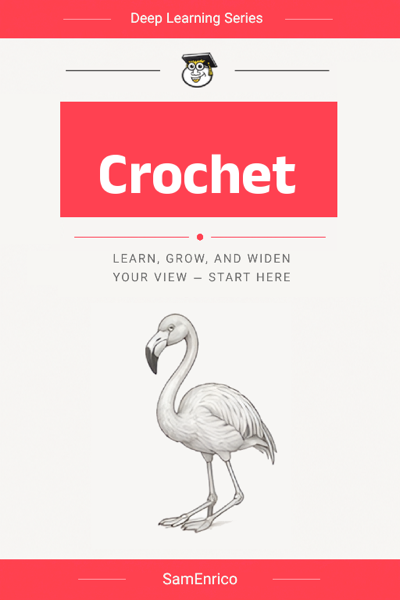
Non-FictionInformativeEducational
Crochet eBook
A Coursebook on Crochet
by Owens Hazel
A Coursebook on Crochet
Formats
Free sample
Chapter 1: The Yarn Whisperer...--Before you make a single loop, before you hold a hook, before you even look at a pattern — there is something more important. It sits in skeins on store shelves, waits in bins at garage sales, and travels in suitcases from far-off mills. It is the single most common reason beginners fail and the hidden secret behind every professional-looking finished object. It is yarn. And you are about to learn to speak its language.Most new crocheters start at the wrong place.
They buy a hook, grab any yarn that looks pretty, and dive into a pattern. Three hours later, they have a curling, stiff, misshapen thing that looks nothing like the photograph. They assume they lack talent. They do not. They lack material literacy.
Crochet is not just hand movements — it is a conversation between hook, yarn, and tension. This chapter teaches you to lead that conversation.By the end of these pages, you will walk into any yarn store — or dig through any stash — and know exactly which yarn to choose for which project. You will predict how a finished object will behave before making a single stitch. You will save money (no more buying the wrong yarn), save time (no more frogging hours of work), and save heartbreak (no more gifts that fall apart in the wash). This is not theory.
This is the foundation of everything that follows.The Hidden Language of Yarn Labels Every skein of yarn tells a story. The label is its autobiography. Most people glance at the color and the price and move on. That is like judging a book by its cover and never reading the first page. Let us decode the label together.Pick up any skein of yarn — the one you already own or the one you will buy tomorrow.
Look for these five numbers.The Weight Number (0 to 7). This is not how much the skein weighs in ounces. It is the thickness of the individual strand. The Craft Yarn Council standardized this system so a Size 4 yarn from one brand works the same as a Size 4 from another brand. Lace weight (0) is thinner than sewing thread.
Fingering (1) is what fine socks are made from. Sport (2) and DK (3) are in-between weights for baby clothes and lightweight garments. Worsted (4) is the most common weight in the world — think classic sweaters, blankets, and hats. Bulky (5) and Super Bulky (6) work up fast for winter accessories. Jumbo (7) is so thick you need your whole hand to move the hook.
The weight number determines everything: how big your stitches will be, how warm the fabric will be, and how long the project will take.The Yardage and Grams. Two numbers appear together: the length of yarn in yards or meters and the weight in grams or ounces. These two numbers together tell you the yarn’s density — its “grist.” A 100-gram skein with 200 yards is thick and heavy. A 100-gram skein with 400 yards is thin and light. When you substitute yarns (and you will), you must match both total yardage AND grist, not just weight.
A common beginner mistake is buying two skeins that both say “100 grams” but have different yardages — one runs out halfway through the project.The Recommended Hook Size. This is a suggestion, not a command. The yarn manufacturer recommends a hook size that produces average fabric with that yarn. But you are not average. Your tension is unique to your hands.
You will learn to adjust hook size up or down to achieve the correct gauge (Chapter 6). For now, treat the recommended size as your starting point.The Washing Symbols. This small grid of icons tells you whether your finished object will survive a washing machine or requires hand-washing in cold water. A tub icon with a hand means hand wash only. A tub with a number means machine wash at that temperature.
A square with a circle inside means tumble dry low. A square with a horizontal line means lay flat to dry. Ignore these symbols at your peril. Acrylic blankets can be machine washed and dried. Wool sweaters will felt into doll clothes if you machine wash them.
Read the symbols before you buy, not after you finish.The Dye Lot Number. This is a string of numbers printed next to the color name. Yarn is dyed in batches called lots. Every skein from the same lot has identical color. Skeins from different lots — even with the same color name — can look noticeably different when worked side by side.
The rule is simple: buy all the yarn for a project at the same time from the same dye lot. If you run out and cannot find the same lot, alternate rows from the old lot and new lot to blend the difference.The Fiber Families: Wool, Cotton, Acrylic, and Beyond Every fiber has a personality. Some are forgiving. Some are demanding. Some will break your heart if you treat them wrong.
Learn their temperaments before you commit to a project.Wool — the forgiving teacher. Wool comes from sheep (and also from alpacas, goats, rabbits, and llamas, but “wool” usually means sheep). Its superpower is elasticity. You can stretch a wool stitch, and it springs back. You can block a wool sweater, and it holds its shape.
You can make a mistake in wool, unravel it, and the yarn still looks new. Wool breathes, wicks moisture, and stays warm even when wet. The downsides? Wool can be itchy (look for merino, cashmere, or baby alpaca for softness). Wool felts — which means heat, agitation, and moisture turn it into a dense, shrunken mat.
Never machine wash wool unless the label specifically says “superwash” (a chemical treatment that scales the fibers). Hand wash in cool water with wool-specific soap. Lay flat to dry.Cotton — the honest architect. Cotton comes from the boll of the cotton plant. Its superpower is stitch definition.
Every single stitch you make in cotton stands up and declares itself. This makes cotton ideal for dishcloths, market bags, summer tops, and home decor where you want the texture to shine. The downsides? Cotton has no stretch. Zero.
If you make a cotton garment with a tight fit, you cannot pull it over your head. Cotton is heavy — a cotton blanket weighs three times what a wool blanket weighs. Cotton also shows every tension inconsistency because it does not bounce back. The upside for beginners: cotton is cheap, widely available, and can be machine washed and dried on hot (it actually softens with heat).Acrylic — the durable pragmatist. Acrylic is plastic — specifically, polyacrylonitrile fibers extruded into yarn.
Its superpower is durability. Acrylic does not shrink. It does not felt. It does not stretch out of shape. It can be machine washed and dried on high heat.
It is hypoallergenic and inexpensive. For these reasons, acrylic is the most popular crochet yarn in the world. The downsides? Acrylic pills (forms little fuzzy balls) over time. It does not breathe — an acrylic sweater will make you sweat.
And acrylic behaves strangely with heat, as you will learn in the blocking section of Chapter 12. For now, know that acrylic is perfect for blankets, toys, and anything that…
This is the end of the free sample. Get the eBook to keep going. Buy now
About this book
Details
- Author
- Owens Hazel
- Publisher
- SamEnrico
- Language
- English
- Genre
- Non-Fiction, Informative, Educational
- Released
- 2026-05-09
- Pages (approx.)
- 155
- Available as
- eBook, Audiobook

Read better in the ZLOADR app
Your eBooks on your phone or tablet. Sign in with your SamEnrico account and start reading.
More by Owens Hazel
 Estate Planning for Stock OptionsOwens Hazel$11.99
 Affirmations For Procrastination HandbookOwens Hazel$11.99
 Cynophobia Dog FearOwens Hazel$11.99
 Uzbekistan Consumer ReportOwens Hazel$11.99
 DBT for Anxiety Regulation GuideOwens Hazel$11.99
 The Maori Warrior and the Lost Tennis Match: A Legend of the PacificOwens Hazel$11.99
 Understanding Pancreatic Carcinoma, FamilialOwens Hazel$17.99
 Sam Altman GuideOwens Hazel$12.99
 How to Start a Veterinary Service BusinessOwens Hazel$11.99
You may also like
 Hong Kong Handover 1997Dunn Johnnie$11.99
 Zumba For Postnatal Recovery CourseNeal Christian$11.99
 Zumba for BeginnersLadner Nikia$11.99
 YouTube Comment Mining GuideHumes Pandora$12.99
 Worry Box MeditationCarlin Rudy$11.99
 Workplace Stress MeditationNguyen Lynn$11.99
 Workplace Stress and Sleep RepairHawley Ivory$11.99
 Workplace Perfectionism CureDelaney Jeffry$11.99
 Workplace Injustice Anger GuideWallen Isabelle$11.99
 Work Addiction and Burnout LinkGreenwood Ester$11.99
 Women in Yoga and WellnessBeattie Galina$11.99
 Women in Stand Up ComedyChun Evangeline$11.99