
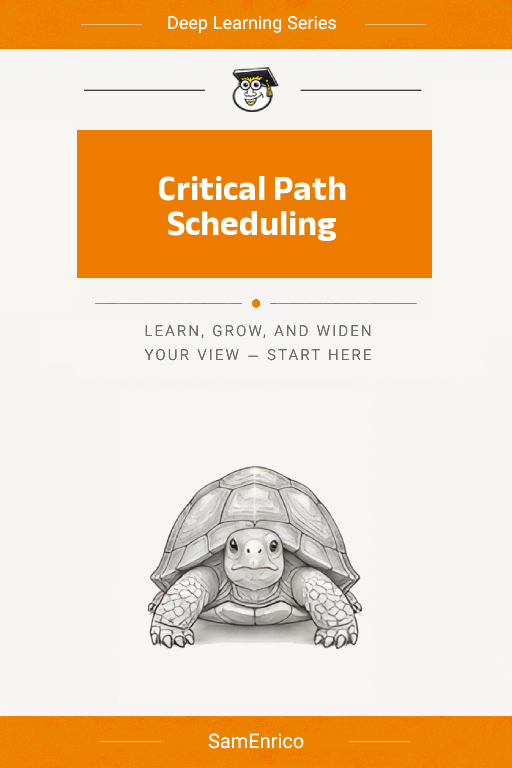
Non-FictionOperational Efficiency ManualCritical Path
Critical Path Scheduling eBook
Sequence production tasks using CPM to identify lo
Sequence production tasks using CPM to identify longest path and minimize project duration.
Formats
Free sample
Chapter 1: The Billion-Dollar Mistake...--–- The conference room was silent, but not the productive kind of silence. It was the silence of thirty people staring at a Gantt chart projected on a wall, each secretly hoping someone else would speak first. The project was a new terminal at a major international airport. It was eighteen months behind schedule. Two hundred million dollars over budget.
And no one in that room could explain why.The project manager, a veteran with thirty years of experience, pointed to a blue bar on the chart. "We started excavation here, as planned. Then foundations here. Then steel here." He traced his finger across the screen, following the bars left to right like a child reading a sentence. "Everything looks right.
But we're late. I don't understand."I was a young scheduling consultant brought in to diagnose the problem. I asked one question: "Show me the dependencies."The room went quiet again. The project manager clicked a button, and thin black lines appeared between some of the bars. But many bars had no lines at all.
Some lines pointed backward. One critical activity—steel delivery—had no predecessor and no successor. It just floated in the middle of the chart, disconnected from reality."You're not managing logic," I said. "You're managing dates. There's a difference."That project cost the airport authority four hundred million dollars in延误 damages, legal fees, and lost revenue.
The terminal opened two years late. And the root cause was not bad weather, not labor strikes, not material shortages. The root cause was a fundamental misunderstanding of how project schedules actually work.This book is about ensuring that never happens to you.The Hidden Cost of Time Time is the only resource in project management that cannot be recovered, stored, or replaced. Spend money, and you can earn more. Waste materials, and you can order more.
Lose a team member, and you can hire a replacement. But lose a day on a critical path, and that day is gone forever. No overtime, no crash program, no amount of money can bring it back.Yet most organizations treat time as an afterthought. They create schedules to satisfy contractual requirements, not to manage work. They update schedules by dragging bars on Gantt charts without understanding the underlying logic.
They measure progress by "percent complete" entered subjectively by team members who have every incentive to be optimistic.The result is a predictable pattern: project starts with enthusiasm, hits unexpected delays, falls behind, adds resources, falls further behind, enters crisis mode, and finally finishes late and over budget. The Standish Group's Chaos Report has tracked this pattern for decades. In 2020, they found that only 37% of large projects finished on time. The average cost overrun was 27% of original budget. And the primary cause was not technical failure but scheduling failure.This chapter establishes the foundation for everything that follows: why time management matters, how Critical Path Method (CPM) was invented, the key definitions you must internalize, and the mindset shift that separates effective schedulers from ineffective ones.Real-World Disaster: The Denver Airport Baggage System No story illustrates the cost of scheduling failure better than the Denver International Airport baggage system.
It is a case study in how ignoring critical path logic can destroy a project.In 1989, the City of Denver began planning a new airport to replace the aging Stapleton International. The centerpiece was a fully automated baggage system designed by BAE Automated Systems. The concept was ambitious: thousands of computer-controlled carts would carry luggage from check-in to planes, from planes to baggage claim, and between connecting flights—all without human intervention. The system would handle 100,000 bags per day across 20 miles of track.The project team created a schedule. Like most schedules of the era, it was a Gantt chart with bars and dates but minimal logic.
The team tracked start dates, end dates, and percent complete. They held weekly status meetings. They reported progress to stakeholders.But they never built a proper network diagram. They never identified the critical path. They never asked: what activities must finish before others can begin?
What happens if the software integration lags behind the hardware installation? What is the longest path through the system?The answer came in 1994, just months before the airport was scheduled to open. The baggage system was not ready. The software controlling the carts crashed repeatedly. Carts collided.
Bags jammed. The system could not reliably move a single bag from check-in to plane, let alone 100,000.The airport delayed its opening. Then delayed again. And again. The opening was postponed from October 1993 to December 1993 to March 1994 to May 1994.
When the airport finally opened on February 28, 1995—sixteen months late—the baggage system operated only for outbound flights from a single concourse. The full automated system never worked as intended and was eventually scrapped.The cost: $560 million in direct overruns. Indirect costs—lost airline revenue, damaged reputation, legal settlements—added hundreds of millions more. And the root cause was not technological impossibility. Other automated systems existed.
The root cause was scheduling. The project team sequenced activities incorrectly, failed to identify critical dependencies between hardware and software development, and did not update their logic when delays occurred. They managed dates, not logic.The Sydney Opera House: A Cautionary Tale in Parallel If Denver Airport is a story of missing logic, the Sydney Opera House is a story of misidentified critical path.The Opera House was designed by Danish architect Jørn Utzon in a 1957 competition. The design was revolutionary: a series of sweeping concrete shells forming sails on Sydney Harbour. But no one knew how to build those shells.
The geometry was so complex that traditional construction methods failed.The original schedule projected completion in 1963 at a cost of $7 million Australian dollars. But the critical path was not where anyone thought it was. The team assumed that the most expensive activities—excavation, foundation, mechanical systems—would drive the timeline. In reality, the critical path ran through the shell design and construction. Until the geometry was solved, no other work could proceed.
But the schedule treated design as a parallel activity to construction, not a predecessor.The result: the Opera House opened in 1973—ten years late—at a cost of $102 million, fourteen times the original budget. Utzon resigned in 1966 after conflicts with the government. The interior was completed by a different architect. And the schedule was rewritten so many times that no one could track the original critical path.What both cases teach us is that time mismanagement is not a technical problem. It is a logical problem.
And it is solvable.The Birth of CPM: Du Pont and the Polaris Missile Critical Path Method was invented twice in the late 1950s, by two unrelated teams solving two different problems.Du Pont Chemical (1957)The first invention happened at E.I. du Pont de Nemours and Company, a chemical giant. Du Pont operated large chemical plants that required periodic maintenance shutdowns. Each shutdown cost the company hundreds of thousands of dollars per day in lost production. A maintenance shutdown that took 125 hours cost millions in lost revenue.
Every hour saved was pure profit.A team led by Morgan Walker at Du Pont and James Kelley at Remington Rand…
This is the end of the free sample. Get the eBook to keep going. Buy now
About this book
Details
- Author
- Guevara Gertha
- Publisher
- SamEnrico
- Language
- English
- Genre
- Non-Fiction, Operational Efficiency Manual, Critical Path
- Released
- 2026-05-29
- Pages (approx.)
- 147
- Available as
- eBook, Audiobook

Read better in the ZLOADR app
Your eBooks on your phone or tablet. Sign in with your SamEnrico account and start reading.
More by Guevara Gertha
 The Funnel for SalonsGuevara Gertha$11.99
 Transcendental Meditation BenefitsGuevara Gertha$11.99
 Mayor of the SuburbsGuevara Gertha$11.99
 Gene Sarazen Shot Heard GuideGuevara Gertha$11.99
 Conversation Starters for SeniorsGuevara Gertha$11.99
 The Forgotten Navigator: Ibn Majid and the Secrets of the Indian OceanGuevara Gertha$11.99
 The Man Who Sold the Moon: How a Visionary Turned Science Fiction into RealityGuevara Gertha$11.99
 How to Become a Chalk-molding-machine OperatorGuevara Gertha$11.99
 Business Plan Spell Check GuideGuevara Gertha$12.99
 Understanding Cleft Lip Palate Mental Retardation Corneal OpacityGuevara Gertha$17.99
 Registered Cardiac Technologist AdvancedGuevara Gertha$11.99
You may also like
 Hong Kong Handover 1997Dunn Johnnie$11.99
 Zumba For Postnatal Recovery CourseNeal Christian$11.99
 Zumba for BeginnersLadner Nikia$11.99
 YouTube Comment Mining GuideHumes Pandora$12.99
 Worry Box MeditationCarlin Rudy$11.99
 Workplace Stress MeditationNguyen Lynn$11.99
 Workplace Stress and Sleep RepairHawley Ivory$11.99
 Workplace Perfectionism CureDelaney Jeffry$11.99
 Workplace Injustice Anger GuideWallen Isabelle$11.99
 Work Addiction and Burnout LinkGreenwood Ester$11.99
 Women in Yoga and WellnessBeattie Galina$11.99
 Women in Stand Up ComedyChun Evangeline$11.99