
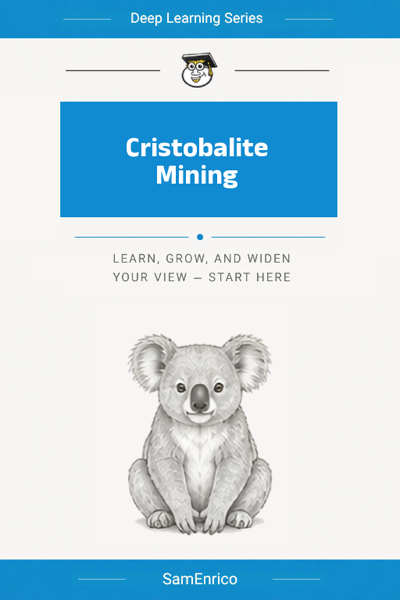
Non-FictionInformativeEducational
Cristobalite Mining eBook
A Coursebook on Cristobalite Mining
by Worth Kendal
A Coursebook on Cristobalite Mining
Formats
Free sample
Chapter 1: The Silica Lie--–- The first problem you will encounter in studying cristobalite is that nearly everything you think you know is wrong. If you came to this book expecting to learn about mining operations—shovels, haul trucks, conveyor belts, and processing plants pulling a mineral called cristobalite directly from the earth—you have been misled by a convenient industry fiction. The truth is far more interesting, far more technical, and far more valuable to understand.This chapter exists to shatter the foundational misconception that has confused engineers, investors, and students for decades. We will uncover why the term "cristobalite mining" persists despite being almost entirely inaccurate, what cristobalite actually is, and why the synthetic production of this remarkable material has become a quiet but essential pillar of modern manufacturing. By the time you finish this chapter, you will understand the silica polymorph system, the dramatic phase transition that makes cristobalite both useful and dangerous, and the physical properties that drive a global market measured in hundreds of millions of dollars.Let us begin with a confession from the industry itself.The Convenient Fiction Walk onto the production floor of any major cristobalite supplier—Sibelco in Belgium, Covia in Ohio, Quarzwerke in Germany—and you will hear workers refer to "mining" cristobalite.
Their websites speak of "natural cristobalite" and "high-purity crystalline silica." Their marketing materials emphasize the "natural origin" of their products. None of this is technically false, but all of it is strategically incomplete.The reality is this: commercially viable deposits of naturally occurring cristobalite do not exist. Yes, cristobalite forms in nature. It appears in volcanic rocks such as obsidian, pumice, and rhyolite. It crystallizes from silica-rich lavas that cooled under specific conditions.
It can be found in some meteorites and in lunar rocks brought back by Apollo astronauts. But these natural occurrences are mineralogical curiosities, not industrial resources.Why? Three reasons.First, natural cristobalite is never pure. Volcanic environments introduce a chaotic array of impurities—iron, titanium, aluminum, sodium, calcium—that become locked into the crystal structure. These impurities alter the material's color (turning it gray, brown, or green), reduce its brightness, and change its thermal behavior.
For most industrial applications, especially engineered stone and high-end coatings, even trace amounts of iron (above 0.02%) ruin the product.Second, natural cristobalite deposits are small and inconsistent. A vein of volcanic cristobalite might run for a few meters before pinching out or transitioning into amorphous silica glass (obsidian) or another polymorph (tridymite). You cannot build a multi-million-ton-per-year industrial operation on such erratic geology.Third, and most critically, even if you found a pure, large deposit of natural cristobalite, the cost of mining, crushing, milling, classifying, and purifying it would exceed the cost of simply manufacturing it synthetically from common silica sand. This is the economic death blow to any proposed "cristobalite mine."So why does the industry persist in using mining language? The answer lies in marketing and regulatory psychology.
"Mined" sounds natural, earthy, and benign. "Synthetically produced" sounds industrial, chemical, and potentially hazardous. Since cristobalite is already classified as a respiratory hazard (more on this in Chapter 7), manufacturers prefer any linguistic distance from "synthetic" that they can reasonably claim. The reality is that the cristobalite in your quartz countertop, your matte paint, and your dental crown was born in a kiln, not dug from a pit.The Silica Family: Quartz, Tridymite, and the High-Temperature Upstart To understand cristobalite, you must first understand the broader family of silica polymorphs. Silicon dioxide (Si O₂) is one of the most common compounds on Earth.
It forms the sand on beaches, the quartz in watches, the flint in ancient tools, and the glass in windows. But "silica" is not a single material with a single structure. It is a family of materials, all with the same chemical formula but different atomic arrangements—what crystallographers call polymorphs.Imagine building the same house with the same bricks but arranging the bricks in different patterns. The house has the same volume, the same weight, and the same basic components, but its strength, stability, and behavior change dramatically. This is the polymorph phenomenon.The three most important silica polymorphs for industrial purposes are quartz, tridymite, and cristobalite.
Each is stable at different temperature ranges, and each has distinct physical properties.Quartz is the low-temperature stable polymorph. It is what you find in most beach sand, in granite, in sandstone. Its crystal structure is trigonal (or hexagonal depending on the temperature), with silicon atoms bonded to four oxygen atoms in a tetrahedral arrangement that spirals in a helical pattern. This helical arrangement gives quartz its piezoelectric property—the ability to generate an electric charge under mechanical stress—which makes it useful for watches, oscillators, and pressure sensors. Quartz is stable from absolute zero up to about 867°C (1,593°F).
Above that temperature, it begins to transform into something else.Tridymite is the intermediate-temperature polymorph. It forms between approximately 867°C and 1,470°C (2,678°F). Its crystal structure is hexagonal, with a more open framework than quartz. This openness makes tridymite less dense than quartz—about 2.26 g/cm³ compared to quartz's 2.65 g/cm³. Tridymite is relatively rare in industrial applications because its formation is slow and it tends to revert to quartz or convert to cristobalite depending on thermal history.
Most of the tridymite found in nature comes from volcanic rocks that cooled slowly enough to allow its crystallization. For industrial cristobalite production, tridymite is generally an unwanted byproduct—a sign that the kiln temperature or residence time was poorly controlled.Cristobalite is the high-temperature stable polymorph. It forms above 1,470°C, all the way up to the melting point of silica at about 1,713°C (3,115°F). Its crystal structure is tetragonal, with an even more open framework than tridymite. The density of cristobalite at room temperature is approximately 2.33 g/cm³—significantly lower than quartz.
This low density reflects the "stretched" atomic framework that cristobalite inherits from its high-temperature origins.Here is where things get strange, and where cristobalite becomes both valuable and problematic.The Alpha-Beta Transformation: A Crystal with a Split Personality Cristobalite is not one material. It is two materials that share the same name but have different structures, different properties, and different behaviors. Crystallographers distinguish between "high" (β) cristobalite and "low" (α) cristobalite.High cristobalite (β-cristobalite) is the form that exists at temperatures above approximately 270°C (518°F). In this high-temperature form, the crystal structure is truly cubic—specifically, it belongs to the space group Fd3m, the same symmetry as diamond but with a much larger unit cell. The silicon and oxygen atoms are arranged in a highly symmetric, expanded framework.
This high-temperature form is stable, uniform, and relatively forgiving.Low cristobalite (α-cristobalite) is the form that exists at temperatures below approximately 220°C (428°F). When β-cristobalite cools through the transition range (220°C to 270°C, depending on purity and thermal history), the crystal structure "collapses" from cubic to tetragonal symmetry. The oxygen atoms shift position, the silicon tetrahedra rotate slightly, and the entire lattice distorts into a lower-symmetry arrangement.This transition is not gradual. It is a first-order phase transformation—sudden, dramatic, and accompanied by a substantial volumetric change. As β-cristobalite transforms to α-cristobalite on cooling, the crystal shrinks by approximately 5% in volume.
Conversely, when α-cristobalite is heated through the transition temperature, it expands suddenly by 5%.A five percent volumetric change is enormous.…
This is the end of the free sample. Get the eBook to keep going. Buy now
About this book
Details
- Author
- Worth Kendal
- Publisher
- SamEnrico
- Language
- English
- Genre
- Non-Fiction, Informative, Educational
- Released
- 2026-06-02
- Pages (approx.)
- 146
- Available as
- eBook, Audiobook

Read better in the ZLOADR app
Your eBooks on your phone or tablet. Sign in with your SamEnrico account and start reading.
More by Worth Kendal
 Ivan Lendl Ice ManWorth Kendal$11.99
 Equifax Class Action LawyersWorth Kendal$11.99
 SAS Motorbike Escape StoryWorth Kendal$11.99
 Emotional Intelligence For DiplomatsWorth Kendal$11.99
 Mistake Recovery EsteemWorth Kendal$11.99
 The Last Analog Call: How the World Said Goodbye to Rotary PhonesWorth Kendal$11.99
 The Architect of the Wind: The Djinn Who Built BabylonWorth Kendal$11.99
 Pop Up Retail Window DisplayWorth Kendal$12.99
 USD Billing Navigation GuideWorth Kendal$12.99
 Understanding Gastric Dumping SyndromeWorth Kendal$17.99
 How to Become a Job AnalystWorth Kendal$11.99
You may also like
 Hong Kong Handover 1997Dunn Johnnie$11.99
 Zumba For Postnatal Recovery CourseNeal Christian$11.99
 Zumba for BeginnersLadner Nikia$11.99
 YouTube Comment Mining GuideHumes Pandora$12.99
 Worry Box MeditationCarlin Rudy$11.99
 Workplace Stress MeditationNguyen Lynn$11.99
 Workplace Stress and Sleep RepairHawley Ivory$11.99
 Workplace Perfectionism CureDelaney Jeffry$11.99
 Workplace Injustice Anger GuideWallen Isabelle$11.99
 Work Addiction and Burnout LinkGreenwood Ester$11.99
 Women in Yoga and WellnessBeattie Galina$11.99
 Women in Stand Up ComedyChun Evangeline$11.99