
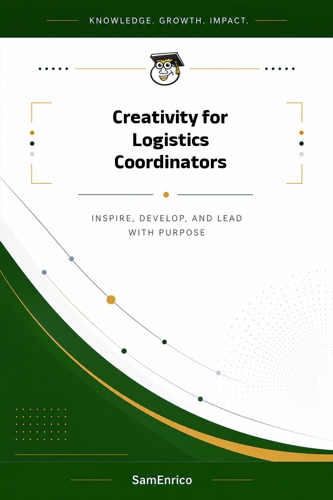
Creativity for Logistics Coordinators eBook
Solve routing, warehousing, and delivery challenge
by Elias Rusty
Solve routing, warehousing, and delivery challenges with fresh approaches.
Formats
Free sample
Chapter 1: The Route Sheet Lie--The three a.m. phone call was never good news. For Elena Vasquez, a thirty-two-year-old logistics coordinator at Last Mile Logistics, the buzzing of her work phone meant one thing: something had broken. She fumbled for the device on her nightstand, squinted at the caller ID, and felt her stomach drop. It was Carl, her regional director.
Carl never called at three a.m. unless a client was screaming or a truck was on fire. Tonight, it was both.“Elena, we have a problem,” Carl said, his voice taut. “Truck 441 is stuck outside of Bakersfield. Bridge is out.
Flooding. The algorithm rerouted him through a four-hour detour. The problem is, he’s carrying two million dollars’ worth of refrigerated vaccines. They expire in three hours.”Elena sat up, her mind already racing. “What does the TMS say?”“The TMS says to follow the detour,” Carl replied.
“That’s what we pay for. That’s the system. Don’t get creative. Just execute.”She hung up and stared at the wall for ten seconds. Then she called the driver directly.“Tommy, it’s Elena.
Forget the TMS. Tell me what you see.”The driver, a twenty-year veteran named Tommy Grimes, spoke slowly. “There’s a farmer’s gate about two miles before the bridge. Old gravel road. Cuts through a walnut orchard.
Comes out on the other side of the wash. The algorithm doesn’t know it exists because it’s not on any map. But I’ve driven it once, fifteen years ago, during a wildfire evacuation.”“Can you make it with a forty-foot reefer?”“Maybe. If the gate’s unlocked. If the ground holds.
If the farmer doesn’t shoot at me.”Elena made a decision that would get her fired or save her career. “Do it. I’ll handle the fallout.”Tommy made the turn. The gate was unlocked. The ground held.
The farmer waved him through. The vaccines arrived at the distribution center with seventeen minutes to spare. Elena was put on probation the next morning for “unauthorized deviation from approved routing protocols.”But six months later, when Last Mile Logistics needed someone to lead a new “creative logistics” pilot, Carl called Elena first. “You broke the rules,” he said. “But you also saved two million dollars.
I don’t know what to call what you did. But I need more of it.”Elena smiled. “It’s called thinking. You should try it sometime.”This book is about what Elena did instinctively and what you can learn systematically. It is about the difference between following a route sheet and redesigning one.
It is about the hidden cost of perfect efficiency and the surprising power of strategic waste. And it is about why the most successful logistics coordinators in the world are not the ones who execute flawlessly but the ones who know when to ignore the algorithm and trust their own judgment.Let us begin.The Traditional View: Logistics as a Machine Most logistics training treats the supply chain as a machine. You have inputs (orders, inventory, trucks), processes (routing, picking, loading), and outputs (deliveries, satisfied customers, revenue). The job of the coordinator is to optimize every moving part: shortest path, lowest cost, fastest time. Anything that does not fit this model—human intuition, local knowledge, creative rule-breaking—is seen as a distraction or a soft skill.
“Stick to the system,” Carl told Elena. “Don’t get creative.”This worldview comes from a noble place. The field of logistics has spent fifty years perfecting algorithms, transportation management systems, and lean methodologies. Companies like Toyota, Walmart, and Amazon built empires on the back of relentless optimization. The Toyota Production System, with its famous “just-in-time” inventory, became the gold standard for eliminating waste.
The logic was simple: waste is anything that does not add value. Idle trucks are waste. Empty miles are waste. Waiting drivers are waste. A coordinator’s job is to eliminate waste until the system runs like a greased piston.But here is the problem that Elena understood intuitively and that the past five years have proven catastrophically: a machine with no slack breaks when the world changes.
And the world always changes.The Hidden Cost of Perfect Efficiency Consider the supply chain disruptions of 2020 through 2022. A single container ship, the Ever Given, got stuck in the Suez Canal for six days. That one event disrupted an estimated nine billion dollars in daily trade. Why? Because global supply chains had been optimized for exactly one condition: everything working perfectly.
No slack. No redundancy. No alternate routes baked into the system. When the canal closed, there was no Plan B because Plan B would have been “inefficient” during normal times.This is what we call brittle efficiency—optimizing for a single, predictable world. Brittle efficiency removes all buffers, all slack, all “waste.” It looks beautiful on a spreadsheet.
It wins awards for cost reduction. And it shatters under unexpected stress like a glass rod bent too far.The opposite is resilient efficiency—eliminating waste while preserving adaptability. Resilient efficiency keeps strategic slack: an extra driver, a backup route, a few empty pallet positions, a fifteen-minute buffer in every schedule. This slack looks like waste on a static spreadsheet, but it becomes the margin that saves you when a bridge floods, a driver calls in sick, or a port strike shuts down the coast.Elena’s decision to ignore the algorithm was not an act of rebellion. It was an act of resilient efficiency.
She preserved the one asset the algorithm could not see: Tommy’s local knowledge of a farmer’s gate. The algorithm optimized for average conditions—clear roads, open bridges, perfect information. Tommy knew about specific conditions—a flood, a gate, a farmer who waves. The algorithm suggested. The driver decided.
Elena facilitated.That is the model for the creative logistics coordinator.The Innovators’ Lesson: Why Abstract Thinking Matters The story of logistics is not just a story of trucks and pallets. It is a story of how humans learned to see systems where others saw only chaos. In Walter Isaacson’s book The Innovators, he traces the history of the digital revolution not through hardware but through abstract thinking—the ability to see patterns, analogies, and possibilities that are not immediately visible.Consider the invention of the shipping container. Most people think Malcom Mc Lean invented a metal box. But as Marc Levinson shows in The Box, Mc Lean’s real invention was a system.
He saw that a container could move seamlessly from a truck to a ship to a train without being opened. He saw relationships between nodes that no one else saw. That is abstract thinking applied to logistics.The same skill separates the average logistics coordinator from the exceptional one. The average coordinator sees a route sheet: Stop A, Stop B, Stop C. The creative coordinator sees a network of relationships: Stop C is near a warehouse that has idle capacity.
Stop B’s customer is also a supplier who has a backhaul that matches Stop A’s empty trailer. The creative coordinator asks questions like: “What if we swapped the order of stops based on traffic that…
This is the end of the free sample. Get the eBook to keep going. Buy now
About this book
Details
- Author
- Elias Rusty
- Publisher
- SamEnrico
- Language
- English
- Genre
- Non-Fiction, Self-Help
- Released
- 2026-06-10
- Pages (approx.)
- 132
- Available as
- eBook, Audiobook

Read better in the ZLOADR app
Your eBooks on your phone or tablet. Sign in with your SamEnrico account and start reading.
More by Elias Rusty
 Coding Syntax CardsElias Rusty$11.99
 Alcohol Sleep Myth GuideElias Rusty$11.99
 ECT for Severe Depression GuideElias Rusty$11.99
 Brushing TechniqueElias Rusty$11.99
 Fear Of Choking GuideElias Rusty$11.99
 Vijay Singh Fijian WarriorElias Rusty$11.99
 Pediatric Hypertension GuideElias Rusty$11.99
 The Deep Blue Pioneers: Black Scientists Who Unlocked the Secrets of the OceanElias Rusty$11.99
 The Day the Sky Wheel Crashed: The Tragic Fall of the Great Ferris WheelElias Rusty$11.99
 How to Produce Tie ClipsElias Rusty$11.99
 How to Become a Granulator TenderElias Rusty$11.99
 A Collector's Handbook to the Ginetta G11Elias Rusty$11.99
You may also like
 Hong Kong Handover 1997Dunn Johnnie$11.99
 Zumba For Postnatal Recovery CourseNeal Christian$11.99
 Zumba for BeginnersLadner Nikia$11.99
 YouTube Comment Mining GuideHumes Pandora$12.99
 Worry Box MeditationCarlin Rudy$11.99
 Workplace Stress MeditationNguyen Lynn$11.99
 Workplace Stress and Sleep RepairHawley Ivory$11.99
 Workplace Perfectionism CureDelaney Jeffry$11.99
 Workplace Injustice Anger GuideWallen Isabelle$11.99
 Work Addiction and Burnout LinkGreenwood Ester$11.99
 Women in Yoga and WellnessBeattie Galina$11.99
 Women in Stand Up ComedyChun Evangeline$11.99