
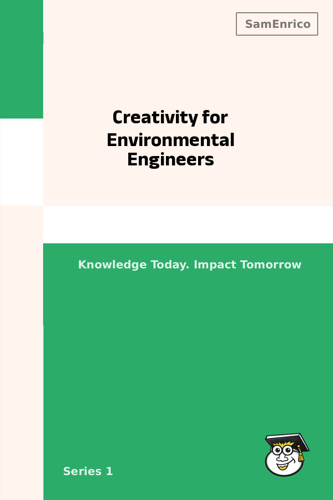
Creativity for Environmental Engineers eBook
Design sustainable solutions for pollution, waste,
by Hobson Trina
Design sustainable solutions for pollution, waste, and resource challenges.
Formats
Free sample
Chapter 1: The Blind Spot--–- On a sunny morning in 2010, a bizarre vessel slipped under the Golden Gate Bridge and pointed its bow toward the open Pacific. It looked like a cross between a racing trimaran and a floating recycling bin. Its hulls were made from 12,500 empty plastic bottles, held together by a frame of reclaimed aluminum and finished with a sail woven from recycled PET. The crew had no support vessel, no engine, and no backup plan. They intended to sail 11,000 nautical miles from San Francisco to Sydney, crossing the infamous Great Pacific Garbage Patch along the way.
Every expert they consulted said it was impossible. The bottles would crush under pressure. The seams would leak. The structure would snap in the first storm. They sailed anyway.
And they made it.The Plastiki expedition, named after Thor Heyerdahl's legendary Kon-Tiki raft, was not designed to be a commercial product or a scalable technology. It was a provocation. Its purpose was to answer a single question: what happens when you stop seeing waste as an endpoint and start seeing it as a starting point? The expedition succeeded not because its engineering was flawless—it wasn't—but because it demonstrated something more fundamental. The crew looked at a plastic bottle, the most notorious symbol of environmental collapse, and asked not "how do we dispose of this?" but "what else could this become?" That shift in perception, from disposal to reimagination, is the subject of this entire book.
And it is the one skill that environmental engineering education almost never teaches.The Engineering Paradox Let us begin with an uncomfortable truth. Environmental engineers are among the most rigorously trained professionals on the planet. They spend four to six years mastering thermodynamics, fluid mechanics, reaction kinetics, transport phenomena, and a dozen other subjects that would make most people's eyes glaze over. They learn to model contaminant plumes in groundwater with mathematical precision. They design wastewater treatment plants that remove 99.9% of pathogens.
They calculate exactly how much methane a landfill will produce over thirty years. By any objective measure, they are extraordinarily good at solving technical problems within defined boundaries.And yet, the environmental crisis worsens. Atmospheric CO2 continues to rise. Ocean plastic accumulates at an accelerating rate. Topsoil erodes.
Species go extinct. The gap between what engineers know how to do and what the planet actually needs grows wider every year. This is not because engineers are incompetent or lazy. It is because they have been trained to optimize linear systems that are fundamentally broken, and they have not been trained to imagine alternatives.Consider the standard engineering approach to a plastic bottle. The engineer asks: how can we make this bottle with less material?
How can we improve the efficiency of the recycling process? How can we reduce the energy required to manufacture it? These are worthy questions. They produce incremental improvements. But they never ask the more radical question: why does this bottle exist as a single-use object at all?
Why is the material designed to travel from an oil well to a factory to a consumer to a landfill, with no provision for its next life? That question is not technical. It is creative. And it is precisely the question that most engineers have been trained not to ask.This book argues that the missing ingredient in environmental engineering is not more data, more computing power, or more stringent regulations. It is creativity—not in the sense of artistic self-expression, but in the specific, disciplined sense of resource reimagination.
Creative engineering means looking at a waste stream and seeing a material inventory. It means questioning the assumption that disposal is the only possible destination. It means designing closed loops where materials cycle indefinitely, rather than linear flows where they end in a hole or a smokestack.The Linear Habit To understand why creativity is so稀缺 in environmental engineering, we must examine the mental models that engineers absorb from their very first day of training. Engineering education is built on linear thinking. Input A goes into process B, producing output C and waste D.
The goal is to maximize C while minimizing D, within a set of constraints. This is a powerful framework for optimizing factories, water treatment plants, and supply chains. But it carries a hidden assumption: that D, the waste, has no further value. Once it leaves the system boundary, it ceases to be the engineer's problem.This assumption is so deeply embedded that most engineers never notice it. They are taught to draw system boundaries around their process and optimize everything inside.
What happens outside the boundary—the landfill, the incinerator, the ocean—is someone else's responsibility. This is not malice. It is training. But it is training that blinds engineers to the most important insight of the last century: in nature, there is no such thing as waste. The output of one organism is the input of another.
Carbon dioxide exhaled by an animal is inhaled by a plant. Dead leaves become soil. Fungi break down fallen trees into nutrients for new growth. Nature operates in cycles, not lines. Every waste stream is simultaneously a resource stream for some other process.The linear habit shows up everywhere in engineering practice.
A chemical engineer designs a process that discharges a slightly warm effluent into a river, meeting all regulatory standards, because the system boundary ends at the pipe. A civil engineer specifies a building material that will last fifty years, with no plan for what happens after fifty years and one day. A mechanical engineer designs a gearbox with twenty different types of plastic, making disassembly and recycling virtually impossible, because the design brief only asked for performance and cost. None of these engineers broke any rules. They followed their training.
And that is precisely the problem.The Plastiki crew understood something that most engineers miss. They looked at a plastic bottle—the paradigmatic piece of linear waste—and refused to accept that its story ended at the landfill. They asked: what properties does this material actually have? It is lightweight, strong, buoyant, and resistant to saltwater degradation. Those are not flaws.
Those are design specifications for a boat hull. The bottle was never a piece of trash. It was a building block waiting to be recognized.Defining Creative Engineering Let us be precise about what creative engineering means in this book. It is not about turning engineers into artists who paint murals or write poetry on the job. It is not about "thinking outside the box" as a vague exhortation.
It is a specific, teachable, repeatable discipline with three core components.First, creative engineering requires resource reimagination: the ability to look at a discarded object or waste stream and see it as a material inventory for a new system. This is not wishful thinking. It requires technical knowledge of the material's properties, economic knowledge of its value, and logistical knowledge of its availability. When the Plastiki crew looked at a plastic bottle, they knew its crush strength (about 200 pounds per square inch), its buoyancy (about 95% of the volume displaces water), and its UV degradation rate (about six months before embrittlement). They did not ignore the technical constraints.
They worked within them. But they first had to imagine that the bottle could be something other than waste.Second, creative…
This is the end of the free sample. Get the eBook to keep going. Buy now
About this book
Details
- Author
- Hobson Trina
- Publisher
- SamEnrico
- Language
- English
- Genre
- Non-Fiction, Self-Help
- Released
- 2026-06-08
- Pages (approx.)
- 131
- Available as
- eBook, Audiobook

Read better in the ZLOADR app
Your eBooks on your phone or tablet. Sign in with your SamEnrico account and start reading.
More by Hobson Trina
 Flying Phobia GuideHobson Trina$11.99
 Depression and Gut Health GuideHobson Trina$11.99
 Art Recognition DeckHobson Trina$11.99
 Nick Price Zimbabwe StarHobson Trina$11.99
 Blood Pressure PregnancyHobson Trina$11.99
 Alcohol Relaxation ExpectancyHobson Trina$11.99
 Familiarity Without RecollectionHobson Trina$11.99
 Fenrir's Howl: The Binding of the World-SerpentHobson Trina$11.99
 The Ironclads Clash: The Battle That Changed Naval WarfareHobson Trina$11.99
 A Collector's Handbook to the Gilbern InvaderHobson Trina$11.99
 Service Providers Guide to Pool & SPA ServiceHobson Trina$11.99
 How to Produce Household Storage ContainersHobson Trina$11.99
You may also like
 Hong Kong Handover 1997Dunn Johnnie$11.99
 Zumba For Postnatal Recovery CourseNeal Christian$11.99
 Zumba for BeginnersLadner Nikia$11.99
 YouTube Comment Mining GuideHumes Pandora$12.99
 Worry Box MeditationCarlin Rudy$11.99
 Workplace Stress MeditationNguyen Lynn$11.99
 Workplace Stress and Sleep RepairHawley Ivory$11.99
 Workplace Perfectionism CureDelaney Jeffry$11.99
 Workplace Injustice Anger GuideWallen Isabelle$11.99
 Work Addiction and Burnout LinkGreenwood Ester$11.99
 Women in Yoga and WellnessBeattie Galina$11.99
 Women in Stand Up ComedyChun Evangeline$11.99