
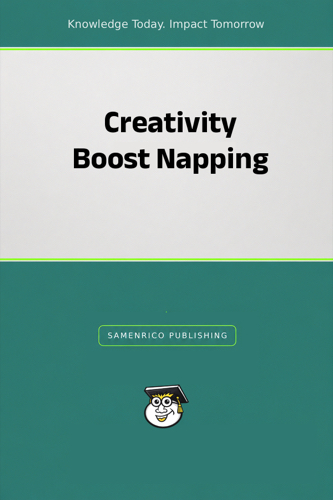
Creativity Boost Napping eBook
Unlocks problem solving with REM naps.
by Metzger Kasi
Unlocks problem solving with REM naps.
Formats
Free sample
Chapter 1: The Eureka Trap--–- You are staring at the problem. It has been ninety minutes. Your coffee is cold, your neck aches from hunching over the keyboard, and you have rewritten the same sentence seventeen times. Or perhaps you are an engineer staring at a schematic that makes less sense now than it did when you started. A founder reviewing the same profit-and-loss statement for the fifth time.
A painter mixing colors that refuse to harmonize. A parent trying to figure out why a child's behavior has suddenly shifted and finding no answer.The harder you try, the worse it gets.This is not a failure of intelligence. It is not a lack of effort. It is not a sign that you are not creative enough, smart enough, or disciplined enough. It is something far more interesting.
It is your brain doing exactly what evolution designed it to do—and exactly what creativity requires you to temporarily stop doing.Here is the paradox that this entire book is built upon: The state of mind that helps you analyze problems is the same state of mind that prevents you from solving them.The moment you stop trying, the answer arrives. In the shower. On a walk. While driving. In that foggy half-sleep just before your alarm.
Or, as you will learn in these pages, during a carefully timed nap that unlocks your brain's most powerful problem-solving mode.This chapter is about why that happens. It is about the neuroscience of focus, the unexpected enemy of creativity that lives inside your own skull, and the single most important shift in mindset you must make before any nap protocol will work for you. Without understanding the Eureka Trap, you will use the techniques in this book like a hammer searching for a nail—effective only by accident. With it, you will stop fighting your brain and start partnering with it.The Invention That Wasn't Invented While Working Let us start with a story that illustrates everything wrong with how we think about problem-solving.In 1928, a Scottish biologist named Alexander Fleming returned to his laboratory after a month-long vacation. He had been a notoriously messy researcher, and before leaving, he had stacked a collection of petri dishes containing Staphylococcus bacteria in a corner of his bench.
When he returned, he noticed something strange. One of the dishes had become contaminated with a mold—and the area immediately surrounding the mold was clear of bacteria.Fleming did not discover penicillin by staring at petri dishes for eighteen hours straight. He discovered it by leaving. By not working. By allowing his brain to stop grinding on the problem he did not even know he had.The story is famous for a reason.
It reveals a truth that most productivity advice aggressively ignores: Breakthroughs rarely happen at the desk.Consider the data. A survey of nearly one thousand scientists conducted by the journal Nature found that the majority of their most creative insights occurred not during scheduled work hours but during "idle" time—walking, showering, driving, or falling asleep. A study of mathematicians at the University of Paris asked participants to record every moment they had an insight into a difficult problem. Eighty-three percent of those insights occurred when the mathematician was not actively working on the problem. A similar study of software developers found that the most elegant bug fixes often came while cooking, exercising, or—crucially—napping.This is not laziness.
This is neuroscience.The Prefrontal Cortex: Your Brilliant But Overbearing Manager To understand why focusing harder fails, you need to meet the part of your brain that does the focusing.The prefrontal cortex (PFC) sits directly behind your forehead. It is the most evolutionarily recent addition to the human brain—so recent that some neuroscientists call it the "CEO of the brain." It is responsible for working memory, planning, impulse control, logical reasoning, and sustained attention. When you sit down to solve a problem, the PFC lights up like a Christmas tree.Here is what the PFC does brilliantly: linear, rule-based, step-by-step thinking. If you are balancing your checkbook, following a recipe, memorizing a list, or executing a procedure you have done a hundred times, your PFC is your best friend. It keeps you on track.
It prevents distractions. It ensures you do not skip steps.Here is what the PFC does terribly: remote associations, unconventional connections, and creative leaps.The PFC is, by its very nature, a filter. It suppresses irrelevant information so you can focus on relevant information. That is its job. But the definition of "relevant" is narrow.
When you are trying to solve a problem, your PFC decides that anything not directly related to the problem is noise and should be ignored.The very mechanism that makes you efficient at routine tasks makes you blind to creative solutions.This is not a metaphor. Functional MRI studies have shown that when people attempt to solve insight problems (problems requiring a sudden creative leap rather than step-by-step logic), the PFC actually decreases its activity in the second before the insight arrives. The brain literally stops focusing right before it figures something out.Let that land. Your brain has to stop trying in order to succeed.The Eureka Trap: Why Effort Backfires Let us name this phenomenon so we can recognize it when it happens.The Eureka Trap is the frustrating cycle in which increased effort leads to decreased creativity, which leads to more frustration, which leads to even more effort, which leads to complete creative paralysis.Here is how it feels. You have a problem.
You sit down to solve it. You try one approach. It fails. You try another approach. It fails.
You try a third approach, a variation of the first, a hybrid of the second and third, a desperate reimagining of the problem itself. Nothing works. Your shoulders tighten. Your jaw clenches. You begin to feel angry—at the problem, at yourself, at the universe for allowing this obstacle to exist.Your PFC, sensing your distress, works even harder.
It narrows its focus further. It discards even more "irrelevant" information. It double-checks every step you have already taken, looking for an error that isn't there.And the solution remains invisible.Then you give up. You walk away. You make a sandwich.
You take a shower. And in the middle of shampooing, the answer arrives, fully formed, embarrassingly obvious.That is the Eureka Trap. You cannot solve a creative problem by applying more of the same kind of thinking that failed. But your brain, under stress, defaults to exactly that strategy. It is like trying to unscrew a bolt by turning it harder in the wrong direction.Cognitive Fixation: The Science of Getting Stuck Psychologists have a formal term for what happens inside the Eureka Trap.
They call it cognitive fixation.Cognitive fixation occurs when your brain becomes locked onto a particular approach, solution category, or mental model, and cannot escape even when that approach has been proven ineffective. It is not stupidity. It is the normal functioning of a brain that values efficiency over exploration.One of the most famous demonstrations of cognitive fixation is the candle problem, designed by…
This is the end of the free sample. Get the eBook to keep going. Buy now
About this book
Details
- Author
- Metzger Kasi
- Publisher
- SamEnrico
- Language
- English
- Genre
- Non-Fiction, Health & Wellness, Creativity
- Released
- 2026-06-08
- Pages (approx.)
- 152
- Available as
- eBook, Audiobook

Read better in the ZLOADR app
Your eBooks on your phone or tablet. Sign in with your SamEnrico account and start reading.
More by Metzger Kasi
 Trance for High Blood PressureMetzger Kasi$11.99
 Pet Loss For Foster FailuresMetzger Kasi$11.99
 Late Stage VC TermsMetzger Kasi$11.99
 The Imposter ParadoxMetzger Kasi$11.99
 The Crisis Hotline Worker StressMetzger Kasi$11.99
 Property Management Software GuideMetzger Kasi$11.99
 Caregiver Legal Planning GuideMetzger Kasi$11.99
 Crowd Work CowboyMetzger Kasi$11.99
 Flying High: The Untold Story of the First Woman to Pilot a Commercial JetMetzger Kasi$11.99
 The Last Whisper of the Akkadian Empire: When Cuneiform Went SilentMetzger Kasi$11.99
 Shadows to Light: The Middle East's Pioneers of Medical ImagingMetzger Kasi$11.99
 The Strategist's Guide to Consumer-generated AdvertisingMetzger Kasi$11.99
You may also like
 Creative Professional NapAllard Barton$11.99
 Creativity Boosting NapSheffield Lore$11.99
 Bipolar And CreativityMackay Chin$11.99
 Menopause And Creativity GuideWhyte Maegan$11.99
 Bipolar And Creativity GuideDuff Phylicia$11.99
 Napping for Creativity BoostTriplett Hermelinda$11.99
 Nap for Creative ProfessionalsRead Tamie$11.99
 Bipolar And Creativity LinkEasley Ka$11.99
 Bipolar Creativity GuideRawlings Jacinta$11.99
 Nap for Creativity BoostCervantes Effie$11.99
 Creative Nap Techniques GuidePetty Vida$11.99
 Bipolar Mania Creative ChannelingCronin Lea$11.99