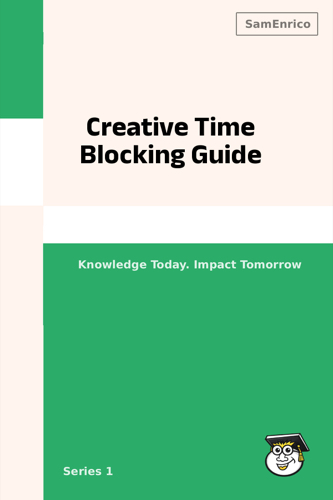
Creative Time Blocking Guide eBook
Protects large blocks for artistic flow states.
by Swank Effie
Protects large blocks for artistic flow states.
Formats
Free sample
Chapter 1: The Robbery You Don’t See...--It begins the same way for almost everyone.You wake up with a plan. Today, you tell yourself, is the day you will finally make progress on the thing that matters most—the painting, the manuscript, the score, the business concept, the song. You have cleared your calendar. You have turned off notifications. You have brewed the coffee.
You sit down at your desk, take a breath, and prepare to enter the deep creative work that you know, somewhere in your bones, you were put on this earth to do.Then something happens.Sometimes it is a phone buzzing. Sometimes it is a family member knocking on the door with a “quick question.” Sometimes it is the sudden, overwhelming urge to check email “just for a second.” Sometimes it is nothing external at all—just a voice inside your head that whispers, You should really organize your reference materials first or You’re not in the right mood for this or Who do you think you are, anyway?You tell yourself you will just handle this one small thing. Then you will return to the work.But you do not return. Or you return, but the feeling is gone. The clarity has evaporated.
The deep creative channel you were about to enter has closed, and now you are sitting at your desk, staring at a blank page or an empty canvas, feeling frustrated, guilty, and vaguely ashamed.You tell yourself you will try again tomorrow.Tomorrow comes. Tomorrow goes. The pattern repeats.And somewhere, in the quiet space between your ambition and your exhaustion, a masterpiece dies.Not because you lacked talent. Not because you lacked passion. Not because you lacked a good idea.But because you never learned how to protect a large, uninterrupted block of time for the one activity that cannot be done in fragments: deep creative work.The Great Deception We have been sold a lie about creativity.The lie says that inspiration is a lightning bolt—unpredictable, dramatic, and beyond our control.
The lie says that artists wait for the muse to arrive, and when she does, they work furiously until the spirit moves elsewhere. The lie says that structure is for accountants and assembly-line workers, not for painters, writers, musicians, or inventors.This lie has destroyed more creative lives than any other force on earth.It is seductive because it absolves us of responsibility. If inspiration is unpredictable, then our failure to create is not our fault. We were simply unlucky. The muse did not visit.
We will try again when the stars align.But here is the truth that the most productive artists throughout history have known: inspiration follows action, not the other way around. The muse does not strike like lightning. The muse arrives like a train—on a schedule. And if you miss the departure, you wait for the next one.Consider the daily schedule of Maya Angelou. She rented a local hotel room, arrived at 6:30 AM every single day, and left at 2:00 PM.
No exceptions. No excuses. She did not wait to feel inspired. She showed up, sat down, and wrote. Sometimes the writing was good.
Sometimes it was not. But she showed up regardless.Consider Twyla Tharp, one of the most celebrated choreographers of our time. She begins every creative day at 5:30 AM with a taxi to the gym, then to the studio. The ritual is identical every day. She does not ask herself whether she feels like working.
She does not check her mood. She follows the ritual, and the ritual carries her into the work.Consider Mozart. The myth of the effortless genius—the music pouring fully formed from his pen—is exactly that: a myth. His letters reveal a man who kept strict daily schedules, practiced ferociously, and revised relentlessly. The magic was not a substitute for discipline.
The magic emerged from the discipline.These artists did not have more talent than you. They did not have more luck. They had one thing that most creative people lack: a system for protecting large, uninterrupted blocks of time.They had what this book will teach you to build.The Neuroscience of Flow Before we can build the system, we need to understand what we are protecting.In the 1970s, psychologist Mihaly Csikszentmihalyi began studying what he called “flow”—the state of complete immersion in an activity where time seems to disappear, self-consciousness evaporates, and the work seems to happen almost effortlessly. He studied artists, athletes, surgeons, and chess players. He found that flow was the single most reliable predictor of both creative output and personal satisfaction.But here is what most people do not understand: flow is not a switch you can flip.
It is not something you can access in ten-minute increments between meetings. Flow requires sustained, uninterrupted focus.The research is clear. It takes the average person between ninety and one hundred twenty minutes of concentrated attention to reach a true flow state. That is not the time you spend in flow. That is the time it takes to get there.
The first hour of a creative block is largely warm-up—settling in, overcoming resistance, finding your entry point. The magic happens in hour two, three, and beyond.This is not a matter of opinion or anecdote. This is neuroscience.When you are in a focused, linear task mode—answering emails, organizing files, running errands—your brain is operating primarily through the prefrontal cortex. This is the part of the brain responsible for self-monitoring, editing, judging, and decision-making. It is essential for navigating daily life.
But it is also the enemy of creativity.Flow requires a state called cortical inhibition. In this state, the prefrontal cortex quiets down. The inner critic falls silent. The part of your brain that says “that’s not good enough,” “that doesn’t make sense,” “who do you think you are”—that part goes offline. And when it does, creativity flows more freely.Here is the problem: your brain cannot be in both states at the same time.
You cannot be answering emails (prefrontal cortex engaged) and then immediately pivot to deep creative work (prefrontal cortex quieted). The transition takes time. It takes, on average, ninety minutes of sustained focus before cortical inhibition fully takes hold.Every interruption resets this clock.Every phone buzz, every “quick question,” every glance at your inbox—each one drags your prefrontal cortex back online. And each one costs you not just the thirty seconds of interruption, but the twenty-three minutes of refocus time that follow. Research on workplace interruptions has shown this consistently: after a thirty-second interruption, it takes an average of twenty-three minutes to return to the same level of focus.A single phone call during a three-hour creative block can destroy ninety minutes of flow.You are not failing because you lack discipline.
You are failing because you are trying to do the impossible: enter a deep flow state in a world designed for constant interruption.The Urgency Audit: Seeing the Leaks You cannot fix what you cannot see.Before we build your creative fortress, we need to understand exactly where your time is currently going. Most…
This is the end of the free sample. Get the eBook to keep going. Buy now
About this book
Details
- Author
- Swank Effie
- Publisher
- SamEnrico
- Language
- English
- Genre
- Non-Fiction, Self-Help, Creative Work
- Released
- 2026-06-07
- Pages (approx.)
- 130
- Available as
- eBook, Audiobook

Read better in the ZLOADR app
Your eBooks on your phone or tablet. Sign in with your SamEnrico account and start reading.
More by Swank Effie
 Focus Breaks ScienceSwank Effie$11.99
 Chuck Berry Roll OverSwank Effie$11.99
 Vendor Contract AccountingSwank Effie$11.99
 Feel Like Fraud Fix GuideSwank Effie$11.99
 Manual Therapy GuideSwank Effie$11.99
 Executive Talent Cross Border FlowSwank Effie$11.99
 Calendar Blocking MethodSwank Effie$11.99
 Caster Semenya: The Unstoppable Force of South African AthleticsSwank Effie$11.99
 The Four Days' Battle: The Dutch Republic's Naval Gambit (1666)Swank Effie$11.99
 How to Produce Pool and SPA AccessoriesSwank Effie$11.99
 Exploring Persian Art: Miniatures, Carpets & ArchitectureSwank Effie$11.99
 Peruvian Stock Option Labor TreatmentSwank Effie$12.99