
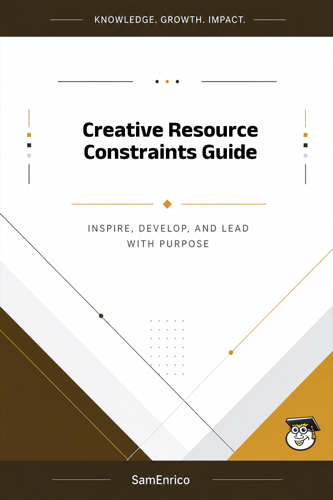
Non-FictionSelf-HelpResource ConstraintsFrugal
Creative Resource Constraints Guide eBook
Innovate effectively when budgets, staff, and time
Innovate effectively when budgets, staff, and time are severely limited.
Formats
Free sample
Chapter 1: The Herbie in Your Inbox--The problem isn’t that you don’t have enough resources. The problem is that you don’t know which resource is strangling you.Let me tell you about a manufacturing plant in Ohio that changed everything I thought I knew about business. In the early 1980s, a plant manager named Alex Rogo was about to be shut down. His factory was late on every order. His team was exhausted.
His budget had been cut three times that year. And yet, every morning, he walked onto the floor and saw the same thing: machines running at full speed, people rushing between stations, and inventory piling up everywhere.He was doing everything right. And he was failing.Alex’s breakthrough came from an unlikely source: a Boy Scout hiking trip. He was leading a troop of boys through the woods, and one boy—a slow, overweight kid named Herbie—was holding up the entire line. Every time the troop sped up, they had to stop and wait for Herbie to catch up.
Alex tried everything. He put Herbie at the front. He had the faster boys carry Herbie’s pack. Nothing worked. The troop moved at Herbie’s speed, no matter what anyone else did.Then Alex had an idea.
He stopped trying to make Herbie faster. Instead, he redistributed Herbie’s weight to the other hikers. Suddenly, the whole troop moved faster—not because the strong hikers got stronger, but because the bottleneck stopped being the bottleneck.That story, from Eliyahu Goldratt’s novel The Goal, is the single most important business lesson you will ever learn. And yet, almost everyone gets it wrong.The Mistake You Are Making Right Now Open your email. Go ahead.
I’ll wait.Look at the last five messages you sent to your team or your boss or your client. Count how many of them are about adding something. More budget. More time. More people.
Another meeting. Another tool. Another round of revisions.Now look at your to-do list. How many items are about improving something that is already working? Upgrading the software.
Optimizing the website. Training the team on a new process. Making the good thing great.Now look at your calendar for the past week. How many hours did you spend on the one thing that is actually slowing you down? Not the urgent fires.
Not the easy wins. The one slow, painful, unavoidable step that every single task has to pass through before it can be finished.If you are like most people I work with, the answer is zero. You spent zero hours on the bottleneck. You spent all your time on everything else.This is not laziness. This is not stupidity.
This is a cognitive bias that every successful person shares, and it is the reason that smart, hardworking, well-intentioned leaders fail when resources get tight.We are wired to improve what is working. We are wired to add resources to problems. We are wired to believe that more is better and faster is smarter. And every single one of those instincts is wrong when you are operating under constraint.The Three Constraints You Cannot Ignore Before we go any further, we need to get specific about what we mean by “constraint.” In the world of business books, this word gets thrown around sloppily. A constraint is a lack of time.
A constraint is a tight budget. A constraint is a skeleton crew. A constraint is a slow approval process. A constraint is a difficult client.These are not the same thing. And confusing them is the fastest way to waste your energy.Let me introduce you to the three types of constraints that will appear in every chapter of this book.
Learn the difference now, or you will spend the next three hundred pages applying the wrong solution to the wrong problem.Macro-Constraints: Your Identity The first type is the big one. The one you complain about at dinner. The one that keeps you up at night. The one that defines your current reality.Macro-constraints are the broad resource categories you lack. There are only three of them, and every single person reading this book has one primary macro-constraint:Time-Starved: You have a deadline tomorrow.
Your calendar is double-booked. You have no schedule slack. Your problem is not money or people; your problem is that the clock is running out.Talent-Starved: You are a solo founder. You have a tiny team. You have no specialists.
You cannot hire. Your problem is not time or money; your problem is that you are the only one who can do the thing that matters.Treasury-Starved: You have near-zero budget. You are bootstrapping. Your credit cards are maxed. Your problem is not time or people; your problem is that every dollar has to be stretched until it screams.Here is the hard truth that most books will not tell you: You cannot fix your macro-constraint.
Not directly. You cannot magically create more time. You cannot clone yourself. You cannot print money. If you spend this book trying to solve your macro-constraint, you will fail.The goal is not to remove your macro-constraint.
The goal is to reorganize everything else around it.Micro-Constraints: Your Leverage Point The second type is the one you can actually change. The one hiding in plain sight. The one that every task has to wait for.Micro-constraints are specific bottlenecks in your workflow. A single approval step that takes three days. A single machine that breaks every Tuesday.
A single person who hoards information. A single software tool that crashes at 2 PM every day.Unlike macro-constraints, micro-constraints are fixable. Not always easily. Not always cheaply. But fixable.
And here is the critical insight that separates the people who succeed under constraint from the people who burn out: Your macro-constraint tells you what you cannot change. Your micro-constraint tells you where to focus what little you have.If you are treasury-starved, your micro-constraint might be a $50 software subscription that you cannot afford. That is a physical bottleneck. It might also be a free approval process that takes five days because no one is empowered to say yes. That is a process bottleneck.
Both are micro-constraints. Both can be changed without solving your macro-constraint.Psycho-Constraints: Your Hidden Enemy The third type is the one no one wants to talk about. The one inside your own head. The one that makes smart people do stupid things.Psycho-constraints are behavioral patterns that sabotage your timelines and drain your energy. Parkinson’s Law: work expands to fill the time allotted.
Student Syndrome: people wait until the last possible moment to start. The Planning Fallacy: we consistently underestimate how long things will take. Loss Aversion: we keep pouring resources into failing projects because we cannot bear to admit we were wrong.These are not fixed by spreadsheets or budgets or timelines. These are fixed by rituals, discipline, and the kind of uncomfortable self-awareness that most business books avoid.Here is the good news: once you name a psycho-constraint, you can start to design around it. You cannot cure Parkinson’s Law.
But you can set a 45-minute timer and force yourself to stop. You cannot cure Student Syndrome. But you can…
This is the end of the free sample. Get the eBook to keep going. Buy now
About this book
Details
- Author
- Massey Eunice
- Publisher
- SamEnrico
- Language
- English
- Genre
- Non-Fiction, Self-Help, Resource Constraints, Frugal
- Released
- 2026-06-10
- Pages (approx.)
- 107
- Available as
- eBook, Audiobook

Read better in the ZLOADR app
Your eBooks on your phone or tablet. Sign in with your SamEnrico account and start reading.
More by Massey Eunice
 Pablo Escobar Bombs DASMassey Eunice$11.99
 Antwerp Heist Security UpgradeMassey Eunice$11.99
 Stress and Cancer Progression GuideMassey Eunice$11.99
 Sick Building Syndrome SolutionsMassey Eunice$11.99
 The Bone Whisperers of Lapita: Decoding the First Pacific AncestorsMassey Eunice$11.99
 The Whispering Shadows of the YureiMassey Eunice$11.99
 Understanding Feigenbaum–bergeron–Richardson SyndromeMassey Eunice$17.99
 Scraper OperatorMassey Eunice$11.99
 Asynchronous Conflict ResolutionMassey Eunice$12.99
 Running Strategy Meetings for Merger IntegrationMassey Eunice$12.99
 How to Start a Hobby in Kite Flying / MakingMassey Eunice$11.99
You may also like
 Hong Kong Handover 1997Dunn Johnnie$11.99
 Zumba For Postnatal Recovery CourseNeal Christian$11.99
 Zumba for BeginnersLadner Nikia$11.99
 YouTube Comment Mining GuideHumes Pandora$12.99
 Worry Box MeditationCarlin Rudy$11.99
 Workplace Stress MeditationNguyen Lynn$11.99
 Workplace Stress and Sleep RepairHawley Ivory$11.99
 Workplace Perfectionism CureDelaney Jeffry$11.99
 Workplace Injustice Anger GuideWallen Isabelle$11.99
 Work Addiction and Burnout LinkGreenwood Ester$11.99
 Women in Yoga and WellnessBeattie Galina$11.99
 Women in Stand Up ComedyChun Evangeline$11.99