
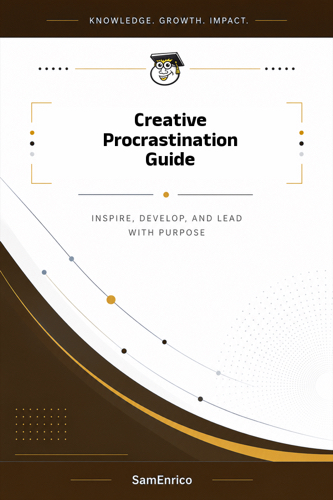
Non-FictionSelf-HelpCreativity
Creative Procrastination Guide eBook
Stop delaying artistic projects using these practi
by Silva Jamie
Stop delaying artistic projects using these practical techniques.
Formats
Free sample
Chapter 1: The Permission Pivot...--–- You are reading this book because you have something you desperately want to create, and you have not created it yet. The gap between those two statements—the wanting and the not-doing—has probably caused you more quiet suffering than you care to admit. You have called yourself lazy. You have called yourself undisciplined. You have stayed up late at night scrolling through the successful work of other artists, feeling a toxic mixture of inspiration and self-loathing.
You have made promises to yourself that you broke within forty-eight hours. You have told yourself that next month will be different, that after the holidays you will finally start, that once the studio is organized or the children are older or the weather changes, you will become the artist you were meant to be.And none of it has worked.Not because you are broken. Not because you lack talent. Not because you secretly do not care about your art. The problem is far more specific, far more fixable, and far more surprising than any of those explanations.
The problem is that you have been taught, probably since childhood, that procrastination is a moral failure—and that belief itself is what is keeping you stuck.This chapter will dismantle that belief. By the time you finish these pages, you will understand something that most working artists learn only after years of unnecessary suffering: there are two completely different kinds of procrastination, and only one of them is your enemy. The other, when understood and used correctly, is not just harmless but essential to the creative process. More importantly, you will learn how to stop the shame spiral that drains your energy before you ever pick up a brush or open a blank document. You will be given explicit, guilt-free permission to rest—not as a reward for working, but as a legitimate part of the creative cycle.
And you will make a simple, powerful commitment that will serve as the foundation for every technique in the rest of this book.But first, we need to talk about where your current beliefs about procrastination came from.The Puritan Trap If you grew up in a Western culture—and especially if you grew up in the United States, Canada, Britain, Australia, or Northern Europe—you were raised inside a set of assumptions about work that date back to the Protestant Reformation. The Protestant work ethic, as sociologists call it, holds that hard work is not merely a means to an end but a moral virtue in itself. Idle hands are the devil's workshop. Time wasted is a sin. Productivity is next to godliness.This ethic served an important purpose in the development of industrial capitalism.
It got people to show up to factories on time, to work long hours without complaint, and to feel virtuous about doing so. But somewhere along the way, we made a catastrophic error: we applied this industrial, assembly-line logic to creative work. And creative work does not operate on an assembly line.On an assembly line, more hours of direct effort reliably produce more output. If you tighten a bolt for ten hours instead of five, you will tighten approximately twice as many bolts. The relationship between time and results is linear, predictable, and controllable.
Creative work is not like that. You cannot reliably produce a great painting by painting for twelve hours straight. You cannot force a breakthrough by staring at the page longer. In fact, the opposite is often true: breakthroughs happen when you step away, when you shower, when you walk the dog, when you fall asleep. The most productive creative workers are not the ones who grind the longest; they are the ones who understand when to work and when to stop working.But the Protestant work ethic does not care about any of this.
It whispers to you in moments of rest: You should be working right now. You are being lazy. Everyone else is out there creating things while you sit here doing nothing. Get up. Get back to work.
And because you have internalized this voice since childhood, you believe it. You believe that rest is a weakness, that breaks are indulgences, that the only virtuous state is one of active, measurable production.This belief does not make you more productive. It makes you exhausted, ashamed, and less likely to create anything at all. And it is completely wrong for the work you are trying to do.The Two Faces of Delay Here is the single most important distinction in this entire book, and you should memorize it: there are two completely different kinds of procrastination, and they feel different, function differently, and require different responses.The first kind is Negative Procrastination. This is the enemy.
It is anxiety-driven avoidance. It feels bad in your body—a tightness in your chest, a knot in your stomach, a restless urge to do anything other than the thing you are supposed to be doing. You know you should be working, but instead you find yourself scrolling through social media, cleaning the refrigerator, reorganizing your bookshelf, checking email for the fifth time in an hour, watching You Tube videos about how to sharpen pencils, or reading articles about procrastination instead of actually working.Negative procrastination is characterized by three things. First, it is unconscious—it happens to you rather than being chosen by you. You do not decide to spend forty-five minutes on Instagram; you look up and realize that forty-five minutes have somehow disappeared.
Second, it is accompanied by shame. Even as you are avoiding your work, a part of you is watching yourself avoid it, and that part is judging you harshly. Third, it drains your energy. The shame and self-criticism that accompany negative procrastination are metabolically expensive. They exhaust you, which makes starting even harder, which creates more shame, which exhausts you further.
This is the engine of the shame spiral, which we will return to shortly.The second kind of delay is Creative Procrastination. This is not the enemy. It is a tool. Creative procrastination is planned, deliberate rest or strategic alternative focus. It feels purposeful.
You choose it. You schedule it. You know why you are doing it, and you do not feel guilty about it.Creative procrastination takes three forms, which we will explore in depth in later chapters. The first is Incubation—passive rest where you deliberately step away from a problem and allow your subconscious to work. This is when you nap, shower, take a walk, or stare out a window, trusting that your brain is making connections beneath the surface of conscious thought.
The second is Structured Procrastination—working on a different, less aversive task instead of the task you are avoiding. You build a hierarchy of tasks so that avoiding the hardest one still results in productivity. The third is Productive Displacement—environmental preparation that feels like procrastination but is actually priming. Cleaning your studio, organizing your files, sharpening your pencils—these are not wasted time when done intentionally.What distinguishes creative procrastination from negative procrastination is a single variable: intentionality. Are you choosing this delay, or is it happening to you?…
This is the end of the free sample. Get the eBook to keep going. Buy now
About this book
Details
- Author
- Silva Jamie
- Publisher
- SamEnrico
- Language
- English
- Genre
- Non-Fiction, Self-Help, Creativity
- Released
- 2026-06-09
- Pages (approx.)
- 137
- Available as
- eBook, Audiobook

Read better in the ZLOADR app
Your eBooks on your phone or tablet. Sign in with your SamEnrico account and start reading.
More by Silva Jamie
 Moai Social Circle GuideSilva Jamie$11.99
 Gut Brain Axis AutoimmuneSilva Jamie$11.99
 The Jair Bolsonaro OpponentSilva Jamie$11.99
 Sciatica Nerve Glide PracticeSilva Jamie$11.99
 Patent Inspiration GuideSilva Jamie$11.99
 Anger Coping StatementsSilva Jamie$11.99
 Gaming and the BrainSilva Jamie$11.99
 The Red River War: Comanche Resistance at the Edge of EmpireSilva Jamie$11.99
 The Alchemist's Heir: The Secret Formulas of the MediciSilva Jamie$11.99
 How to Produce Remote Control ToysSilva Jamie$11.99
 Co-Founder Vetting Checklist HandbookSilva Jamie$12.99
 Title and Level Negotiation GuideSilva Jamie$12.99
You may also like
 Hong Kong Handover 1997Dunn Johnnie$11.99
 Zumba For Postnatal Recovery CourseNeal Christian$11.99
 Zumba for BeginnersLadner Nikia$11.99
 YouTube Comment Mining GuideHumes Pandora$12.99
 Worry Box MeditationCarlin Rudy$11.99
 Workplace Stress MeditationNguyen Lynn$11.99
 Workplace Stress and Sleep RepairHawley Ivory$11.99
 Workplace Perfectionism CureDelaney Jeffry$11.99
 Workplace Injustice Anger GuideWallen Isabelle$11.99
 Work Addiction and Burnout LinkGreenwood Ester$11.99
 Women in Yoga and WellnessBeattie Galina$11.99
 Women in Stand Up ComedyChun Evangeline$11.99