
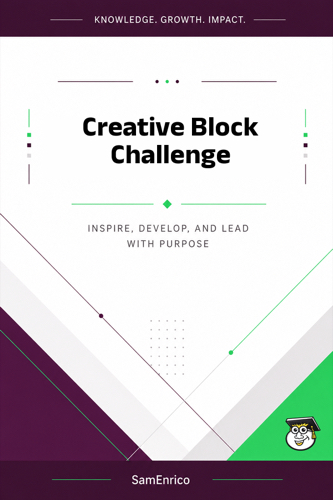
Creative Block Challenge eBook
Thirty days of daily creative acts to rebuild mome
Thirty days of daily creative acts to rebuild momentum.
Formats
Free sample
Chapter 1: The Diagnostic Trap...--You are not blocked because you lack talent. You are not blocked because you are lazy. You are not blocked because the universe has decided to withhold its mysterious spark of inspiration from you specifically, as if creativity were a weather system that simply failed to arrive over your particular latitude.You are blocked because you have learned to diagnose yourself into paralysis.Let me say that again, because it matters more than any exercise in this book: The act of naming your block—calling it "writer's block," "creative block," or "burnout"—has, for most people, become a sophisticated form of procrastination dressed in the language of psychology. We treat the diagnosis as if it were the cure. We say "I have writer's block" with the same finality as "I have a broken leg." But a broken leg is a physical reality that requires rest and external intervention.
A creative block is not a broken bone. It is a behavioral pattern. And behavioral patterns can be interrupted in seconds, not months.This chapter will do three things. First, it will demolish the mythology of the block as an external force that happens to you. Second, it will introduce you to the concept of Resistance—the true enemy, which Steven Pressfield called "the most toxic force on the planet." Third, it will give you your first real tool: not a cure, but a mirror.
Because the first step to rebuilding momentum is not finding the right technique. It is seeing the pattern of stopping for what it really is.The Three Faces of "Blocked"Most people use the word "blocked" as a single, undifferentiated blob of misery. But in my work with thousands of creatives—writers, painters, entrepreneurs, programmers, musicians, and marketers—I have observed three distinct states that all get lumped under the same label. Confusing them is like treating a sprained ankle and a bacterial infection with the same antibiotic. It won't work, and you will feel worse for having tried.State One: Resistance-Block This is the most common form, accounting for roughly seventy percent of what people call "creative block." Resistance-Block is not a lack of ideas.
It is not a lack of skill. It is a psychological defense mechanism that activates precisely when you are about to do something that matters. Resistance feels like fear. It feels like procrastination. It feels like sudden exhaustion, sudden hunger, sudden urgent need to organize your bookshelf or research the perfect pencil or read just one more article before you start.Resistance-Block is characterized by a specific pattern: you sit down to work, and within minutes, you find yourself doing something else.
Not because you are lazy—lazy people do not feel guilty about being lazy—but because some part of you is terrified of what will happen if you actually succeed. Resistance is the voice that says "who do you think you are?" It is the voice that says "this has already been done better." It is the voice that says "wait until you're ready."Here is the paradox that undoes Resistance: you will never feel ready. Readiness is not a prerequisite for action. Action is a prerequisite for readiness. Resistance-Block is a trap that can only be escaped by lowering the stakes so dramatically that the fear response shuts off.
That is why the daily acts in this book start with things like "write three pages of garbage in twenty minutes" and "make the ugliest thing you can imagine." You cannot be afraid of failing if failure is the explicit goal.State Two: Skill-Gap Block The second form of block is honest, and it is often misdiagnosed as Resistance. Skill-Gap Block occurs when you genuinely do not yet possess the technical ability to execute the vision in your head. This is not a psychological failure. It is a learning curve. The painter who has mastered still life but cannot paint a human hand is not blocked.
She is undertrained. The novelist who can write beautiful sentences but cannot structure a plot is not creatively constipated. She has a skill gap.Skill-Gap Block feels different from Resistance. Resistance produces anxiety and avoidance. Skill-Gap Block produces frustration and boredom.
You sit down, you try to do the thing, and it comes out wrong—not in an interesting, experimental way, but in a flat, incompetent way. You can see the gap between what you want and what you can do, and that gap feels like a wall.The solution to Skill-Gap Block is not more permission to be bad. (That was for Resistance.) The solution is deliberate practice on a single, tiny sub-skill. You do not need to paint the whole hand. You need to practice the knuckle for an hour.
You do not need to write the whole novel. You need to write twenty versions of the same sentence. Skill-Gap Block is solved by shrinking the scope of the problem until it matches your current ability, then expanding outward.State Three: Attention-Block The third form of block is the newest and, in many ways, the most pernicious. Attention-Block is not a lack of ideas or a lack of skill. It is a lack of sustained focus.
You have ten tabs open. Your phone buzzes every four minutes. You check email, then Slack, then Instagram, then news, then back to email. You sit down to work, and your attention is fractured into so many pieces that no single thought can gather enough mass to become an action.Attention-Block feels like static. It is not dramatic.
It does not produce the existential dread of Resistance or the frustrated sigh of Skill-Gap. It produces a low-grade, constant sense of busyness that masquerades as productivity. You were "working" all day, but at the end of the day, you have nothing to show for it except a thousand small interruptions.The solution to Attention-Block is environmental and behavioral. You need physical boundaries (phone in another room, internet blocker on your computer) and temporal boundaries (timed sprints, defined containers). Unlike Resistance, which requires you to lower your standards, Attention-Block requires you to raise your standards for what counts as "working."By the end of this chapter, you will know which of these three states is your primary pattern.
More importantly, you will have a diagnostic tool to identify which state you are in on any given day—because they shift, and the solution for one is useless or even harmful for another.The Great Lie: "Inspiration Will Come"Before we go further, I need to kill something. I need to kill the romantic myth that creativity requires a lightning bolt of inspiration before action can begin. This myth is not merely wrong. It is destructive. It has delayed more projects, silenced more voices, and produced more unopened sketchbooks than any other single belief.The myth goes like this: Creative work flows from a mysterious source.
The artist is a vessel. When the muse visits, the work pours out effortlessly. When the muse is absent, the artist waits. To force the work in the absence of inspiration is to produce something mechanical, soulless, inauthentic.This is beautiful poetry. It is also complete nonsense.Every working creative…
This is the end of the free sample. Get the eBook to keep going. Buy now
About this book
Details
- Author
- Anaya Caroyln
- Publisher
- SamEnrico
- Language
- English
- Genre
- Non-Fiction, Self-Help, 30 Day
- Released
- 2026-06-09
- Pages (approx.)
- 111
- Available as
- eBook, Audiobook

Read better in the ZLOADR app
Your eBooks on your phone or tablet. Sign in with your SamEnrico account and start reading.
More by Anaya Caroyln
 Friend Active Listening GuideAnaya Caroyln$11.99
 Immigrant Music Studio To Label GuideAnaya Caroyln$11.99
 Flash Mentorship for Quick WinsAnaya Caroyln$11.99
 Enforcement History TimelineAnaya Caroyln$11.99
 The Perfect Daughter's MeltdownAnaya Caroyln$11.99
 Swimming Shoulder PreventionAnaya Caroyln$11.99
 Redgrave Dynasty - Joely RichardsonAnaya Caroyln$11.99
 Assertiveness With In LawsAnaya Caroyln$11.99
 Dust and Dreams: The Untold Story of the Great Dust Bowl's Unsung HeroesAnaya Caroyln$11.99
 The Pathfinders: Canada's Forgotten Pioneers of the NorthwestAnaya Caroyln$11.99
 The Opium Wars of the Polish-Lithuanian Commonwealth: A Forgotten Drug WarAnaya Caroyln$11.99
 SMMA Client Acquisition SystemsAnaya Caroyln$11.99
You may also like
 Workplace Esteem ChallengeRife Lolita$11.99
 Jealousy ChallengeMcdougal Caprice$11.99
 Sleep Meditation ChallengeGarrison Florinda$11.99
 Purpose Challenge GuideWhittaker Luis$11.99
 Personal Ing For Success ChallengeCulver Larisa$11.99
 Flow ChallengeOuellette Harriette$11.99
 Affirmation ChallengeMelvin Dorris$11.99
 Loneliness ChallengeDick Kasie$11.99
 Post Hypnotic ChallengeMcreynolds Rhiannon$11.99
 Divorce ChallengeRoby Mia$11.99
 Sleep Memory Improvement PlanHillman Zetta$11.99
 Improv ChallengeSchell Dusty$11.99