
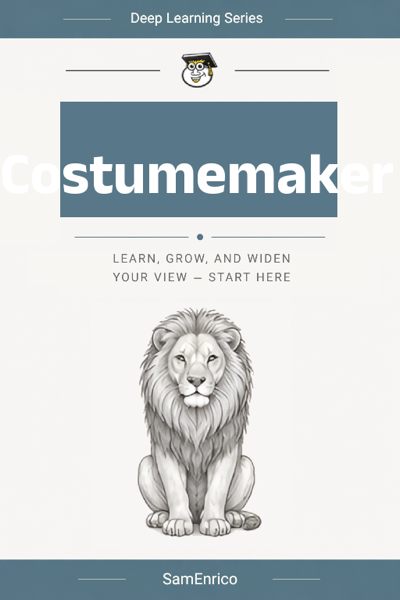
Costumemaker eBook
A Coursebook on Costumemaker
A Coursebook on Costumemaker
Formats
Free sample
Chapter 1: Fabric, Fire, and Fearlessness—– A costume begins its life as a whisper. Not in a fitting room or a dye bath, but in the space between a designer's sketch and a cutter's shears. Before the first pin touches fabric, before a single seam is sewn, the costumemaker must learn to listen—to fibers, to tools, to the unspoken needs of actors, directors, and deadlines. This book is not a collection of patterns or a gallery of finished work. It is a coursebook, designed to be written in, stained with coffee, and kept open on your workbench until the spine cracks.
By the end of these twelve chapters, you will have built a reference binder that contains everything from fabric burn test results to freelance contracts. You will have distressed a cotton shirt into a post-apocalyptic relic, sewn a miniature corset with plastic boning, and illuminated a costume with sewable LEDs—or chosen the no-code alternative. You will have become a costumemaker.But first, you must learn the language of cloth. And you must learn to be unafraid.The Costume Shop Ecosystem: Who Does What and Why It Matters Every garment that appears on a stage, a film set, or a convention floor passes through a hierarchy of hands. Understanding this ecosystem is not academic gatekeeping—it is practical navigation.
You need to know who to ask, when to ask, and what to call them when you walk into your first professional shop.The Designer sits at the top of the food chain. They translate a script or a character concept into a visual language: colors, silhouettes, historical periods, and emotional arcs. They produce renderings (full-color drawings) and swatch boards. In a small indie production, you might be both designer and maker. In a Broadway shop, you will never speak to the designer unless something has gone very wrong.
Your job is to execute their vision, not interpret it.The Cutter is the most feared and respected person in the room. They take the designer's flat sketch and the draper's muslin mockup and turn them into pattern pieces laid out on fabric. A great cutter can fit a complex gown onto just a few yards of expensive silk by angling pieces like Tetris blocks. The cutter's shears are sacred. Never borrow them.
Never touch them. If you see them left on a table, walk the other way. Cutters develop a reputation for being sharp-tongued and exacting. Earn a cutter's respect, and you will learn more in six months than in six years of trial and error.The Draper works in three dimensions. They pin, pleat, and shape muslin directly on a dress form, creating a rough sculpture of the final garment.
That muslin is then removed, trued (smoothed into flat pattern pieces), and handed to the cutter. Draping is intuitive and physical. If you enjoy problem-solving with your hands and hate math, draping might be your path. If you prefer precision and spreadsheets, flat patterning (Chapter 3) will feel like home.The First-Hand Stitcher sews the final garment. This is the most directly creative role—you feel the fabric under the needle, you decide the seam finish, you install the zipper, you shape the lapel.
In many shops, first-hands specialize: corsets, coats, millinery, or alterations. A first-hand stitcher can look at a designer's rendering and know exactly which techniques will make it stageworthy and which will fail under hot lights.The Crafts Artisan lives in a different world entirely. They build hats, armor, prosthetics, jewelry, and props. They work with foam, thermoplastics, resin, wire, and found objects. They rarely touch a sewing machine.
They are wizards. If you are reading this book because you want to build a Mandalorian helmet or a fairy crown, you are a crafts artisan at heart. Chapters 9, 10, and 11 are yours.The Stitcher (or Second-Hand) assists the first-hand. They sew darts, hem linings, attach buttons, and chain-stitch facings. This is where most beginners start, and it is an excellent place to learn.
Second-hand stitching teaches you speed, accuracy, and humility. You will rip out more seams than you sew correctly. This is normal.The Wardrobe Supervisor (or Costume Shop Manager) runs the show. They create the costume plot, manage the budget, hire the stitchers, and coordinate with the stage manager. They are the person who will ask you, "Can you finish that bodice by Tuesday?" when Tuesday is tomorrow.
Learn to say yes, then learn to say no gracefully. Both skills are survival tools.Why does this hierarchy matter to you, reading alone at your kitchen table? Because when you eventually walk into a professional shop—or when you hire help for a large cosplay build—you must know who holds which responsibilities. And because this book will teach you to play all of these roles at a beginner-to-intermediate level. By Chapter 12, you will have cut, draped, stitched, and crafted.
You will not be a master of any. You will be competent in all. That is the goal of a coursebook.Textiles 101: What You Are Actually Sewing (And Burning)Fabric is not just "cloth." It is an engineered material with specific properties: fiber content, weave or knit structure, weight, drape, and dye affinity. Choosing the wrong fabric for a project is like building a sailboat out of concrete. It might look right on the bolt, but it will fail under stress.
The audience may not know why your queen's gown looks wrong, but they will feel it. They will sense that the silhouette is off, that the fabric does not move correctly, that something is amiss.Let us fix that.Natural Fibers: The Living Fabrics Cotton is the workhorse of costumery. It takes dye beautifully, breathes, presses crisply, and is cheap enough to practice on. Use it for muslin mockups, historical undergarments, peasant blouses, and anything that needs to look soft and worn-in. Weaknesses: it wrinkles instantly and molds if stored damp.
A cotton costume that sits in a damp basement for a month will grow green fur. I have seen it happen. It is not pretty.Linen is cotton's sophisticated older sibling. It has a natural slub (tiny bumps along the thread) and a crisp hand that softens with washing. It wicks moisture away from the body—critical for actors under hot stage lights.
In a two-hour play under a 500-watt follow spot, linen can mean the difference between a dry actor and a drenched one. Weakness: it creases so dramatically that some designers use linen specifically for the wrinkle effect. A linen jacket fresh from the iron looks sharp. Ten minutes later, it looks like it survived a hurricane. Embrace this or avoid linen entirely.Wool is magical.
It can be felted, woven, or knit. It takes dye richly, insulates even when wet, and sheds wrinkles like a snake sheds skin. Use it for coats, cloaks, military uniforms, and Victorian tailoring. Weakness: it shrinks aggressively if washed in hot water or agitated. Dry clean only, unless you are deliberately fulling (shrinking and matting) it for a medieval look.
Fulling is a technique where you wash wool in hot water and agitate it intentionally, causing the fibers to lock together into a dense, felted fabric. This…
This is the end of the free sample. Get the eBook to keep going. Buy now
About this book
Details
- Author
- Caruso Edgardo
- Publisher
- SamEnrico
- Language
- English
- Genre
- Non-Fiction, Informative, Educational
- Released
- 2026-05-04
- Pages (approx.)
- 131
- Available as
- eBook, Audiobook

Read better in the ZLOADR app
Your eBooks on your phone or tablet. Sign in with your SamEnrico account and start reading.
More by Caruso Edgardo
 Tuskegee Syphilis StudyCaruso Edgardo$11.99
 Mindfulness for Overthinkers GuideCaruso Edgardo$11.99
 Pattern Recognition in PhysicsCaruso Edgardo$11.99
 Mindful Parenting Stress ReductionCaruso Edgardo$11.99
 The Lament of the Nine-Tailed Fox: A Samurai’s Oath in the Moonlit CourtCaruso Edgardo$11.99
 How to Produce a Brake SystemCaruso Edgardo$11.99
 English and Localized Listings for Ghana MarketCaruso Edgardo$12.99
 How to Start a Area Sales Management Business (Beginners Guide)Caruso Edgardo$11.99