
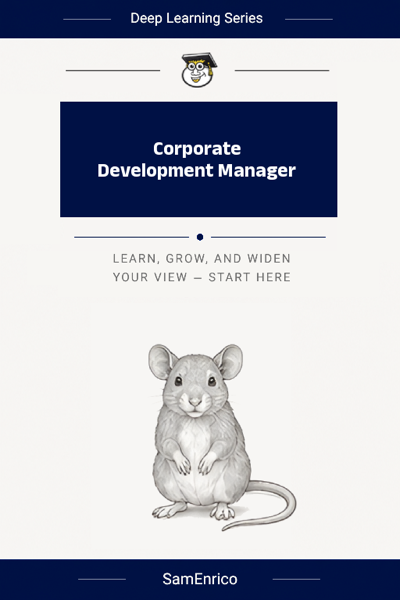
Non-FictionInformativeEducational
Corporate Development Manager eBook
A Coursebook on Corporate Development Manager
A Coursebook on Corporate Development Manager
Formats
Free sample
Chapter 1: The Seven-Figure Mistake--–- The conference room on the 47th floor had a view of three states, a mahogany table that cost more than most people's cars, and seventeen executives who had just realized they were about to lose a billion dollars. Not all at once, not in a single dramatic collapse, but slowly, over eighteen months, in a death by a thousand spreadsheet errors. The acquisition had been announced with press releases and champagne. The target was a fast-growing software company with sticky customers, impressive margins, and a founding team that seemed to share every value the acquirer held dear. The integration had been assigned to a capable team.
The synergies had been modeled with precision. And yet, here they were, eighteen months later, staring at a write-down that would cost the CEO his job, the CFO her bonus, and the Corporate Development Manager—a sharp, hardworking woman named Sarah—her reputation.Sarah had done everything right, by the textbook. She had sourced the deal through formal channels, run a thorough diligence process, negotiated favorable terms, and closed on time. She had even stayed through the first ninety days of integration to ensure a smooth transition. The problem was not what Sarah had done.
The problem was what her organization had assumed—that Corporate Development was a transaction function, not a strategic one. Sarah had been hired to close deals, not to question whether the deals should be closed at all. She had been measured on velocity, not on value creation. And when the acquisition inevitably struggled, no one asked why the deal had been approved in the first place. They only asked who had executed it.This book exists because that scene plays out every single day in boardrooms across the world.
According to a decade of research from Mc Kinsey, BCG, and Harvard Business School, between 70 and 90 percent of acquisitions fail to create shareholder value. That is not a typo. The vast majority of the billions of dollars spent on M&A every year—over $3 trillion globally in 2023 alone—simply vanishes. Some of it is destroyed by poor integration, some by overpayment, some by bad timing. But the root cause, the common denominator in almost every failed deal, is something more fundamental: the organization never truly understood what Corporate Development was supposed to do in the first place.This chapter is about that misunderstanding.
It is about the seven-figure mistake that companies make before they ever look at a single target. And it is about how you, as a Corporate Development Manager, can ensure that your organization never makes that mistake again.The $1.2 Billion Misunderstanding Let us return to Sarah, whose story is real, though her name and identifying details have been changed. Sarah worked for a publicly traded industrial company we will call Indico. Indico had a problem: its core market was mature, growing at only 2 percent annually, and its shareholders were demanding higher returns. The solution, as articulated by the CEO, was to "aggressively pursue adjacent market acquisitions." The board approved.
Sarah was tasked with making it happen.Over the next fourteen months, Sarah and her team of three analysts evaluated over two hundred potential targets. They ran financial models, conducted management interviews, and presented eleven deals to the investment committee. Four of those deals received approval to proceed to diligence. Two received final approval. One closed: a $500 million acquisition of a software company that served a related industry.The diligence had been thorough.
Sarah's team had reviewed five years of audited financials, interviewed the top ten customers, and hired outside consultants to validate the technology. The valuation model showed a compelling 18 percent internal rate of return, driven primarily by revenue synergies—cross-selling Indico's existing products to the target's customer base and vice versa. The deal was announced to applause. The stock price rose 4 percent on the news.Then reality intervened. The revenue synergies never materialized, not because the sales teams were incompetent but because the customers did not want what the other company was selling.
Indico's industrial customers had no interest in software. The target's software customers had no interest in industrial equipment. The cross-selling assumption—which had been the cornerstone of the valuation model—was based on a survey of five friendly customers who had said "sure, that sounds interesting" in a thirty-minute call. No one had asked them to sign a letter of intent. No one had run a pilot.
No one had tested the assumption with real money on the line.At the same time, the cultural integration was failing. Indico was a hierarchical, process-driven organization where decisions required three signatures and two meetings. The target was a flat, fast-moving startup where decisions were made in Slack channels. Key talent from the target departed within six months, taking with them the very capabilities Indico had paid for. By the end of the first year, the acquisition was generating less than half the revenue projected and had lost 20million.Bytheendofthesecondyear,Indicotooka20 million.
By the end of the second year, Indico took a 20million.Bytheendofthesecondyear,Indicotooka400 million goodwill impairment charge. The total shareholder value destroyed, including the acquisition price and the opportunity cost of capital, was estimated at $1.2 billion.The post-mortem revealed a painful truth. Sarah had done her job. She had followed the process. The failure was not hers.
It was the failure of the organization to define what Corporate Development was supposed to be. Indico had treated Corp Dev as a transaction execution machine—a way to turn strategic aspirations into signed paperwork. What Indico needed was a strategic partner—a function that could challenge assumptions, test hypotheses, and say no when a deal did not fit. Sarah had not been empowered to say no. She had been measured on how many deals she closed, not on how much value she created.
And so she closed deals.Defining Corporate Development: More Than a Deal Desk If you ask ten executives what Corporate Development does, you will get eleven answers. Some will tell you it is M&A by another name. Some will say it is the internal version of investment banking. Others will confuse it with FP&A, or strategy, or venture capital. This confusion is not accidental.
The role of Corporate Development has evolved dramatically over the past thirty years, and many organizations have simply never caught up.Let us start with the clearest possible definition. Corporate Development is the function responsible for executing inorganic growth strategies—that is, growth achieved through transactions rather than internal investment. The scope of Corporate Development typically includes mergers, acquisitions, divestitures, joint ventures, strategic alliances, and minority investments. In some organizations, Corporate Development also oversees post-merger integration and portfolio management.That is the textbook definition. But the real definition is more interesting.
Corporate Development is the function that sits at the intersection of strategy, finance, and operations. It is the only function that touches every aspect of a transaction from initial idea to final integration. It is the function that must understand the company's strategic direction, evaluate the financial implications of a deal, and manage the operational reality of putting two organizations together. No other role requires this combination of skills. No other…
This is the end of the free sample. Get the eBook to keep going. Buy now
About this book
Details
- Author
- Harlow Estrella
- Publisher
- SamEnrico
- Language
- English
- Genre
- Non-Fiction, Informative, Educational
- Released
- 2026-05-25
- Pages (approx.)
- 155
- Available as
- eBook, Audiobook

Read better in the ZLOADR app
Your eBooks on your phone or tablet. Sign in with your SamEnrico account and start reading.
More by Harlow Estrella
 Tobacco Cessation for Shift WorkersHarlow Estrella$11.99
 The Labor IllusionHarlow Estrella$11.99
 Meditation for OverthinkersHarlow Estrella$11.99
 Financial Stress for FreelancersHarlow Estrella$11.99
 Inanna and the Forbidden Orchard: A Goddess’s Descent into the UnderworldHarlow Estrella$11.99
 How to Produce Audio and Video ReceiversHarlow Estrella$11.99
 Marginal Analysis Excel PrimerHarlow Estrella$12.99
 How to Start a Braces Made of Leather Business (Beginners Guide)Harlow Estrella$11.99
You may also like
 Hong Kong Handover 1997Dunn Johnnie$11.99
 Zumba For Postnatal Recovery CourseNeal Christian$11.99
 Zumba for BeginnersLadner Nikia$11.99
 YouTube Comment Mining GuideHumes Pandora$12.99
 Worry Box MeditationCarlin Rudy$11.99
 Workplace Stress MeditationNguyen Lynn$11.99
 Workplace Stress and Sleep RepairHawley Ivory$11.99
 Workplace Perfectionism CureDelaney Jeffry$11.99
 Workplace Injustice Anger GuideWallen Isabelle$11.99
 Work Addiction and Burnout LinkGreenwood Ester$11.99
 Women in Yoga and WellnessBeattie Galina$11.99
 Women in Stand Up ComedyChun Evangeline$11.99