
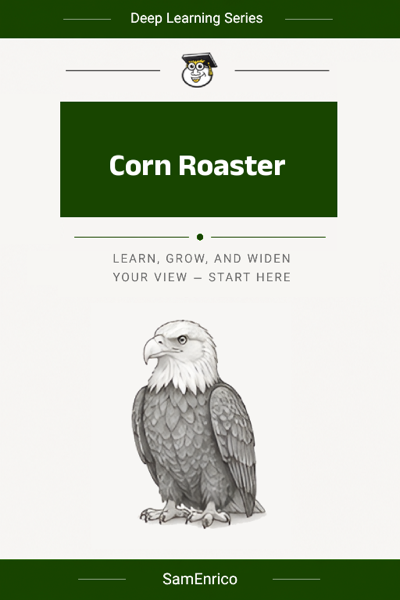
Corn Roaster eBook
A Coursebook on Corn Roaster
A Coursebook on Corn Roaster
Formats
Free sample
Chapter 1: The Golden Kernel’s Secret...--The corn sits on the counter, wrapped in pale green husks, silken threads trailing from its tip. To most people, it is a vegetable destined for a pot of boiling water. But to you—now turning the pages of this book—it is something else entirely. It is a canvas. A battery of stored sunlight.
A test of fire, timing, and touch. And somewhere inside that row of plump, pearly kernels lies the difference between corn that is merely cooked and corn that is roasted: sweet, smoky, blistered, and unforgettable.This book will teach you to close that gap. But before we light a single flame, before we discuss rotating cages or street-cart logistics or the perfect smear of crema, we must answer a more fundamental question: What is roasting corn, really? And why does the same ear of corn, harvested from the same field on the same morning, taste dramatically different depending on how—and when—you apply heat?The answer begins not in the kitchen, but in the biology of the corn plant itself. The golden kernel holds a secret.
That secret is sugar. And sugar, as every roaster eventually learns, is a fugitive.The Great Corn Lie: Not All Corn Is Equal Walk into any supermarket in August, and you will see pyramids of corn stacked under misters, often with a hand-lettered sign proclaiming “Sweet Corn—5 for $4.” What the sign does not tell you is that much of that corn was bred not for flavor, but for durability. Modern industrial sweet corn varieties have been selected to hold their sugar content longer during shipping, to resist bruising, and to look uniformly yellow under fluorescent lights. These are worthy goals for a global supply chain, but they are not the same goals as a roaster’s.You must unlearn what the grocery store has taught you.Field corn (also called dent corn) is the pale, hard-kerneled corn used for animal feed, ethanol, corn syrup, and industrial starches. It contains very little sugar and a great deal of starch.
Roast it, and you will get a tough, chewy, floury disappointment. Do not use it.Sweet corn is the category you want. But within sweet corn, there are three genetic sub-types, and they matter enormously:Standard (su) sweet corn – The old-fashioned kind your grandparents grew. It converts sugar to starch so quickly that you have about six hours after picking before it becomes noticeably less sweet. Almost never found in supermarkets; only at farmers’ markets or your own garden.
Roasting it is a revelation: explosively sweet, thin-skinned, and juicy.Sugar-enhanced (se) sweet corn – A hybrid that holds its sweetness longer, about two to three days. Varieties like Silver Queen and Butter and Sugar fall here. This is excellent for roasting if you can get it within 48 hours of harvest.Supersweet (sh2) sweet corn – Bred to remain sweet for up to two weeks. It contains a gene that slows the sugar-to-starch conversion dramatically. This is what you find in most supermarkets.
It is reliably sweet but often has tougher skins and a less complex flavor. It roasts fine, but it does not reach the heights of a truly fresh su or se variety.Then there are the heirlooms. Honey Select, Peaches and Cream, Bodacious, Mirai. These are not marketing names; they are specific cultivars, each with its own sugar profile, kernel tenderness, and moisture content. Honey Select, for example, is an augmented supersweet that has won multiple taste tests for its balance of sugar and creamy texture.
Peaches and Cream is a bicolor variety—white and yellow kernels on the same cob—with a softer, almost buttery mouthfeel.If you have a choice, seek out a local farmer who grows a named variety and can tell you when it was picked. The difference between a nameless “sweet corn” and a Honey Select harvested that morning is the difference between a photograph and a live performance.The Sugar Heist: Why Freshness Is Non-Negotiable Here is the biological drama that unfolds the moment an ear of corn is detached from the stalk.The corn plant constantly produces sugars in its leaves through photosynthesis. Those sugars travel down the stalk and into the developing kernels, where they are stored. While the ear is still attached, the plant also has the ability to convert some of those sugars into starch for long-term energy storage—but it maintains a balance favoring sugar as long as the kernels are growing.The instant you snap the ear from the stalk, that balance shatters.Without the plant’s metabolic support, the kernels’ own enzymes take over. And those enzymes have one primary job: convert sugar into starch.
This is not a slow, gentle decline. It is a heist. Within the first six hours after picking, a standard sweet corn variety can lose 25% of its sugar content. Within 24 hours, that loss reaches 40–50%. At 48 hours, the corn is still sweet enough to be pleasant if boiled, but for roasting—where heat amplifies every flavor and texture—the degradation is noticeable.
At three days, you are roasting a shadow.This is why farmers who sell at roadside stands will often tell you, “Pick it yourself, or buy it this morning.” They are not being precious. They are telling you the truth about time.Let me give you a visceral example. I once conducted a side-by-side test with two dozen ears of the same variety, Butter and Sugar. One dozen were roasted within two hours of harvest. The other dozen were refrigerated (husks on) for 48 hours, then roasted identically.
The fresh corn had kernels that popped in the mouth with a sweet, milky burst; the char on the exterior tasted complex, almost nutty. The 48-hour corn was still sweet, but the texture was slightly denser, and the roasted flavor was one-dimensional—just caramelized sugar without the aromatic high notes. Both were good. Only one was memorable.The lesson is brutal but liberating: your roasting skill cannot rescue old corn. You must start with the best possible raw material.
Everything else is damage control.The Tight Husk Test: Selecting Winning Corn Because you cannot always harvest your own corn, you need a reliable method for evaluating corn at a market, a roadside stand, or even a supermarket. The tight husk test is your friend. Here is how to perform it in four steps.Step One: Feel the Weight. Pick up an ear. It should feel heavy for its size.
That weight is water—fresh, juicy water trapped inside plump kernels. A light ear means the kernels have begun to dry out, either from age or poor storage.Step Two: Squeeze the Husk. The husk should be tight against the ear, not loose or papery. Run your fingers from the base (the cut end) to the tip. You should feel distinct bumps—the kernels pressing outward.
If the husk feels smooth or hollow, the kernels have shrunk.Step Three: Check the Silk. Pull back the very tip of the husk just enough to expose the silk (the tuft of threads). The silk should be moist, pale gold, and slightly sticky. If it is dry, brittle, brown, or black, the corn…
This is the end of the free sample. Get the eBook to keep going. Buy now
About this book
Details
- Author
- Gladden Jayna
- Publisher
- SamEnrico
- Language
- English
- Genre
- Non-Fiction, Informative, Educational
- Released
- 2026-05-04
- Pages (approx.)
- 137
- Available as
- eBook, Audiobook

Read better in the ZLOADR app
Your eBooks on your phone or tablet. Sign in with your SamEnrico account and start reading.
More by Gladden Jayna
 Natural Migraine RemediesGladden Jayna$11.99
 Listening For Medical ProfessionalsGladden Jayna$11.99
 Metabolic Syndrome African AmericansGladden Jayna$11.99
 Cocaine Work Performance RecoveryGladden Jayna$11.99
 The Last Quest of Sir Balin the SavageGladden Jayna$11.99
 Learn to Play the Inline OcarinaGladden Jayna$11.99
 AI Redlining Assistant GuideGladden Jayna$12.99
 How to Start a Needle Roller Bearings Business (Beginners Guide)Gladden Jayna$11.99