
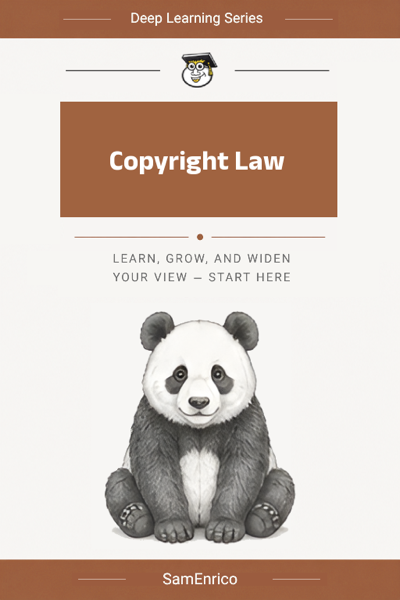
Non-FictionInformativeEducational
Copyright Law eBook
A Coursebook on Copyright Law
A Coursebook on Copyright Law
Formats
Free sample
Chapter 1: The Invisible Property Line--You have already broken copyright law today. Probably multiple times. And unless you are reading this book from inside a prison library, you have almost certainly faced zero consequences. This is the first and most important truth about copyright law: it governs nearly every creative act of your daily life, but it is enforced so selectively that most violations simply vanish into the noise of ordinary existence.Think about your morning. You hummed a Taylor Swift lyric while making coffee.
You forwarded a meme that included a photograph taken by a stranger. You screenshotted a tweet and sent it to a group chat. You saved a recipe from a food blog to your phone. You sang "Happy Birthday" to your child before school—a song that was, until 2016, legally owned by a music publishing company that demanded royalties for public performances. Every single one of these acts triggered a legal analysis under Title 17 of the United States Code.
Every single one could, in theory, expose you to liability. And yet, the world spins on.This is the paradox that makes copyright law simultaneously fascinating and frustrating. It is everywhere and nowhere. It is extraordinarily powerful and often powerless. It can make a musician a millionaire or drive a startup into bankruptcy, but it cannot stop a teenager from downloading a movie in twelve seconds.Why This Chapter Matters to You Before we dive into the Statute of Anne, the Berne Convention, or the Constitutional clause that grants Congress the power to create copyright law, you need to understand one thing: this area of law is not merely a set of rules for lawyers to argue about in courtrooms.
It is the operating system for the entire creative economy. It determines whether a You Tuber can keep their channel alive, whether a podcast host can play a clip from a movie, whether a musician can sample a drum break from a 1970s funk record, whether a writer can quote from a competing novel in a review, and whether a software developer can build a tool that interacts with someone else's application.Every creative professional who reads this book needs to understand copyright not as an abstract legal doctrine but as a practical tool for protecting their work and avoiding catastrophic mistakes. Every lawyer reading this book needs to see beyond the black-letter rules to the underlying policy battles that shape how courts decide close cases. And every curious person reading this book deserves to understand why a law written in 1790 continues to generate headline-grabbing lawsuits about artificial intelligence, social media, and streaming video in 2026.The Statute of Anne: A Revolution Against Royal Control To understand copyright law, you must understand its origin story. Before 1710, printing in England was regulated by the Licensing Act of 1662, which granted a monopoly to the Stationers' Company—a guild of printers who effectively controlled everything that could be published.
This system had nothing to do with protecting authors. It was about censorship and economic control. The Crown wanted to suppress seditious works, and the Stationers wanted to suppress competition.When the Licensing Act finally lapsed in 1695, the printing industry descended into chaos. Anyone with a printing press could now publish any book, including unauthorized reprints of popular works. Established printers demanded a new legal framework—not to protect authors, but to protect their own investments.
What emerged from their lobbying was the Statute of Anne, formally titled "An Act for the Encouragement of Learning, by Vesting the Copies of Printed Books in the Authors or Purchasers of such Copies."The Statute of Anne, enacted in 1710, was radical for its time. For the first time in history, it recognized that authors—not just printers—had rights in their works. It granted authors a fourteen-year term of protection, renewable for another fourteen years if the author was still alive. After that term expired, the work fell into the public domain, free for anyone to reprint and sell. The statute also included a price control provision to prevent publishers from charging exorbitant rates for books.But here is the dirty secret that most law school courses gloss over: the Statute of Anne did not actually help most authors.
Eighteenth-century authors typically sold their copyrights outright to publishers for a one-time payment, often before the work was even printed. The author received a lump sum; the publisher received fourteen years of monopoly control. The statute's preamble spoke of "encouraging learning," but its practical effect was to transform a system of royal censorship into a system of commercial monopoly. This tension—between the stated goal of promoting creativity and the actual outcome of enriching intermediaries—has never disappeared from copyright law.The Berne Convention: Exporting European Romanticism While British and American copyright law developed around utilitarian, economic justifications, continental Europe took a very different path. French and German thinkers embraced what we now call the "personality theory" of copyright—the idea that a work is an extension of the author's soul, and that author therefore has natural, moral rights that no contract can extinguish.
This philosophical divide would eventually collide in the Berne Convention.The Berne Convention for the Protection of Literary and Artistic Works, adopted in 1886, was Europe's attempt to create an international copyright system. Its core principles were simple and, for the time, revolutionary. First, protection must be automatic—no registration, no copyright notice, no formalities of any kind. Second, protection must be at least life of the author plus fifty years (later extended to life plus seventy years). Third, protection must extend to all works of literature and art, regardless of the country of origin.The United States famously refused to join Berne for nearly a century.
Why? Because the automatic protection requirement directly conflicted with the American system of formalities. Under U.S. law before 1978, you could lose your copyright entirely if you failed to include a proper copyright notice, register the work with the Copyright Office, or deposit copies with the Library of Congress. These formalities were designed to create a clear public record of what was protected and to ensure that the Library of Congress actually received copies of every work published in America.
But they also trapped countless unwitting authors who failed to comply with technical requirements.When the United States finally joined the Berne Convention in 1988, the effect was transformative. The copyright notice—the familiar © symbol—became optional. Registration remained possible (and still provides significant benefits, as Chapter 6 will explain), but it was no longer a condition of protection. Overnight, hundreds of thousands of works that had fallen into the public domain due to technical violations were resurrected. The Berne Convention's most important legacy, however, was not any specific rule but the principle that copyright should arise automatically from the act of creation itself.
This principle will reappear throughout this book, most notably in Chapter 6's discussion of formalities and in Chapter 12's exploration of whether AI-generated outputs can be copyrighted without human intervention.The Constitutional Bargain: Limited Monopoly for Public Good While Europe was debating the moral rights of authors, the American founders were drafting a Constitution that treated copyright as a purely utilitarian instrument. Article I, Section 8…
This is the end of the free sample. Get the eBook to keep going. Buy now
About this book
Details
- Author
- Bolden Georgine
- Publisher
- SamEnrico
- Language
- English
- Genre
- Non-Fiction, Informative, Educational
- Released
- 2026-06-02
- Pages (approx.)
- 115
- Available as
- eBook, Audiobook

Read better in the ZLOADR app
Your eBooks on your phone or tablet. Sign in with your SamEnrico account and start reading.
More by Bolden Georgine
 The Meeting Note Sharing RuleBolden Georgine$11.99
 Breast Cancer Caregiver GuideBolden Georgine$11.99
 The Parkinson's Pain GuideBolden Georgine$11.99
 Data Leak Merger and Acquisition ScriptsBolden Georgine$11.99
 The Viking Plague: Blood, Ice, and the Birth of Maritime MedicineBolden Georgine$11.99
 The Silent War: The Rise and Fall of the Hittite EmpireBolden Georgine$11.99
 Understanding Collagen DisorderBolden Georgine$17.99
 Blocking for Hiring SeasonBolden Georgine$12.99
 UK Company Structure GuideBolden Georgine$12.99
 How to Start a Shotblasting of Buildings Business (Beginners Guide)Bolden Georgine$11.99
You may also like
 Hong Kong Handover 1997Dunn Johnnie$11.99
 Zumba For Postnatal Recovery CourseNeal Christian$11.99
 Zumba for BeginnersLadner Nikia$11.99
 YouTube Comment Mining GuideHumes Pandora$12.99
 Worry Box MeditationCarlin Rudy$11.99
 Workplace Stress MeditationNguyen Lynn$11.99
 Workplace Stress and Sleep RepairHawley Ivory$11.99
 Workplace Perfectionism CureDelaney Jeffry$11.99
 Workplace Injustice Anger GuideWallen Isabelle$11.99
 Work Addiction and Burnout LinkGreenwood Ester$11.99
 Women in Yoga and WellnessBeattie Galina$11.99
 Women in Stand Up ComedyChun Evangeline$11.99