
Non-FictionSelf-HelpGrief Social Skills
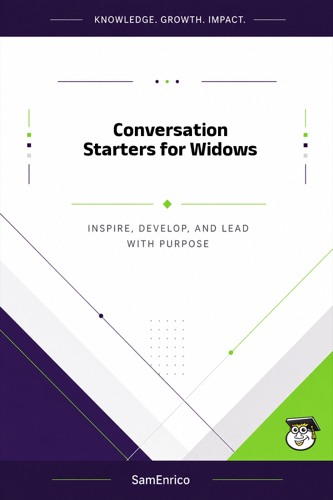
Conversation Starters for Widows eBook
Navigates grief while re-entering social situation
by Meador Kisha
Navigates grief while re-entering social situations with sensitive openers.
Formats
Free sample
Chapter 1: The Vanished "We"...--The first time someone asked me “How are you?” after my partner died, I opened my mouth and nothing came out. Not because I didn’t have an answer—I had too many answers, all of them jumbled together like a drawer full of expired coupons and unpaid bills. I wanted to say, “I just watched the person I love die, and now I’m standing in line at a CVS buying toilet paper, and I don’t know which of those two facts is more surreal.” Instead, I stood there frozen while the cashier’s smile slowly faded into concern, then pity, then that particular kind of panic people get when they realize they’ve accidentally stepped into someone else’s tragedy.I finally managed to croak out “Fine,” which was such an obvious lie that we both just stared at each other for an uncomfortable moment before I grabbed my bag and fled.That was the moment I realized: I had lost my script.For years, I had operated on social autopilot. I was part of a “we.” When someone asked how I was, the answer was implicitly shared—how we were. When I walked into a party, I had a social anchor, a person to glance at for reassurance, someone who would jump in if I forgot a name or blanked on a story.
My partner was my conversational safety net. And then, suddenly, the net was gone, and I was expected to perform the same high-wire act without it.This chapter is for everyone who has ever hidden from a mailman because you couldn’t face saying “I’m fine” one more time. It’s for the widow who has sat in her car outside a grocery store for twenty minutes because the thought of a casual chat with the checkout clerk felt like climbing Everest. It’s for anyone who has ever felt that the simple machinery of human conversation—the thing that used to run on autopilot—has suddenly become a foreign language you never learned.We’re going to start by naming what you’re experiencing, giving it language, and then giving you the first set of tools to get through the next conversation, the next hour, the next day. Because you don’t need to become a great conversationalist right now.
You just need to survive the next one.The Social Autopilot: What You Lost Without Knowing It Let’s back up and talk about what “social autopilot” actually means.For most of your adult life, conversation was largely automatic. You didn’t think about how to order coffee—you just did it. You didn’t rehearse how to greet a neighbor—you smiled and said hello. This wasn’t magic; it was the result of years of practice and, more importantly, the presence of what psychologists call a social anchor.A social anchor is a person in your life who provides stability in social situations. They don’t have to be doing anything obvious—they don’t have to speak for you or rescue you from awkward silences.
Their presence alone is enough. When you’re anchored, your brain knows that if something goes wrong—if you forget someone’s name, if a conversation turns uncomfortable, if you suddenly feel overwhelmed—there is someone there who has your back. This knowledge lowers your social anxiety. It frees up mental energy. It allows you to be more present, more relaxed, more yourself.Here’s what most people don’t realize: losing a spouse isn’t just losing a person you love.
It’s losing your primary social anchor. And you don’t realize how much you relied on that anchor until it’s gone.Consider the small, invisible ways your partner supported you in social situations:They remembered the name of the person you’d met twice before.They picked up the conversation when you ran out of things to say.They gave you a subtle signal when it was time to leave a party.They absorbed some of the attention in a group, so you weren’t always “on.”They provided a default answer to “How are you?”—because the answer was always “We’re good.”Now all of that is gone. And no one handed you a replacement.Why Small Talk Suddenly Feels Like Torture One of the most bewildering experiences for new widows is the sudden, visceral aversion to small talk. Before loss, you may have chatted easily about weather, weekend plans, or reality TV. After loss, those same topics can feel not just boring but almost offensive.There’s a neurological reason for this.When you experience a major loss, your brain enters a state of grief-related hypervigilance.
Your nervous system is on high alert, constantly scanning for threats. This is an evolutionary survival mechanism—after a catastrophic event, your brain wants to make sure it doesn’t happen again. The problem is that this hypervigilance doesn’t distinguish between real threats (a dangerous situation) and social ones (a neighbor asking about your weekend).So when someone cheerfully asks, “What are you doing this weekend?” your brain interprets the question as a demand. It requires energy to answer. It requires you to pretend that your weekend isn’t an empty expanse of grief.
It requires you to perform normalcy at a time when nothing feels normal. And because your brain is already exhausted from hypervigilance, it rebels. You feel irritated, drained, or even angry at the person who asked—even though they meant no harm.This is not a personality flaw. This is not you becoming a bitter person. This is your brain doing exactly what it evolved to do: protecting you.
The problem is that it’s protecting you from the wrong things.The solution isn’t to force yourself to enjoy small talk. The solution is to have scripts—pre-written, low-energy responses that allow you to get through the interaction without depleting yourself further. We’ll get to those in a moment.But first, let’s talk about a concept that will appear throughout this book and that you need to understand starting now.Introducing Brain Fog: The Invisible Symptom No One Warned You About If you’ve found yourself staring at a grocery list you just wrote and not remembering writing it, you’ve experienced brain fog. If you’ve walked into a room and forgotten why, lost your train of thought mid-sentence, or read the same paragraph four times without understanding it, you’ve experienced brain fog.Brain fog is the common name for the cognitive symptoms of grief: difficulty concentrating, short-term memory problems, trouble following conversations, and a general sense of mental slowness. It’s not a sign that you’re “losing it.” It’s a documented neurological response to stress and loss.Here’s what happens in your brain when you’re grieving: the areas responsible for emotional processing (the amygdala and limbic system) go into overdrive.
They consume enormous amounts of energy. Meanwhile, the areas responsible for executive function (the prefrontal cortex)—things like planning, focusing, and remembering—get less blood flow and less energy. It’s not that those…
This is the end of the free sample. Get the eBook to keep going. Buy now
About this book
Details
- Author
- Meador Kisha
- Publisher
- SamEnrico
- Language
- English
- Genre
- Non-Fiction, Self-Help, Grief Social Skills
- Released
- 2026-06-08
- Pages (approx.)
- 144
- Available as
- eBook, Audiobook

Read better in the ZLOADR app
Your eBooks on your phone or tablet. Sign in with your SamEnrico account and start reading.
More by Meador Kisha
 Flashback Dream MeaningMeador Kisha$11.99
 Secular Forgiveness GuideMeador Kisha$11.99
 MBSR for Dental AnxietyMeador Kisha$11.99
 Quantum Pioneers: The Nobel Laureates Who Shattered Cosmic BoundariesMeador Kisha$11.99
 How to Produce a BatteriserMeador Kisha$11.99
 Bank Account for Stripe AtlasMeador Kisha$12.99
 How to Start a Bedsteads Made of Wood Business (Beginners Guide)Meador Kisha$11.99
 Human Resource AssistantMeador Kisha$11.99
You may also like
 Hong Kong Handover 1997Dunn Johnnie$11.99
 Zumba For Postnatal Recovery CourseNeal Christian$11.99
 Zumba for BeginnersLadner Nikia$11.99
 YouTube Comment Mining GuideHumes Pandora$12.99
 Worry Box MeditationCarlin Rudy$11.99
 Workplace Stress MeditationNguyen Lynn$11.99
 Workplace Stress and Sleep RepairHawley Ivory$11.99
 Workplace Perfectionism CureDelaney Jeffry$11.99
 Workplace Injustice Anger GuideWallen Isabelle$11.99
 Work Addiction and Burnout LinkGreenwood Ester$11.99
 Women in Yoga and WellnessBeattie Galina$11.99
 Women in Stand Up ComedyChun Evangeline$11.99