
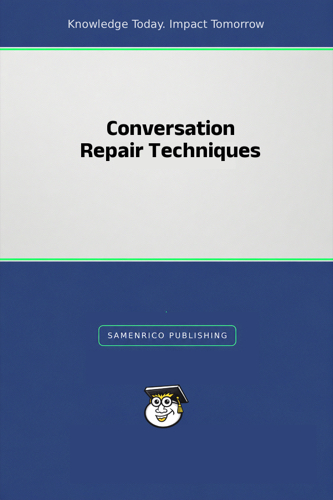
Non-FictionSelf-HelpSocial Resilience
Conversation Repair Techniques
Teaches how to recover from awkward moments and so
Teaches how to recover from awkward moments and social mistakes without spiraling into shame or withdrawal.
Formats
About this book
Free sample
Chapter 1: The Spiral Interrupted--You have just said something wrong. Perhaps you called a longtime colleague by the wrong name. Maybe you made a joke that landed like a lead balloon. Or you shared an opinion that, the moment it left your mouth, you realized was deeply insensitive. In the span of a single heartbeat, your face flushes, your stomach drops, and a voice inside your head begins its familiar, merciless monologue: Why did you say that?
Everyone is staring. You always do this. What is wrong with you?This is the conversation crash. And what happens in the next ten seconds will determine whether you spiral into shame or pivot into repair.Most people, when they feel that internal collision, choose one of three responses. They freeze, hoping the moment will pass if they stay very still.
They flee, changing the subject or physically withdrawing from the conversation. Or they overcompensate, pouring out a flood of apologies that only makes everyone more uncomfortable. Each of these responses is an attempt to escape the discomfort of having been imperfect in front of other people. And each of them, paradoxically, makes the original mistake worse.This book is built on a counterintuitive premise: the mistake is not the problem. The avoidance of the mistake is the problem.
And the shame that follows the mistake is the real relationship killer.The Critical Distinction: Guilt Versus Shame Let us be clear about what we mean by shame, because this distinction will shape every chapter that follows. Shame is not the same as guilt. Guilt says, I did something bad. It focuses on behavior. Guilt is uncomfortable, but it is also useful—it motivates us to apologize, to make amends, to do better next time.
Shame says, I am bad. It focuses on identity. Shame is not useful. It does not motivate repair; it motivates hiding. When you feel guilt, you want to fix what you broke.
When you feel shame, you want to disappear.The great tragedy of social mistakes is not that we make them. Everyone makes them. The tragedy is that we mistake…
This is the end of the free sample. Get the eBook to keep going. Buy now
Contents
- Chapter 1
- Chapter 2
- Chapter 3
- Chapter 4
- Chapter 5
- Chapter 6
- Chapter 7
- Chapter 8
- Chapter 9
- Chapter 10
- Chapter 11
- Chapter 12
Details
- Author
- Garris Barabara
- Publisher
- SamEnrico
- Language
- English
- Genre
- Non-Fiction, Self-Help, Social Resilience
- Released
- 2026-06-07
- Pages (approx.)
- 130
- Available as
- eBook, Audiobook

Read better in the ZLOADR app
Your eBooks on your phone or tablet. Sign in with your SamEnrico account and start reading.
More by Garris Barabara
 Customer Service De escalationGarris Barabara$11.99
 Spin Class Recovery Nutrition WorkbookGarris Barabara$11.99
 The Golfer Mental GameGarris Barabara$11.99
 Antwerp Diamond Heist Surveillance TapesGarris Barabara$11.99
 Whistling in the Dark: The Untold Story of the First Animal SpyGarris Barabara$11.99
 The Last Words of Cleopatra: Secrets in the SandsGarris Barabara$11.99
 Understanding Diaphragmatic Agenesis Radial Aplasia OmphaloceleGarris Barabara$17.99
 How to Start a Powders for Cosmetic or Toilet Use (commission Agent) Business (Beginners Guide)Garris Barabara$11.99
 CTA For Real Estate EntitiesGarris Barabara$12.99
 Delaware BOI Rules GuideGarris Barabara$12.99
 AI-Driven Corporate Finance SolutionsGarris Barabara$11.99
You may also like
 Hong Kong Handover 1997Dunn Johnnie$11.99
 Zumba For Postnatal Recovery CourseNeal Christian$11.99
 Zumba for BeginnersLadner Nikia$11.99
 YouTube Comment Mining GuideHumes Pandora$12.99
 Worry Box MeditationCarlin Rudy$11.99
 Workplace Stress MeditationNguyen Lynn$11.99
 Workplace Stress and Sleep RepairHawley Ivory$11.99
 Workplace Perfectionism CureDelaney Jeffry$11.99
 Workplace Injustice Anger GuideWallen Isabelle$11.99
 Work Addiction and Burnout LinkGreenwood Ester$11.99
 Women in Yoga and WellnessBeattie Galina$11.99
 Women in Stand Up ComedyChun Evangeline$11.99