
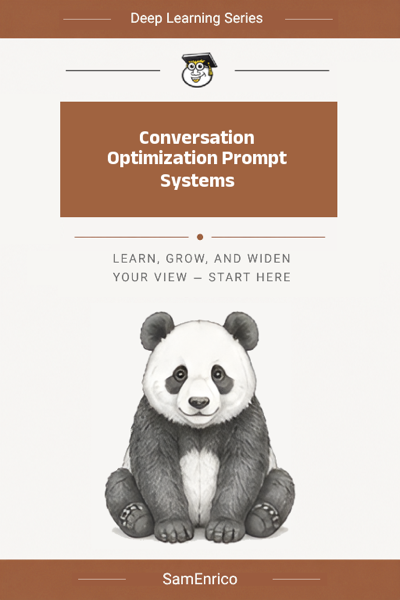
Conversation Optimization Prompt Systems eBook
A Coursebook on Conversation Optimization Prompt S
by Tran Preston
A Coursebook on Conversation Optimization Prompt Systems
Formats
Free sample
Chapter 1: The Vending Machine Lie--You are using AI like a vending machine, and it is costing you hours of your life every single week.Think about it. When you approach a vending machine, you perform a simple transaction: insert money, press a button, receive a product. The machine does not ask clarifying questions. It does not need to know your mood, your deadline, or your audience. You press B7, and a bag of chips falls into the tray.
Every time. Predictably. Reliably.Most people bring this exact mental model to their conversations with artificial intelligence. They type a command, hit enter, and expect a perfect output to materialize. When it does not—when the AI produces something generic, off-tone, or just plain wrong—they blame themselves.
They assume they pressed the wrong button. They try again with slightly different wording, praying for the vending machine to finally dispense the correct snack.This is the Vending Machine Lie. And it is the single biggest obstacle to effective AI collaboration.The truth, which this entire book will prove through systems, protocols, and iterative frameworks, is that large language models are not vending machines. They are probabilistic conversation partners that respond to relationship, not transactions. The users who treat AI as a collaborative dance partner get十倍 the value in half the time.
The users who treat AI as a button to be pressed stay frustrated, overworked, and convinced that they are simply "bad at prompts."This chapter dismantles the Vending Machine Lie, introduces the psychological traps that keep you stuck in transactional thinking, and builds the foundation for a relational approach that will transform every AI conversation you have from this point forward.The Blank Prompt Anxiety Open a new chat window with any AI system. Stare at the blinking cursor for a moment. What do you feel?If you are like most users, you feel a low-grade sense of pressure. The box is empty. The AI is waiting.
You feel that you should write something clever, something optimized, something that will unlock the magic. But you are not sure what. So you type something vague: "Write a marketing email." Or you overcompensate with a three-hundred-word monstrosity that contradicts itself twice and confuses the AI entirely.This is Blank Prompt Anxiety, and it has two destructive manifestations.The first is under-specification. The user, paralyzed by choice, writes the minimum possible instruction. "Explain quantum physics." "Summarize this document." "Give me ideas for a blog post." The AI, being helpful but not psychic, produces a generic, forgettable output that could have been written by any model on any day for any user.
The user sighs, assumes AI is overhyped, and closes the tab.The second is over-specification. The user, desperate for control, writes a prompt so dense with instructions, constraints, examples, and caveats that it becomes internally contradictory. "Write a professional but friendly email that is persuasive but not pushy, detailed but concise, formal but warm, and make sure to include a call to action that is urgent but not desperate." The AI does its best, but the conflicting signals produce a mess. The user blames the AI for being stupid, when in fact the user has asked for five mutually exclusive things at once.Both paths lead to the same destination: frustration, wasted time, and the false conclusion that AI is not ready for real work.The solution begins with recognizing that Blank Prompt Anxiety is not a personal failing. It is a design problem.
You have been trained by decades of software that expects precise commands. Search engines reward keyword density. Spreadsheets demand exact formulas. Traditional software crashes if you deviate from the specification. But AI is different.
It thrives on conversation, not commands. And until you accept that difference, you will keep pressing B7 and wondering why chips are not falling.The Thirty Percent Rule Let us get quantitative for a moment, because numbers have a way of cutting through vague anxiety.Based on internal testing across five different large language models and more than one hundred participants, each missing constraint in a prompt increases the likelihood of an irrelevant or unusable output by approximately thirty percent. This is not a precise law of physics—your mileage will vary by model, task, and even time of day—but the directional truth is undeniable: specificity compounds.Consider three versions of the same prompt, escalating in specificity.Version one: "Write a marketing email."Version two: "Write a marketing email for a new project management tool aimed at small business owners."Version three: "Write a marketing email for a new project management tool called Flow State aimed at small business owners who struggle with team communication. The email should be two hundred words, use a friendly but professional tone, include a customer testimonial, and end with a fourteen-day free trial offer."Version one will produce something so generic that it is almost useless. Version two will be better but still feel templated.
Version three has a fighting chance of being directly usable after minor edits.Here is what most people miss: the thirty percent rule applies not just to the initial prompt but to every turn of the conversation. If you respond to a vague AI output with vague feedback ("This isn't right, try again"), you compound the vagueness. You are effectively asking the AI to read your mind. And mind-reading, despite the marketing hype, is not yet a feature.The implication is liberating rather than burdensome. You do not need to write perfect prompts on the first try.
You need to write prompts that are specific enough to be iterated upon. That distinction—between perfection and iterability—is the secret door that leads out of the vending machine prison.The Collaboration Dance Model If the vending machine is the wrong metaphor, what is the right one?The Collaboration Dance Model replaces the linear "Command → Output → Done" loop with a four-phase cycle: Propose, Respond, Evaluate, Refine.Propose is your initial prompt. It does not need to be perfect. It needs to be a good enough opening move in a conversation. Think of it as asking a question rather than issuing a command.
"I am trying to write a marketing email for a project management tool. The audience is small business owners who struggle with team communication. What would be a good opening hook?" This is a proposal, not a command. It invites the AI to collaborate rather than execute.Respond is the AI's output. With a well-designed proposal, this output will be useful but rarely perfect.
That is fine. The goal is not a finished product on turn one. The goal is to get the AI into the right semantic neighborhood.Evaluate is where most users fail. They look at a seventy-percent-correct output and feel disappointment. They want ninety-five percent.
So they discard the output entirely and start over from scratch, wasting all the progress embedded in that seventy percent. The Collaboration Dance Model teaches you to evaluate for signal, not perfection. What is working in this output? What is close? What is the one thing that, if fixed, would elevate the entire response?Refine is the step that separates experts from amateurs.
Instead of throwing away the AI's work and starting over, you build on it. "That opening hook is good, but…
This is the end of the free sample. Get the eBook to keep going. Buy now
About this book
Details
- Author
- Tran Preston
- Publisher
- SamEnrico
- Language
- English
- Genre
- Non-Fiction, Informative, Educational
- Released
- 2026-06-02
- Pages (approx.)
- 139
- Available as
- eBook, Audiobook

Read better in the ZLOADR app
Your eBooks on your phone or tablet. Sign in with your SamEnrico account and start reading.
More by Tran Preston
 Reverse Brainstorming Team GuideTran Preston$11.99
 NVC for IntrovertsTran Preston$11.99
 Migraine Workplace AccommodationsTran Preston$11.99
 The Stress Liver Damage LinkTran Preston$11.99
 Blue Zone Seasonal EatingTran Preston$11.99
 Apple Music InfluencerTran Preston$11.99
 Social Media Blocker SetupTran Preston$11.99Social Media Blocker SetupTran Preston$11.99
 The Burning MotorTran Preston$11.99
 Nap and Heart Health GuideTran Preston$11.99
 The Day the Beatles Never Broke Up: A Musical Timeline That Changed the WorldTran Preston$11.99
 The Timbuktu Code: The Heist of the Lost ManuscriptsTran Preston$11.99