
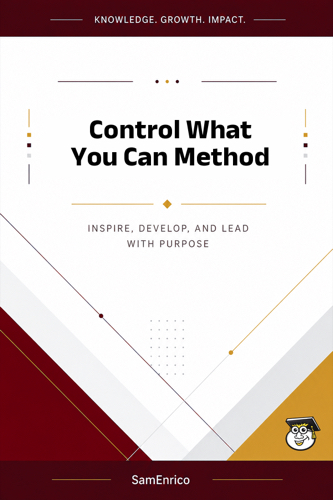
Non-FictionSelf-HelpLocus of Control
Control What You Can Method eBook
Teaches radical acceptance and focus on controllab
Teaches radical acceptance and focus on controllable factors to reduce burnout from helplessness.
Formats
Free sample
Chapter 1: The Prediction Trap--–- You are reading this because you are exhausted from caring. Not from laziness. Not from weakness. From caring too much about things you were never meant to control.Let me describe a morning that might feel familiar.Your alarm goes off at 6:15 a.m. Before you sit up, you reach for your phone.
Three news notifications. Two emails from your boss sent at 11:47 p.m. One text from a friend who is upset about something you cannot fix. Your heart rate increases before your feet touch the floor. By 6:18 a.m., you are already behind.
Already failing. Already carrying the weight of problems you did not create and cannot solve.This is not a moral failing. It is a neurological design flaw.Your brain has a prediction engine. It is a magnificent piece of biological engineering—honed over millions of years to keep you alive in a world of predators, scarcity, and sudden threats. The prediction engine constantly asks one question: What is about to happen next, and can I stop the bad version?When your ancestors heard rustling in the grass, the prediction engine said: That might be a lion.
Run now. It did not wait for certainty. It did not ask for 98 percent confidence. It acted. And that hair-trigger system kept your lineage alive long enough for you to be born.But here is the problem.
You do not live in the savanna. You live in a world of delayed email responses, passive-aggressive Slack messages, climate change forecasts, political chaos, and social media comparisons that never end. Your prediction engine cannot tell the difference between a lion in the grass and a text message left on read. To your amygdala, uncertainty is uncertainty. Threat is threat.
And the only tool the prediction engine has is the same one it has always had: Try to control the outcome.So you do. You try to control your boss’s mood by overworking. You try to control your partner’s feelings by walking on eggshells. You try to control your children’s futures by obsessing over their homework. You try to control your health by researching symptoms at 2 a.m.
You try to control the news cycle by refreshing. You try to control the past by replaying conversations in your head, searching for the perfect thing you should have said.None of it works. But you keep doing it, because the alternative—admitting that you cannot control these things—feels like death. Not literal death, but something close: helplessness. And your brain has evolved to treat helplessness as an existential threat.This is the Prediction Trap.
It is the gap between what your brain thinks you can control and what you can actually control. And that gap is where burnout lives.The Invention of Total Control Let me ask you a strange question. When did you first believe that you should be able to control everything?For most people, the answer is: I never consciously decided that. It just feels true.That feeling is not truth. It is the residue of thousands of small cultural messages, repeated so often that they have become invisible.
Consider what you have been taught:"If you want something done right, do it yourself.""Where there’s a will, there’s a way.""You can achieve anything if you work hard enough.""Don’t be a victim. Take control of your life."Each of these sayings contains a kernel of useful truth. Effort matters. Agency matters. Personal responsibility matters.
But notice what happens when you apply these sayings to situations you genuinely cannot control.Try this experiment: Stand in front of a wall. Say to the wall: "If I want you to move, I can make you move if I try hard enough." The wall will not move. And no amount of effort, positive thinking, or determination will change that. You know this. You accept it.
You do not lie awake at night feeling guilty about the wall’s unwillingness to relocate.Now think about something you have been trying to control. A person who will not change. A health outcome that is already decided. A past mistake that cannot be undone. An economic condition you did not create.
A family member who refuses your advice.Why do you accept the wall’s immovability but not the person’s? Why do you accept gravity but not grief? Why do you accept weather but not the passage of time?Because you have been taught a lie. The lie is that sufficient effort can overcome any constraint. This lie is seductive because it promises safety.
If you can control everything, you never have to feel helpless. You never have to feel afraid. You just have to try harder.But the lie has a cost. And the cost is your life.The Hidden Cost of "If Only I Try Harder"Let me introduce you to a concept called over-effort. It is distinct from healthy effort in one critical way: healthy effort is directed at controllable variables, while over-effort is directed at uncontrollable ones.Here is how they differ in daily life.Healthy effort: You study for an exam.
You cannot control what questions appear, but you can control how many hours you prepare. You take the exam. You do not ruminate afterward. You did your part.Over-effort: You study for an exam. You also try to control the professor’s grading tendencies, the performance of other students, the exact wording of questions, the temperature of the exam room, and your own anxiety level.
You study fourteen hours a day. You still feel unprepared. After the exam, you replay every question, searching for mistakes you cannot change.Healthy effort: You express your feelings to a partner. You cannot control their response, but you can control your honesty and timing. Whatever they say next, you know you showed up authentically.Over-effort: You try to predict your partner’s reaction before you speak.
You rehearse thirty different versions of the conversation. You monitor their facial expressions for signs of disapproval. After the conversation, you replay what you should have said differently. You feel responsible for their emotional state.Healthy effort: You apply for a job. You tailor your resume.
You prepare for the interview. You cannot control whether they hire you, but you control your preparation.Over-effort: You obsess over the status of your application. You check your email forty times a day. You try to read the interviewer’s mind. You convince yourself that if you had phrased one answer differently, you would have gotten the job.
Six months later, you are still replaying that interview.Do you see the pattern? Over-effort is not more effort. It is misplaced effort. It is effort aimed at targets that do not respond to effort.The cost of over-effort is not just wasted energy. It is a specific form of psychological damage that researchers call learned helplessness.
This is the name for what happens when you repeatedly try to control the uncontrollable and fail. Your brain learns a devastating lesson: Nothing I do matters. Not because it is true, but because you have been aiming at the wrong targets.Here…
This is the end of the free sample. Get the eBook to keep going. Buy now
About this book
Details
- Author
- Calcagno Ellsworth
- Publisher
- SamEnrico
- Language
- English
- Genre
- Non-Fiction, Self-Help, Locus of Control
- Released
- 2026-06-10
- Pages (approx.)
- 146
- Available as
- eBook, Audiobook

Read better in the ZLOADR app
Your eBooks on your phone or tablet. Sign in with your SamEnrico account and start reading.
More by Calcagno Ellsworth
 Exam Week Survival GuideCalcagno Ellsworth$11.99
 NFT Market SentimentCalcagno Ellsworth$11.99
 Overcoming Loneliness JournalCalcagno Ellsworth$11.99
 The Untold Tales of The Doug Anthony Allstars: Australia’s Wildest Improv RevolutionCalcagno Ellsworth$11.99
 How to Produce Baby MobilesCalcagno Ellsworth$11.99
 Pizza Team Scrum GuideCalcagno Ellsworth$12.99
 Service Desk SpecialistCalcagno Ellsworth$11.99
 Ultimate Handbook Guide to Changzhi : (China) Travel GuideCalcagno Ellsworth$11.99
You may also like
 Hong Kong Handover 1997Dunn Johnnie$11.99
 Zumba For Postnatal Recovery CourseNeal Christian$11.99
 Zumba for BeginnersLadner Nikia$11.99
 YouTube Comment Mining GuideHumes Pandora$12.99
 Worry Box MeditationCarlin Rudy$11.99
 Workplace Stress MeditationNguyen Lynn$11.99
 Workplace Stress and Sleep RepairHawley Ivory$11.99
 Workplace Perfectionism CureDelaney Jeffry$11.99
 Workplace Injustice Anger GuideWallen Isabelle$11.99
 Work Addiction and Burnout LinkGreenwood Ester$11.99
 Women in Yoga and WellnessBeattie Galina$11.99
 Women in Stand Up ComedyChun Evangeline$11.99