
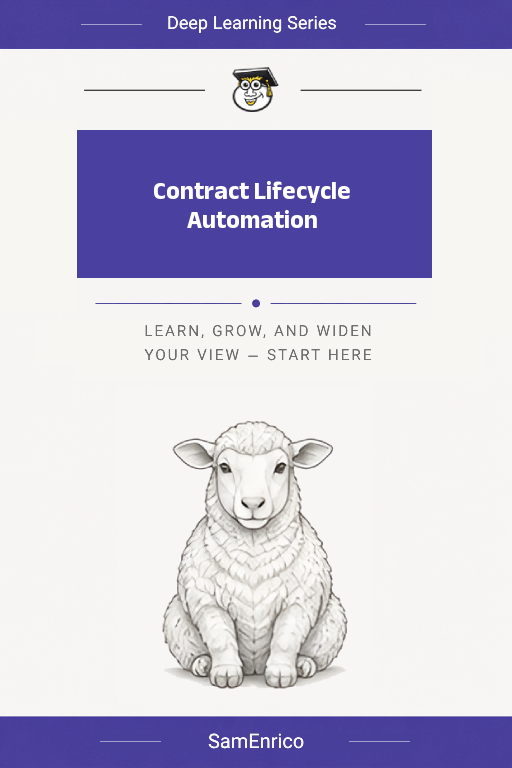
Non-FictionOperational Efficiency ManualContract Management
Contract Lifecycle Automation eBook
Automates contract creation, approval, negotiation
Automates contract creation, approval, negotiation, and renewal processes using templates and digital signature tools.
Formats
Free sample
Chapter 1: The Hidden Factory--–- Every business has one. A secret, invisible operation running inside the walls, consuming time, burning money, and frustrating employees—yet no one ever budgets for it, no one measures its output, and no one is held accountable for its inefficiency. It is called the hidden factory, and in most organizations, it lives inside the contracting process.The term "hidden factory" originated in manufacturing to describe the unbilled, unmeasured work that happens after a product leaves the assembly line—rework, inspection, defect correction. But today, the most expensive hidden factory is not on the shop floor. It is inside your email inbox, your shared drive, and the seventeen versions of the same contract floating between legal, sales, and procurement.Contracts are the operating system of commerce.
Every revenue transaction, every supplier relationship, every partnership, every hire, every lease—they all run on contracts. Yet most organizations treat contracting as an afterthought, a necessary evil, a cost of doing business rather than a source of competitive advantage. The result is a process so fragmented, so manual, and so resistant to improvement that it quietly destroys value every single day.This chapter reveals the true cost of manual contracting. It introduces the six pillars of automation that will serve as the foundation for the rest of this book. And it makes the case that transforming your contracting process from a hidden factory into a strategic asset is not just possible—it is essential for survival in an era of digital acceleration.The Billion-Dollar Black Hole Let us start with a number: 9.2 percent.According to the World Commerce and Contracting's annual benchmark study, companies lose an average of 9.2 percent of contract value through inefficiencies in the contracting process.
That is not a typo. Nearly one tenth of the value of every agreement is eroded before the ink dries—or in many cases, before the ink ever makes it to the page.Consider what 9.2 percent means for a typical mid-sized company with 100millioninannualrevenue.Thatis100 million in annual revenue. That is 100millioninannualrevenue.Thatis9.2 million vanishing into the hidden factory every year. For a Fortune 500 company with 10billioninrevenue,thenumberapproaches10 billion in revenue, the number approaches 10billioninrevenue,thenumberapproaches1 billion. Not in one-time savings or theoretical upside, but in actual, measurable leakage that flows directly to the bottom line—or more accurately, away from it.Where does this money go?
It leaks through four primary channels.First, delayed revenue. Every day a contract sits in an inbox waiting for approval is a day that revenue is not recognized, not billed, not collected. For a software company with 1millionindailycontractvalue,afive−dayapprovaldelaycosts1 million in daily contract value, a five-day approval delay costs 1millionindailycontractvalue,afive−dayapprovaldelaycosts5 million in deferred revenue—and that is before accounting for the risk that the deal dies entirely.Second, missed renewals. Automatic renewals are the silent killer of contract value. Companies routinely auto-renew contracts for years—sometimes decades—because no one set a reminder to renegotiate or terminate.
A single missed renewal on a 500,000softwarelicensecosts500,000 software license costs 500,000softwarelicensecosts500,000. Most companies have dozens or hundreds of these ticking time bombs in their contract portfolio.Third, unmanaged compliance. When contracts are scattered across shared drives and email folders, no one knows what has been promised to whom. Discounts are given twice. Volume commitments are missed.
Service level penalties go unenforced. Indemnification caps are exceeded. Each of these failures is a small leak, but together they form a flood.Fourth, opportunity cost. This is the largest and most invisible channel. Every hour a salesperson spends chasing approvals is an hour not spent selling.
Every hour a legal professional spends reviewing a routine NDA is an hour not spent on strategic advice. Every hour a procurement manager spends reconciling contract versions is an hour not spent on supplier innovation. The hidden factory consumes not just money, but potential.The Anatomy of Chaos To understand why manual contracting is so expensive, you must understand how it actually works in most organizations. Not the idealized process documented in the policy manual, but the real process that happens every day.The typical manual contracting process follows a predictable pattern of failure.A sales representative closes a deal. She needs a contract signed.
She emails legal. No response. She emails again. Legal responds: "Use the template in the shared drive." She opens the shared drive. There are forty-seven templates, none labeled clearly.
She guesses. She fills in the blanks. She emails the draft to the customer.The customer redlines. They send back a Word document with Track Changes turned on. The sales rep cannot tell what changed.
She forwards to legal. Legal takes three days to respond. Legal makes changes. The sales rep sends back to the customer. The customer makes more changes.
This cycle repeats four times over two weeks.Finally, everyone agrees. The sales rep prints the contract, signs it, scans it, emails it. The customer prints, signs, scans, emails back. The sales rep saves the PDF to the shared drive. Six months later, no one can find the contract.
The customer exercises a renewal clause that no one remembered existed. The company pays for another year.This story is not an exaggeration. It is the median experience in thousands of organizations. Let us name the specific failure modes so we can recognize them in our own processes.Version Control Nightmare. The same contract exists in seventeen places: three email inboxes, two shared drive folders, four local hard drives, and eight versions on a collaboration platform.
No one knows which is the latest. The signature page belongs to version three, but the terms are from version seven. This is not a process problem. It is a disaster waiting for a lawsuit.Email as Workflow. The approval chain exists entirely in email CC lines.
"Can you approve?" "Forwarded to finance." "What is the status?" "I thought you approved it." "No, I approved the previous version." There is no visibility. There is no accountability. There is only the illusion of progress.The Black Hole of Legal Review. Contracts disappear into legal and emerge days or weeks later, transformed but with no explanation of what changed or why. Sales reps learn to send contracts early "just in case," which clogs the queue further.
Legal professionals, overwhelmed by volume, cannot provide the strategic counsel they were trained to deliver.Template Chaos. Every contract is a snowflake, unique and unrepeatable. Even when templates exist, no one enforces their use. Sales reps copy from previous deals. Legal rewrites from scratch.
Procurement imports supplier paper. The result is a portfolio of agreements that cannot be compared, analyzed, or managed at scale.The Post-Signature Void. Once the contract is signed, it enters a black hole. No one tracks obligations. No one calendars renewals.
No one enforces performance. The contract exists only as a PDF that no one will read again until something goes wrong. By then, it is too late.These failure modes are not technical problems. They are not software problems. They are process and behavior problems—and they are solvable.The Six Pillars of Automation The remainder of this book builds on a single framework: the Six Pillars of Contract Lifecycle Automation.
Every pillar addresses one of the failure modes described above. Together, they form a complete system for transforming contracting from…
This is the end of the free sample. Get the eBook to keep going. Buy now
About this book
Details
- Author
- Otero Angelia
- Publisher
- SamEnrico
- Language
- English
- Genre
- Non-Fiction, Operational Efficiency Manual, Contract Management
- Released
- 2026-05-29
- Pages (approx.)
- 147
- Available as
- eBook, Audiobook

Read better in the ZLOADR app
Your eBooks on your phone or tablet. Sign in with your SamEnrico account and start reading.
More by Otero Angelia
 Mindful Commute HandbookOtero Angelia$11.99
 Goodbye Dear Friend GuideOtero Angelia$11.99
 The Anticipatory Complicated Grief GuideOtero Angelia$11.99
 The Empathy for Partners GuideOtero Angelia$11.99
 Nurse Creative GuideOtero Angelia$11.99
 Blood and Blossoms: The Forbidden Love of Empress Wu ZetianOtero Angelia$11.99
 Understanding Stickler Syndrome, Type 2Otero Angelia$17.99
 How to Become a Pipe StripperOtero Angelia$11.99
 Time Tracking AI GuideOtero Angelia$12.99
 Chantecler Chicken BreedingOtero Angelia$11.99
You may also like
 Hong Kong Handover 1997Dunn Johnnie$11.99
 Zumba For Postnatal Recovery CourseNeal Christian$11.99
 Zumba for BeginnersLadner Nikia$11.99
 YouTube Comment Mining GuideHumes Pandora$12.99
 Worry Box MeditationCarlin Rudy$11.99
 Workplace Stress MeditationNguyen Lynn$11.99
 Workplace Stress and Sleep RepairHawley Ivory$11.99
 Workplace Perfectionism CureDelaney Jeffry$11.99
 Workplace Injustice Anger GuideWallen Isabelle$11.99
 Work Addiction and Burnout LinkGreenwood Ester$11.99
 Women in Yoga and WellnessBeattie Galina$11.99
 Women in Stand Up ComedyChun Evangeline$11.99