
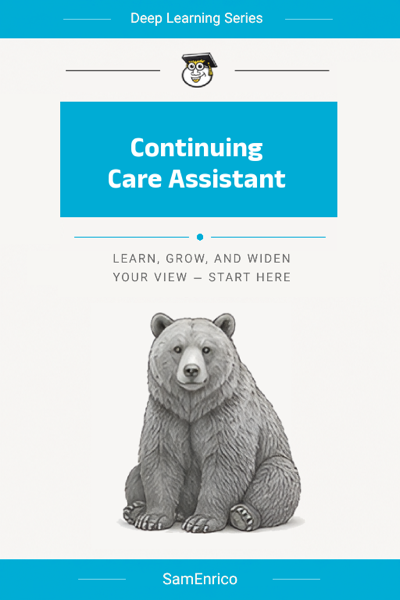
Non-FictionInformativeEducational
Continuing Care Assistant eBook
A Coursebook on Continuing Care Assistant
by Dodson Meda
A Coursebook on Continuing Care Assistant
Formats
Free sample
Chapter 1: The Invisible Backbone...--– The alarm blares at 6:00 AM. For Maria, a Continuing Care Assistant (CCA) with twelve years of experience, the sound is not an interruption—it is a summons. She rolls out of bed, her feet finding the floor with the automatic precision of someone who has done this thousands of times before. By 6:45 AM, she is walking through the doors of the Mapleton Long-Term Care Home, where twenty-three residents will rely on her hands, her eyes, her patience, and her professional judgment over the next twelve hours. By 7:15 AM, she is helping Mrs.
Kovacs, who has advanced Parkinson's disease, sit up in bed and wash her face. By 8:00 AM, she is feeding Mr. Chen, who has dysphagia following a stroke, one small spoonful at a time, watching for the subtle chin-tuck that protects his airway. By 10:00 AM, she is walking alongside Mrs. O'Brien, whose dementia makes her believe she is late for work at a factory that closed thirty years ago, and Maria does not correct her—instead, she walks beside her, validating the feeling while ensuring she does not wander toward the exit door.This is the invisible backbone of healthcare.
Not the surgeons with their dramatic life-saving operations. Not the emergency room physicians featured on television dramas. Not the researchers developing breakthrough medications. The backbone is Maria. It is the CCA who knows that Mrs.
Kovacs prefers her tea lukewarm, that Mr. Chen becomes agitated if rushed, and that Mrs. O'Brien's sundowning begins precisely at 4:30 PM unless she has had a restful afternoon. The CCA is the person who spends more time with the client than any other healthcare professional. The CCA is the eyes and ears of the care team, the first to notice that a pressure injury is forming on a heel, that a client's breathing has become labored, that a normally cheerful resident has become withdrawn and tearful.
And yet, despite this essential role, the CCA is often the least visible, the least understood, and the most undervalued member of the healthcare hierarchy.This chapter exists to change that. Before you learn the clinical skills of bathing and feeding, before you master the technical procedures of vital signs and catheter care, you must first understand who you are becoming. You are not merely a task-doer. You are not a pair of hands that follows orders without thinking. You are a Continuing Care Assistant—a professional with a defined scope of practice, legal responsibilities, ethical obligations, and a unique position within the healthcare team.
This chapter establishes the foundation upon which every subsequent skill will be built. Without understanding your role, your boundaries, and your relationships with other healthcare professionals, the most perfect bed bath or the most accurate blood pressure reading is meaningless—or worse, dangerous.In this chapter, you will learn the legal definition of the CCA's scope of practice, the specific tasks you are authorized to perform and those that are prohibited. You will understand the three primary settings in which CCAs work—long-term care, home care, and acute care—and how the demands of each setting shape your daily work. You will differentiate between the roles of CCAs, Licensed Practical Nurses (LPNs), and Registered Nurses (RNs), learning where your responsibilities end and theirs begin. You will master the critical distinction between delegation (a nurse transferring a specific task to you) and assignment (routine tasks within your scope that do not require specific delegation).
And you will learn the chain of command—the formal pathway through which you report concerns, seek guidance, and escalate issues when necessary.By the end of this chapter, you will no longer see yourself as "just a CCA." You will see yourself as a professional. And you will understand that the invisible backbone of healthcare is not invisible because it is unimportant—it is invisible because it is so constant, so reliable, so foundational that the entire system would collapse without it. You are about to become that backbone. Let us begin.Defining the Role: What Is a Continuing Care Assistant?The title "Continuing Care Assistant" carries different names across different regions. In some provinces, you may be called a Personal Support Worker (PSW).
In others, a Nursing Assistant (NA) or a Health Care Aide (HCA). Regardless of the label, the core of the role remains consistent: the CCA provides direct personal care and support to individuals who require assistance due to aging, illness, injury, or disability. This care is not limited to physical tasks—it encompasses emotional support, observation, reporting, and the preservation of dignity.The scope of practice is the most important concept you will learn in your entire career. Scope of practice refers to the legally and professionally defined boundaries of what a CCA is authorized to do. These boundaries are not arbitrary; they exist to protect clients from harm and to ensure that care is provided only by individuals who have demonstrated the necessary competence.
When you work outside your scope of practice—performing a task you have not been trained for, or a task legally reserved for a nurse or physician—you are not being "helpful." You are being dangerous. You are also placing your certification, your employment, and potentially your clients' lives at risk.The CCA's scope of practice includes, but is not limited to, the following authorized tasks:Personal care and Activities of Daily Living (ADLs): Bathing, oral care, grooming, dressing, toileting, perineal care, and mobility assistance Vital signs measurement: Temperature (oral, axillary, tympanic), pulse (radial and apical), respiration, blood pressure (manual and automatic), pain assessment, and oxygen saturation (Sp O2)Nutrition and hydration: Feeding dependent clients, serving meal trays, recording intake and output, and assisting with fluids Elimination support: Bedpan and urinal use, basic catheter care (cleaning around the meatus, emptying drainage bags), and basic ostomy care (emptying pouches)Mobility and transfers: Using gait belts, mechanical lifts (Hoyer, sit-to-stand), pivot transfers, and two-person lifts Skin care: Inspecting for pressure injuries, applying creams and lotions as directed, and basic foot care (filing, not cutting, for diabetic clients)Household management (home care only): Light cleaning, laundry, meal preparation, and grocery shopping Observation and reporting: Monitoring changes in condition, documenting objectively, and reporting using SBAR (Situation, Background, Assessment, Recommendation)Medication assistance (limited): Reminding clients when it is time for medication, opening bottles (if the client requests), positioning the client for swallowing, and reporting missed doses or side effects. Note: CCAs do NOT administer medication (placing it in the mouth or on the skin), draw up liquid medicine, crush pills, or decide to skip doses.The CCA's scope of practice explicitly prohibits the following tasks unless specific delegation and additional training have been provided (and even then, some tasks are never permitted):Medication administration (placing medication in the client's mouth or on their skin)Sterile procedures (wound packing, sterile catheter insertion)Injections (subcutaneous, intramuscular, or intravenous)Inserting or removing tubes (nasogastric tubes, urinary catheters—removal may be delegated in some jurisdictions but is not universal)Wound care beyond simple dressing changes (and those only if delegated and trained)Diagnosing conditions or interpreting lab results Prescribing or adjusting treatments Performing surgical or invasive procedures The key takeaway: know your scope, and live within it. When a client or family member asks you to do something outside your…
This is the end of the free sample. Get the eBook to keep going. Buy now
About this book
Details
- Author
- Dodson Meda
- Publisher
- SamEnrico
- Language
- English
- Genre
- Non-Fiction, Informative, Educational
- Released
- 2026-05-04
- Pages (approx.)
- 160
- Available as
- eBook, Audiobook

Read better in the ZLOADR app
Your eBooks on your phone or tablet. Sign in with your SamEnrico account and start reading.
More by Dodson Meda
 Bipolar And Thyroid FunctionDodson Meda$11.99
 Open Source Dependency RisksDodson Meda$11.99
 The Teen Immigrant Confidence GuideDodson Meda$11.99
 Imposter Syndrome Peer SupportDodson Meda$11.99
 The Food Addiction Sleep Link GuideDodson Meda$11.99
 The Forgotten Ice Warriors: Japan's First Hockey Pioneers and the Birth of a Winter Sport (1880s)Dodson Meda$11.99
 Executive Summary Template HandbookDodson Meda$12.99
 Australia Export Green GuideDodson Meda$12.99
 Understanding Primary HyperoxaluriaDodson Meda$17.99
 A Beginners Guide to Five-a-side football (Volume 1)Dodson Meda$11.99
You may also like
 Hong Kong Handover 1997Dunn Johnnie$11.99
 Zumba For Postnatal Recovery CourseNeal Christian$11.99
 Zumba for BeginnersLadner Nikia$11.99
 YouTube Comment Mining GuideHumes Pandora$12.99
 Worry Box MeditationCarlin Rudy$11.99
 Workplace Stress MeditationNguyen Lynn$11.99
 Workplace Stress and Sleep RepairHawley Ivory$11.99
 Workplace Perfectionism CureDelaney Jeffry$11.99
 Workplace Injustice Anger GuideWallen Isabelle$11.99
 Work Addiction and Burnout LinkGreenwood Ester$11.99
 Women in Yoga and WellnessBeattie Galina$11.99
 Women in Stand Up ComedyChun Evangeline$11.99