
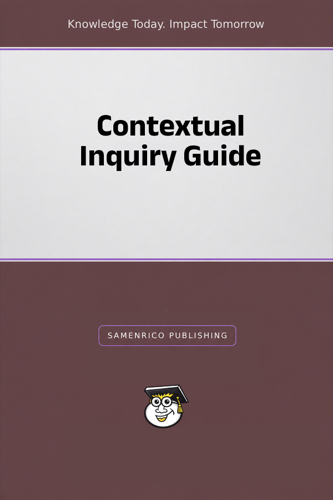
Contextual Inquiry Guide eBook
Interviews users in their own environment.
Interviews users in their own environment.
Formats
Free sample
Chapter 1: The Oracle’s Lie--–- Every year, companies spend billions of dollars asking users what they want. They conduct surveys, assemble focus groups, and bring people into sterile usability labs. And every year, those same companies build products that miss the mark—sometimes by inches, often by miles. The problem is not a lack of effort or budget. The problem is a fundamental misunderstanding of how human beings actually work.
We have been asking the wrong question. We have been asking users to be oracles—to peer into the future of their own behavior and tell us exactly what they will need. But users cannot do this. No one can. And the moment we accept this uncomfortable truth, we open the door to a radically more effective way of designing.The User as Oracle Fallacy The most persistent and damaging myth in product design is the belief that users can accurately articulate their own needs when removed from the context of their actual work.
I call this the "User as Oracle" fallacy. It is the assumption that if you simply ask the right questions, a user will deliver a complete, accurate, and actionable set of requirements. This assumption is seductive because it promises efficiency. You do not need to leave your office. You do not need to observe messy, unpredictable real-world behavior.
You just need a questionnaire and a willing participant.But the Oracle fallacy collapses under the weight of cognitive science. Human memory is not a video recording. It is a reconstructive process. When you ask a user to describe how they perform a task, they do not replay a mental tape. They construct a narrative based on typical cases, recent examples, and their own sense of how things should work.
This narrative is often wrong in ways that matter profoundly.Consider a simple experiment that has been replicated across dozens of domains. Ask someone to describe how they brush their teeth. Most people will give a clean, linear account: I pick up the toothbrush, I apply toothpaste, I brush for two minutes, I rinse, I spit. Now actually watch them brush their teeth. You will observe something different.
They might wet the brush before applying toothpaste. They might brush while walking around the bathroom. They might interrupt themselves to answer a question from a family member. They might brush longer on one side because it feels better. They might rinse the brush and reapply toothpaste halfway through.
The observed behavior is richer, messier, and more truthful than the reported behavior.The stakes are much higher in professional contexts. I once worked with a team designing software for hospital nurses. During interviews in a conference room, nurses described a logical, step-by-step process for documenting patient vitals. They said they recorded temperature, blood pressure, heart rate, and respiratory rate in that exact order, every time. The team was confident they understood the workflow.
Then we actually watched nurses on the floor. What we saw was completely different. Nurses documented vitals in whatever order the patient tolerated. They recorded values on scraps of paper tucked into their pockets before entering them into the system. They skipped certain measurements when a patient was distressed, with the intention of returning later—a return that often did not happen.
They relied on memory for some values and on written notes for others, depending on how many patients they were managing. The conference room narrative was not a lie. It was a useful fiction. But designing from that fiction would have produced software that fought against how nurses actually worked, rather than supporting them.The Oracle fallacy persists because it flatters our need for control. If users could simply tell us what they need, design would be a straightforward process of transcription.
We would not need to venture into chaotic, unpredictable real-world environments. We would not need to confront the gap between what people say and what people do. But that gap is precisely where the most valuable insights live. Closing our eyes to it does not make it disappear. It only ensures that our competitors will discover what we refused to see.The Cold Data Versus Warm Data Distinction To understand why the Oracle fallacy is so damaging, we must distinguish between two fundamentally different kinds of information: cold data and warm data.
This distinction is not about temperature. It is about proximity to the moment of action.Cold data is abstracted away from the context of real work. It includes survey responses, focus group transcripts, diary studies completed after the fact, and retrospective interviews conducted in conference rooms. Cold data tells you what users think they do, what they remember doing, and what they believe is important. Cold data is useful for certain purposes.
It can reveal attitudes, preferences, and self-reported satisfaction. It can help you understand a user's identity and values. But cold data is a poor foundation for designing tools, systems, and environments because it has been filtered through memory, social desirability, and the user's own theories about their behavior.Warm data is collected in the moment, in the actual environment where work happens. It comes from observation, not interrogation. Warm data captures what users actually do, including all the deviations, workarounds, improvisations, and mistakes that cold data smooths over.
Warm data is often uncomfortable because it reveals inefficiency and contradiction. Users do things that seem irrational. They violate their own stated procedures. They rely on hacks and patches that would never appear in a training manual. This discomfort is not a sign that something has gone wrong.
It is a sign that you are finally seeing reality.The difference between cold and warm data is the difference between a map and a territory. A map is useful. It abstracts away complexity to help you navigate. But if you confuse the map for the territory, you will walk into swamps that were never surveyed and miss shortcuts that no cartographer bothered to record. Cold data is the map.
Warm data is the territory.Let me offer a concrete example from my own practice. A financial services company wanted to redesign the software its loan officers used to evaluate applications. The team had already conducted extensive cold data research. They had surveyed hundreds of loan officers about their priorities. They had run focus groups where officers described their decision-making processes.
They had a clear picture of the workflow, complete with flowcharts and time estimates. Everyone felt ready to start designing.Then we conducted contextual inquiry. We sat beside loan officers at their actual desks, watching them process real applications under real time pressure. The warm data told a different story. Officers constantly switched between three different software systems because no single system contained all the information they needed.
They kept handwritten notes on legal pads, then transferred those notes into digital forms—a step that added hours to each workweek. They developed personal systems of color-coded sticky notes to flag applications that required follow-up, because the software had no reliable reminder function. They called colleagues in other departments not because the information was unavailable digitally, but because they trusted a human voice more than a database field.None of this behavior appeared in…
This is the end of the free sample. Get the eBook to keep going. Buy now
About this book
Details
- Author
- Mcadams Eliana
- Publisher
- SamEnrico
- Language
- English
- Genre
- Non-Fiction, Self-Help, Contextual Inquiry
- Released
- 2026-06-06
- Pages (approx.)
- 142
- Available as
- eBook, Audiobook

Read better in the ZLOADR app
Your eBooks on your phone or tablet. Sign in with your SamEnrico account and start reading.
More by Mcadams Eliana
 Neuropathic Pain AssessmentMcadams Eliana$11.99
 Gestalt Dream Work TechniquesMcadams Eliana$11.99
 Postpartum Grandparent GuideMcadams Eliana$11.99
 Eisenhower For Meeting PlanningMcadams Eliana$11.99
 Imposter Syndrome UnmaskedMcadams Eliana$11.99
 MBSR for Chronic Pain GuideMcadams Eliana$11.99
 Sheppard Case Police InvestigationMcadams Eliana$11.99
 Alcohol Recovery Nutrition GuideMcadams Eliana$11.99
 Silicon Shadows: The Unseen War for the Future of AIMcadams Eliana$11.99
 Plastic Dreams: The Rise and Fall of the Rubik's Cube EmpireMcadams Eliana$11.99
 Silk & Steel: The Rise and Fall of the Hanseatic LeagueMcadams Eliana$11.99
 The Dancer's Guide to Cross-step WaltzMcadams Eliana$11.99