
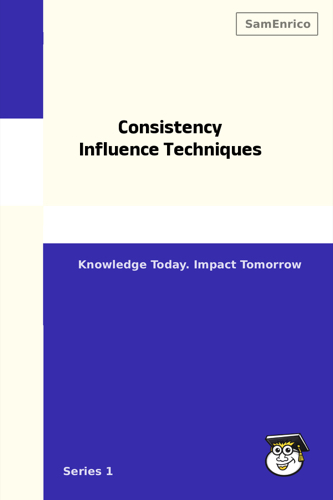
Non-FictionSelf-HelpCommitmentConsistency
Consistency Influence Techniques eBook
Use small initial commitments to lead toward large
Use small initial commitments to lead toward larger desired actions.
Formats
Free sample
Chapter 1: The 5-Cent Yes--–- The homeless man stood at the busy intersection, cardboard sign in hand. But he wasn't asking for money. He was asking for high-fives. And something extraordinary happened. Eighty percent of drivers who rolled down their windows gave him a high-five.
Then he spoke: "Since we're already friends, could you spare a dollar?" His conversion rate that afternoon was thirty-four percent—higher than any direct mail campaign in the history of the children's hospital he was actually fundraising for. He wasn't homeless. He was a professional fundraiser. And he understood a secret that most salespeople, marketers, and leaders never learn: the smallest possible "yes" is worth more than the most persuasive "please."This is the foot-in-the-door effect. It is the most replicated, most reliable, and most underestimated principle of influence in the behavioral sciences.
And this book exists because almost everyone uses it backward.You have been taught to lead with value. Show them the benefits. Build a compelling case. Overcome objections. Ask for the sale.
But the data says something else entirely. The data says that people do not say yes because you convinced them. People say yes because they have already said yes to something smaller. The commitment comes first. The belief follows.Consider the classic study that started everything.
In 1966, psychologists Jonathan Freedman and Scott Fraser walked into a neighborhood in California. They asked homeowners if they would allow a massive, ugly billboard to be installed on their front lawn. The billboard read "DRIVE CAREFULLY" in letters three feet high. It would block their view, ruin their curb appeal, and announce to every neighbor that they were the kind of people who allowed advertising on their property. Ninety-two percent said no.
That is not surprising.But then Freedman and Fraser tried something different. They went to a different set of homeowners and asked a much smaller question first. Would you be willing to put a small, three-inch sticker in your window? The sticker read "BE A SAFE DRIVER." It was tiny. It required no effort.
It signaled a positive identity. Eighty percent said yes. It was a trivial commitment. A five-second decision. A "5-cent yes."Two weeks later, a different researcher knocked on the same doors.
He asked about the massive billboard. The one that ninety-two percent of people had rejected when asked directly. This time, seventy-six percent of the homeowners who had taken the small sticker said yes to the billboard.Let that sink in. A three-inch sticker, given freely and placed voluntarily, turned a ninety-two percent rejection rate into a seventy-six percent acceptance rate. That is not a small improvement.
That is a revolution in how influence works.THE PSYCHOLOGY OF SELF-PERCEPTIONWhy does this happen? The answer lies in a theory that most people have never heard of but that explains more human behavior than almost any other concept in psychology: self-perception theory.Proposed by Daryl Bem in 1972, self-perception theory argues that people do not have direct access to their own attitudes, beliefs, or internal states. Instead, they observe their own behavior and infer what they must have been thinking. You see yourself putting a sticker in your window. You ask yourself why.
There was no payment. No one forced you. You must have done it because you care about safe driving. Therefore, you are the kind of person who cares about safe driving. Therefore, of course you will allow a billboard.
It is consistent with who you are.This is radically different from how most people think persuasion works. The conventional model is linear: attitude → behavior. First you change someone's mind. Then they act accordingly. But self-perception theory reveals the opposite sequence: behavior → attitude.
First you get someone to act. Then their mind catches up to justify the action.This is not a minor academic distinction. It is the difference between pushing a boulder uphill and rolling it downhill. When you try to change someone's attitude first, you are fighting against their existing identity, their prior commitments, and their natural resistance to being persuaded. When you get them to act first, you are not fighting anything.
You are simply giving them evidence about who they already are.The implications are staggering. Every time you ask someone to do something small, you are not just getting a task completed. You are giving them a piece of evidence about their own identity. And human beings are fanatical about maintaining consistency with that identity—even when the identity was created by accident, by trivial action, or by a three-inch sticker.THE 5% RULEIf the foot-in-the-door effect is so powerful, the obvious question becomes: how small is small enough? How do you know if your first ask is truly trivial or still too large?This book introduces the 5% Rule.
Take your final desired action—the macro-commitment you eventually want someone to make. Strip away ninety-five percent of the effort, time, risk, or social cost. What remains is your first ask.If you want someone to buy a one-thousand-dollar course, the 5% ask is not a free consultation. A free consultation requires thirty minutes of their time, scheduling, showing up, and the social awkwardness of saying no at the end. That is not five percent.
That is closer to fifty percent. The 5% ask for a one-thousand-dollar course is a two-minute explainer video. Or a one-page PDF. Or a single question answered via email.If you want someone to run a marathon, the 5% ask is not a one-mile run. A mile requires changing clothes, leaving the house, and sustained physical effort.
The 5% ask is putting on running shoes. That is it. Shoes on feet. No run required. Because once the shoes are on, the identity shift has begun.
"I am the kind of person who puts on running shoes." From there, the next step is natural.If you want a client to sign a fifty-thousand-dollar consulting contract, the 5% ask is not a discovery call. A discovery call is a macro-commitment for a busy executive. The 5% ask is replying to an email with a single word: "Yes." Or clicking a link to a three-minute case study. Or filling out a two-field form: name and company.The 5% Rule works because it bypasses the brain's defensive systems. Cognitive psychology distinguishes between two modes of thinking.
System 1 is fast, automatic, effortless, and trusting. System 2 is slow, deliberate, analytical, and suspicious. When you present a large ask, System 2 activates. The brain says: "This is important. Let me scrutinize this.
Let me find reasons to say no." When you present a trivial ask—a 5% ask—System 1 handles it. The brain says: "This is not worth my attention. Yes, fine, whatever." And that tiny, automatic "yes" becomes the first brick in the identity wall.THE SMALL ASK MATRIXNot all small asks are created equal. Some small asks lead to large commitments. Others lead nowhere.
The difference lies in two variables: effort and identity relevance.The Small Ask Matrix is a two-by-two grid that helps you find the optimal first ask.On the vertical axis: Effort. Low effort means the ask takes less than two minutes, fewer than three clicks, or costs less than one dollar. High effort means anything above that threshold.On the horizontal axis: Identity Relevance.…
This is the end of the free sample. Get the eBook to keep going. Buy now
About this book
Details
- Author
- Haller Kallie
- Publisher
- SamEnrico
- Language
- English
- Genre
- Non-Fiction, Self-Help, Commitment, Consistency
- Released
- 2026-06-10
- Pages (approx.)
- 141
- Available as
- eBook, Audiobook

Read better in the ZLOADR app
Your eBooks on your phone or tablet. Sign in with your SamEnrico account and start reading.
More by Haller Kallie
 The Senior Real Estate Specialist GuideHaller Kallie$11.99
 First Black Mayor StoryHaller Kallie$11.99
 Influencer Disclosure In PodcastsHaller Kallie$11.99
 Goal Setting for Grief GuideHaller Kallie$11.99
 Neon Shadows: The Forgotten DJs of Cold War BerlinHaller Kallie$11.99
 Focused Ion Beam TechnicianHaller Kallie$11.99
 Understanding Iron OverloadHaller Kallie$17.99
 Green Procurement Mandates GuideHaller Kallie$12.99
 African Mental Health ToolkitHaller Kallie$12.99
 How to Start a Baler Twine Business (Beginners Guide)Haller Kallie$11.99
You may also like
 Hong Kong Handover 1997Dunn Johnnie$11.99
 Zumba For Postnatal Recovery CourseNeal Christian$11.99
 Zumba for BeginnersLadner Nikia$11.99
 YouTube Comment Mining GuideHumes Pandora$12.99
 Worry Box MeditationCarlin Rudy$11.99
 Workplace Stress MeditationNguyen Lynn$11.99
 Workplace Stress and Sleep RepairHawley Ivory$11.99
 Workplace Perfectionism CureDelaney Jeffry$11.99
 Workplace Injustice Anger GuideWallen Isabelle$11.99
 Work Addiction and Burnout LinkGreenwood Ester$11.99
 Women in Yoga and WellnessBeattie Galina$11.99
 Women in Stand Up ComedyChun Evangeline$11.99