
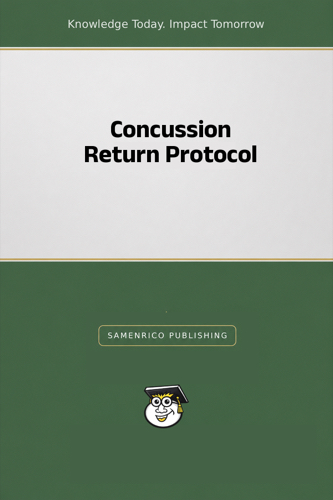
Concussion Return Protocol eBook
Guides graded exertion and cognitive rest for safe
Guides graded exertion and cognitive rest for safe return to contact sports.
Formats
Free sample
Chapter 1: The Cracked Teacup...--The moment of impact lasts less than a tenth of a second. The headache, the fog, the nausea, the fear—those can linger for months. What happens inside your skull during that tenth of a second is not a bruise. It is not a contusion in the way a bruised shin is a contusion. It is an energy crisis of microscopic proportions, and understanding that crisis is the difference between returning to your sport in six weeks versus sitting on the sidelines for six months—or worse, never playing again.This chapter is not a biology lecture.
You do not need a medical degree to understand what follows. But you do need to unlearn almost everything you have been told about "toughing it out" and "shaking it off." Those phrases, well-intentioned as they may be, are the single biggest reason athletes suffer prolonged recoveries. They are the enemy. And this chapter is going to show you why.If you take nothing else from this book, take this: A concussion is not an injury to your skull, your scalp, or even your brain cells themselves. It is an injury to your brain's ability to produce and manage energy.
And energy management, not pain tolerance, is the only path back to the game you love.The Neurometabolic Cascade: What Actually Happens Inside Let us begin with a moment of honesty. For decades, coaches, trainers, and even some doctors believed that a concussion was essentially a bruise on the brain. The logic seemed simple: hit your head, bruise your brain, wait for the bruise to heal. That logic is wrong. And it has caused incalculable harm.The reality is far more complex and far more fascinating.
When your brain accelerates rapidly and then decelerates—whether from a helmet-to-helmet hit, a fall onto the ice, or a soccer ball struck with force—the neurons inside your skull stretch and shear at a microscopic level. This mechanical stretching does not kill the neurons. What it does is far more insidious: it rips open the cell membranes just enough to cause a catastrophic leak.Imagine a wall of water bottles lined up on a table. Each bottle has a small pinhole near the top. Now imagine someone shakes the table violently.
The bottles wobble, and the pinholes widen just slightly. Water begins to leak. Not a flood, but a steady, draining trickle. That is what happens to your neurons.The "water" in this analogy is a flood of electrolytes—specifically potassium and calcium. Potassium rushes out of the neuron, and calcium rushes in.
This sudden shift, called the neurometabolic cascade, triggers an emergency response. Your brain, which is nothing if not a master of homeostasis, immediately demands massive amounts of glucose (its primary fuel) to pump the potassium back inside and kick the calcium back out. This is like calling in every fire truck in the city to handle a trash can fire.But here is the cruel twist: at the exact moment your brain needs the most energy, cerebral blood flow drops by twenty to thirty percent. The blood vessels in your brain constrict. The fuel trucks cannot get to the fire.
Your brain is starving in the middle of a feast.This state of metabolic mismatch—high demand, low supply—can last for days or even weeks. During this time, your brain is operating on a fraction of its normal energy budget. Every thought, every glance at a screen, every conversation, every decision depletes that budget a little more. And when the budget runs out? Symptoms spike.
Headache intensifies. Dizziness returns. Brain fog descends like a curtain.This is not weakness. This is not laziness. This is biology.The Teacup Analogy: Why Multitasking Is Your Enemy The most useful way to understand your brain's energy crisis is what I call the Teacup Analogy.
I have used this with professional athletes, high school freshmen, and everyone in between. It works because it is simple, visual, and undeniably true.Before your concussion, your brain's energy reserves were like a sturdy ceramic mug. You could pour in mental tasks—homework, practice, social media, video games, conversations, anxiety about tomorrow's test—and the mug held everything. It might have been full, but it did not crack. You could multitask because your energy budget was large enough to cover the overflow.The concussion cracked the mug.
The crack may be small. You might not even see it at first. But it is there. And now, every time you pour mental energy into that cracked mug, some of it leaks out before you can use it. The harder you try to hold onto that energy, the faster it leaks.
This is the paradox of concussion recovery: effort makes things worse.Let me give you a concrete example. Before your injury, you could easily do three things at once: listen to music, scroll through Instagram, and text a friend. Your mug was intact. After your concussion, trying to do just two of those things simultaneously might send your symptoms from a 2 out of 10 to a 7 out of 10 in under five minutes. The mug is cracked.
The energy is leaking. And the only way to stop the leak is to pour less in.This is not a metaphor. Functional MRI studies of concussed athletes show that the brain must recruit additional regions to perform tasks that were once automatic. Your brain is working harder to accomplish less. That extra work costs energy—energy you do not have.The teacup analogy explains why "pushing through" fails.
When an athlete tries to ignore their symptoms and continue studying or practicing, they are not strengthening their brain. They are not building resilience. They are pouring water into a cracked mug and watching it spill onto the floor. The mug does not heal because you test its limits. The mug heals when you stop pouring altogether—or pour only the smallest, most careful trickle.Absolute Rest vs.
Active Management: The Critical Distinction For years, the standard advice for concussion was simple: sit in a dark room and do nothing until you feel better. This approach, called "cocoon therapy," made intuitive sense. If your brain is injured, do not use it. Rest it.The problem is that cocoon therapy does not work. In fact, it can make recovery slower.Multiple high-quality studies have now shown that prolonged absolute rest—beyond the first forty-eight to seventy-two hours after injury—leads to worse outcomes.
Athletes who stay in dark rooms for a week or more report higher rates of anxiety, depression, and persistent symptoms. They become deconditioned. They lose muscle mass. They fear exertion. And their brains, starved of stimulation, actually become more sensitive to sensory input over time, not less.This is where the distinction between absolute rest and active management becomes crucial.Absolute rest is what you do in the first twenty-four to seventy-two hours after the injury, and only before you have achieved symptom stabilization.
During absolute rest, you minimize all cognitive load. No screens. No reading. No conversations beyond basic needs. No music with lyrics.
No bright lights. This is the period when your brain is in the acute phase of the metabolic crisis, and…
This is the end of the free sample. Get the eBook to keep going. Buy now
About this book
Details
- Author
- Gerber Lavenia
- Publisher
- SamEnrico
- Language
- English
- Genre
- Non-Fiction, Health & Wellness, Traumatic Brain Injury
- Released
- 2026-06-06
- Pages (approx.)
- 157
- Available as
- eBook, Audiobook

Read better in the ZLOADR app
Your eBooks on your phone or tablet. Sign in with your SamEnrico account and start reading.
More by Gerber Lavenia
 Sibling Religious Differences GuideGerber Lavenia$11.99
 Social Connection After RetirementGerber Lavenia$11.99
 Keto Intermittent Fasting GuideGerber Lavenia$11.99
 The Golden Shields of Dahomey: Africa's Warrior Queens and the Art of WarGerber Lavenia$11.99
 Residential AppraiserGerber Lavenia$11.99
 How to Start a Pipe Tobacco Business (Beginners Guide)Gerber Lavenia$11.99
 How to Produce a Cherry PickerGerber Lavenia$11.99
 AI Financial Dashboard GuideGerber Lavenia$12.99