
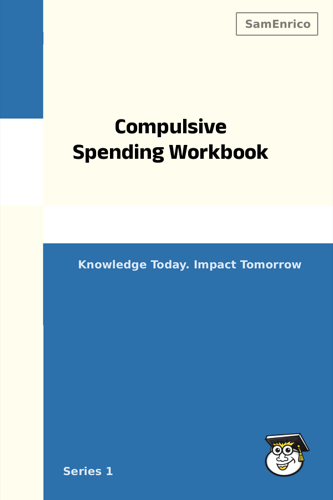
Compulsive Spending Workbook eBook
Daily logs and exercises to track and reduce purch
Daily logs and exercises to track and reduce purchases.
Formats
Free sample
Chapter 1: The Receipt Funeral...--–- You are about to do something that most people never dare to do: you are going to look directly at your spending without flinching, without making excuses, and without drowning in shame. This chapter is called The Receipt Funeral for a reason. A funeral is not a celebration. It is not a punishment either. A funeral is an honest acknowledgment that something has ended so that something new can begin.
For you, that "something" is the fantasy that your spending is under control, that you know where your money goes, that those small purchases don't really matter. That fantasy ends here. In its place, you will build something far more useful: a shame-free, factual baseline of your actual financial behavior. You will not change a single thing yet. You will not set a budget, delete your shopping apps, or swear off Amazon.
All you will do for the next three days is collect, log, and observe. This is the data collection phase of your recovery, and without it, everything else in this workbook is guesswork.You did not arrive at this workbook by accident. Maybe you have scrolled through your bank account and felt a sickening lurch in your stomach when you saw the balance. Maybe you have hidden a package from your partner or lied about how much something cost. Maybe you have told yourself "just this once" so many times that the phrase has lost all meaning.
Or maybe you are simply exhausted from the mental gymnastics of justifying purchases you know you do not need. Whatever brought you here, one thing is true: the way you have been managing money has not been working. That is not a moral failing. It is a systems problem. And systems problems require data before they require solutions.The entire premise of this workbook rests on a single counterintuitive idea: you cannot hate yourself into better behavior.
Shame does not work. Guilt does not work. Beating yourself up after every impulse buy only deepens the cycle of compulsion. You feel bad, so you shop to feel better, then you feel worse, so you shop again. The only way out is through radical, non-judgmental observation.
Think of yourself as a scientist studying a subject. The subject happens to be you. A scientist does not yell at a lab rat for pressing the wrong lever. A scientist records what the rat did, notes the conditions, and looks for patterns. That is what you will do in this chapter.
You are the scientist and the rat, and you are allowed to be both.Before you turn another page, you need to understand the three-day receipt collection that is about to become your entire focus. This is not a suggestion. It is a requirement. The entire first part of this workbook depends on you completing this exercise with honesty and without editing. If you skip it, every subsequent chapter will feel like building a house on a cracked foundation.
So commit now: for the next three days, you will collect every single receipt, every digital confirmation, every credit card alert, every Venmo transaction, every "I'll pay you back" coffee purchase. You will not throw any away. You will not say "this one doesn't count." You will not wait until you have a "normal" three days. Start today, even if today has already included a purchase you regret. Especially if today has included a purchase you regret.The Physical Act of Collection There is a reason this workbook asks you to tape physical receipts into its pages rather than simply writing down numbers.
The physical act matters. When you hold a receipt in your hand, you are holding evidence. That small strip of thermal paper represents minutes of your life traded for dollars, traded for an object. Most of the time, receipts go straight into the trash or get crumpled into a purse or wallet, never to be seen again. That is by design.
The less you see the evidence of your spending, the easier it is to keep spending. This chapter asks you to do the opposite. You will collect, tape, and display your receipts like specimens pinned to a board.For the next three days, carry a dedicated envelope or a zippered pocket in your bag. Every time you spend money on anything that is not an automatic bill payment (rent, utilities, insurance), put the receipt in that envelope. For digital purchases, take a screenshot of the confirmation email or the order summary.
If you use Apple Pay or Google Wallet, open the transaction history and screenshot it. If you buy something with cash and do not get a receipt, write down the amount, the store, the item, and the time on a slip of paper and put that in the envelope. No transaction is too small. That $3 coffee counts. That $1.99 app purchase counts.
That "I'll just browse" Target run where you spent $47 on things you did not plan to buy absolutely counts.At the end of each day, you will sit down with this workbook and a glue stick or tape. You will turn to the Receipt Log pages (provided at the end of this chapter) and you will physically tape each receipt onto the page. If a receipt is too long, fold it. If it is faded, write the amount next to it in pen. The goal is not neatness.
The goal is visibility. You want to see the clutter. You want to see how many strips of paper accumulate in just 72 hours. Most people are shocked by the sheer volume. That shock is not shame.
That shock is information.The Spending Autopsy Log Next to each taped receipt, you will complete a five-column log. This log is the heart of the chapter. It moves beyond "what did you buy" to the far more important question "why did you buy it." Here is exactly what you will record for each purchase:Column 1: Item and Amount. Write exactly what you bought and the total cost including tax. Be specific.
"Coffee" is fine. "Large caramel latte with oat milk at Starbucks" is better. Specificity reveals patterns.Column 2: Time and Location. Write the hour of day (7:30 AM, 12:15 PM, 9:45 PM) and the specific store, website, or app. "Amazon" is not specific enough.
"Amazon app on my phone while lying in bed" is specific. "Target" is not specific enough. "Target, the one near work, after a stressful meeting" is specific.Column 3: Essential or Non-Essential. Refer to the Essential vs. Non-Essential table printed on the inside front cover of this workbook.
That table is your bible for the next 12 weeks. Rent, utilities, groceries (basic food, not prepared meals), prescription medications, gas for commuting, insurance premiums, minimum debt payments, and necessary childcare are essential. Everything else is non-essential. That includes takeout coffee, restaurant meals, clothing, electronics, home decor, beauty products, books, games, hobby supplies, gifts beyond a set budget, and anything purchased because it was on sale. Be honest here.
If you bought a $6 smoothie because you were thirsty, that is non-essential (you could have drunk water). If you bought a $30 candle because your apartment smelled weird, that is non-essential (you…
This is the end of the free sample. Get the eBook to keep going. Buy now
About this book
Details
- Author
- Hudson Mathew
- Publisher
- SamEnrico
- Language
- English
- Genre
- Non-Fiction, Self-Help, Workbook
- Released
- 2026-06-06
- Pages (approx.)
- 145
- Available as
- eBook, Audiobook

Read better in the ZLOADR app
Your eBooks on your phone or tablet. Sign in with your SamEnrico account and start reading.
More by Hudson Mathew
 Low FODMAP Diet ProtocolHudson Mathew$11.99
 Ending Emotional Eating NowHudson Mathew$11.99
 Equity Cure Right GuideHudson Mathew$11.99
 Chandragupta's Bloodless Conquest: The Rise of the Mauryan EmpireHudson Mathew$11.99
 Technical Support CoordinatorHudson Mathew$11.99
 Ghana Import Duty Exceptions ManualHudson Mathew$12.99
 How to Produce Animal Husbandry SuppliesHudson Mathew$11.99
 How to Start a Discount Department Store BusinessHudson Mathew$11.99
You may also like
 Hong Kong Handover 1997Dunn Johnnie$11.99
 Zumba For Postnatal Recovery CourseNeal Christian$11.99
 Zumba for BeginnersLadner Nikia$11.99
 YouTube Comment Mining GuideHumes Pandora$12.99
 Worry Box MeditationCarlin Rudy$11.99
 Workplace Stress MeditationNguyen Lynn$11.99
 Workplace Stress and Sleep RepairHawley Ivory$11.99
 Workplace Perfectionism CureDelaney Jeffry$11.99
 Workplace Injustice Anger GuideWallen Isabelle$11.99
 Work Addiction and Burnout LinkGreenwood Ester$11.99
 Women in Yoga and WellnessBeattie Galina$11.99
 Women in Stand Up ComedyChun Evangeline$11.99