
Non-FictionInformativeEducational
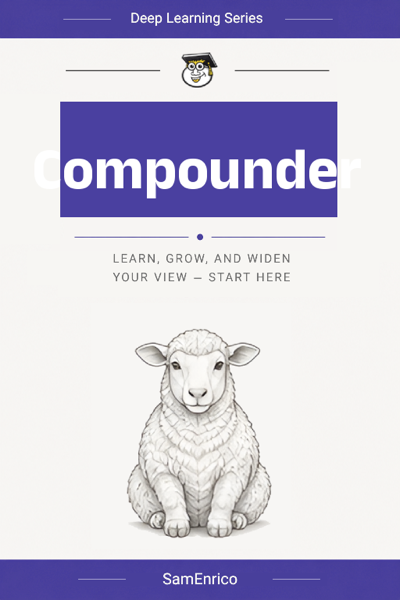
Compounder eBook
A Coursebook on Compounder
A Coursebook on Compounder
Formats
Free sample
Chapter 1: The Invisible Graveyard--–- Every morning, you wake up and make a series of small decisions. What time to rise. Whether to check email or meditate. Whether to open the brokerage app or read a single page of an annual report. These decisions feel insignificant.
They take five seconds each. They leave no trace. And yet, collectively, they are digging your grave or building your launchpad.This is the Invisible Graveyard—the collection of all the futures you have quietly buried by doing nothing. Not by making terrible choices, but by making no choices at all. By defaulting to passive consumption when a tiny action would have shifted your trajectory.
By checking stock prices seventeen times a day instead of checking your own behavioral data. By optimizing for the approval of your colleagues this quarter instead of the freedom of your future self in a decade.The graveyard is invisible because no one sees the millionaire you never became. No one mourns the book you never wrote, the business you never started, the relationship you never deepened. The absence is not recorded anywhere except in the gap between your potential and your reality. That gap is not filled by a single heroic act.
It is filled—or not filled—by the accumulation of ordinary choices, repeated daily, over years.This book is about making those choices visible. It is about becoming a Compounder: someone who understands that small, consistent inputs today produce massive, non-linear outputs tomorrow. A Compounder does not wait for a lucky break. A Compounder builds a system where luck becomes inevitable.But before we build, we must excavate. We must understand why most people remain linear thinkers in an exponential world.
We must understand why the Invisible Graveyard is so full—and how to stop adding to it.The Great Deception: Why We Believe in Heroes We are raised on stories of heroes. The entrepreneur who pulled an all-nighter and coded the app that changed the world. The investor who made a single brilliant bet and turned 10,000into10,000 into 10,000into10 million. The athlete who trained in obscurity and then, in one perfect moment, won the championship.These stories are not false. But they are dangerously incomplete.
They focus on the moment of breakthrough—the ice cube melting at 32 degrees—while ignoring the thousands of hours when the temperature rose from 31.1 to 31.9 degrees, when nothing seemed to be happening at all.The great deception is believing that major outcomes require major actions. This is why New Year's resolutions fail. This is why most investment portfolios underperform a simple index fund. This is why 80% of people who start a diet quit within 90 days. We are looking for the dramatic intervention when the real solution is the boring, daily, unglamorous repetition of a small useful behavior.Consider two investors.
Investor A does nothing for twenty years except automatically invest 500 per month into a low-cost S&P 500 index fund. She never checks the price. She never reads financial news. She never sells. After twenty years, assuming average historical returns, she has approximately 380,000.
She has done nothing heroic.Investor B spends twenty years trying to time the market. He buys hot stocks, sells on dips, chases trends, listens to pundits. He is smart, engaged, and spends forty hours a year on his portfolio. After twenty years, after taxes and fees and emotional mistakes, he has approximately $180,000. He has worked harder and achieved half the result.The difference is not intelligence.
The difference is not effort. The difference is the decision to let the machinery of compounding work versus the decision to constantly interfere with it.This is the first truth of this book: You cannot outperform your own system. If your system is based on heroics, you will fail when you are tired, scared, or distracted. If your system is based on automation and small daily inputs, you will succeed even when you are uninspired.The Choice Architecture of the Top 1%If small decisions determine everything, why do most people make the wrong small decisions? The answer is not laziness or stupidity.
The answer is Choice Architecture—the design of the environment in which you make decisions.Your environment is not neutral. It is constantly pushing you toward certain choices and away from others. If your phone is on your nightstand, the choice architecture pushes you toward checking it immediately upon waking. If your brokerage app is on your home screen, the architecture pushes you toward checking prices twenty times a day. If your kitchen has cookies on the counter, the architecture pushes you toward eating them.The top 1% of compounders do not have more willpower than everyone else.
They have better choice architecture. They have designed their environment so that the right choice is the easy choice and the wrong choice is the hard choice.Warren Buffett does not have a computer on his desk. He has to walk across the room to check prices. That friction—the inconvenience of standing up—saves him billions of dollars in impulse trades over a lifetime.Darren Hardy, author of The Compound Effect, does not have a television in his house. The friction of having to go to a friend's house to watch TV makes him watch almost no television.
The time saved compounds into reading, writing, and building businesses.James Clear, author of Atomic Habits, designed his gym so that he literally trips over his workout bag on the way to the bathroom. The friction of moving the bag is greater than the friction of doing a few pushups. So he does pushups.Choice architecture is not about being disciplined. It is about being honest with yourself about your own psychology and then building a fortress around your future self.The Six Steps to Building Your Compounding Machine The remainder of this chapter presents the foundational framework of this book—the operating system that every Compounder uses, whether they are managing a billion-dollar portfolio or a personal budget. This framework synthesizes the best practices from the most successful compounders in history, from Benjamin Graham to Warren Buffett to Ray Dalio to Darren Hardy.Before we list the steps, a crucial note on the cadence of review.
Many books give contradictory advice: check your progress daily, or never check it at all, or rebalance monthly, or rebalance annually. This book resolves that contradiction with a single, unified system:Daily: Execute your habits. Do not judge them. Do not check prices. Do not measure progress.
Just execute.Quarterly (every 90 days): Conduct a learning review. What worked? What didn't? What needs to change? This review takes 30 minutes maximum.Annually (every January): Rebalance your portfolio.
Execute the One-Page Rebalancing Protocol from Chapter 10. This takes one hour.Never: Check stock prices daily. Make emotional decisions. Sell out of boredom.With that cadence established, here are the six steps to building your compounding machine.Step One: Track Everything You cannot improve what you do not measure. This is not about perfectionism.
It is about awareness. Most people have no idea how many times they check their phone, how many minutes they spend on social media, how many impulse purchases they make, how many hours they spend watching financial…
This is the end of the free sample. Get the eBook to keep going. Buy now
About this book
Details
- Author
- Noel Jackelyn
- Publisher
- SamEnrico
- Language
- English
- Genre
- Non-Fiction, Informative, Educational
- Released
- 2026-06-02
- Pages (approx.)
- 142
- Available as
- eBook, Audiobook

Read better in the ZLOADR app
Your eBooks on your phone or tablet. Sign in with your SamEnrico account and start reading.
More by Noel Jackelyn
 Acceptance Commitment PainNoel Jackelyn$11.99
 Sibling Fight Parental Anger GuideNoel Jackelyn$11.99
 Flexible Time Blocking HandbookNoel Jackelyn$11.99
 Brand Ranking Event ImpactNoel Jackelyn$11.99
 Titanium Dreams: The Forgotten Robots of Ancient GreeceNoel Jackelyn$11.99
 The Last Dance of the Red Baron: Aerial Legends and Lost TapesNoel Jackelyn$11.99
 How to Become a Chemical-engineering TechnicianNoel Jackelyn$11.99
 Five Year Clean Energy ForecastNoel Jackelyn$12.99
 Interview Gap Story HandbookNoel Jackelyn$12.99
 Understanding Hyperinsulinism In Children, CongenitalNoel Jackelyn$17.99
You may also like
 Hong Kong Handover 1997Dunn Johnnie$11.99
 Zumba For Postnatal Recovery CourseNeal Christian$11.99
 Zumba for BeginnersLadner Nikia$11.99
 YouTube Comment Mining GuideHumes Pandora$12.99
 Worry Box MeditationCarlin Rudy$11.99
 Workplace Stress MeditationNguyen Lynn$11.99
 Workplace Stress and Sleep RepairHawley Ivory$11.99
 Workplace Perfectionism CureDelaney Jeffry$11.99
 Workplace Injustice Anger GuideWallen Isabelle$11.99
 Work Addiction and Burnout LinkGreenwood Ester$11.99
 Women in Yoga and WellnessBeattie Galina$11.99
 Women in Stand Up ComedyChun Evangeline$11.99