
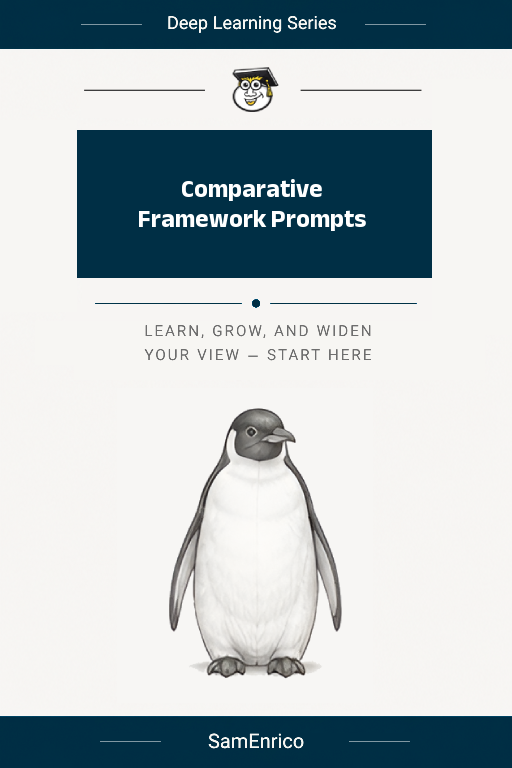
Comparative Framework Prompts eBook
Establish clear criteria for comparing multiple it
Establish clear criteria for comparing multiple items using GPT prompts for structured comparison.
Formats
Free sample
Chapter 1: The 100-Hour Decision--–- It was a Tuesday evening when Sarah realized she had spent over fourteen hours spread across three weeks deciding on a $79 project management tool. She had watched seventeen You Tube reviews, created a spreadsheet with twenty-two columns, asked her team for input twice, and still felt paralyzed. The irony was not lost on her: she was evaluating software designed to increase productivity, yet the evaluation itself had become her least productive activity of the month.Sarah is not an exception. She is a pattern.In boardrooms and living rooms, across industries and income levels, people are trapped in a quiet epidemic of inefficient comparison. We spend hours comparing laptops, vacation rentals, job candidates, insurance plans, and investment options.
We create elaborate mental or spreadsheet-based pros and cons lists. We ask friends, colleagues, and internet strangers for their opinions. And still, we frequently end up with one of three unsatisfactory outcomes: we choose the default option out of exhaustion, we delay the decision until the opportunity passes, or we make a choice and immediately wonder if we got it wrong.This book exists because there is a better way. And that better way does not require more willpower, more time, or a degree in data science. It requires a shift in how you ask questions—specifically, how you ask them of artificial intelligence systems like GPT.The Paradox That Paralyzes The “paradox of choice” is one of the most replicated findings in modern behavioral science.
Coined by psychologist Barry Schwartz in his 2004 book of the same name, the paradox describes a counterintuitive reality: beyond a certain point, increasing the number of available options reduces satisfaction and increases decision difficulty. When you have three options, you can compare them reasonably well. When you have thirty, your brain begins to short-circuit.Consider a famous study conducted at a gourmet food market. Researchers set up a tasting booth for high-quality jams. On some days, they offered six varieties.
On other days, they offered twenty-four. The booth with twenty-four varieties attracted more visitors. But here is the critical finding: customers who saw twenty-four jams were ten times less likely to make a purchase than those who saw only six. More options led to fewer decisions.This same dynamic plays out everywhere. A manager choosing between three software vendors feels confident.
The same manager choosing between twelve feels anxious, even if the twelfth option is objectively excellent. Why? Because the human brain did not evolve to make fine-grained comparisons across many multidimensional options. We evolved to evaluate immediate threats and opportunities—ripe fruit, approaching predators, potential mates—not to weight the relative importance of scalability versus time-to-implementation across a dozen cloud platforms.The Bias Trap When faced with more than a handful of options, your brain does not simply struggle. It cheats.
It takes shortcuts called cognitive biases, and these biases systematically distort your comparisons.Let us examine three of the most damaging biases for comparative decision-making.First is anchoring. You encounter an initial piece of information—the first price you see, the first candidate you interview, the first feature you learn about—and that information becomes a mental anchor. Every subsequent option is judged relative to that anchor, not on its absolute merits. In one classic study, real estate agents were shown a house and given either a low or high list price. Even though the agents knew the list price was arbitrary, those who saw the higher price appraised the house significantly higher.
The anchor had done its work. When you compare options, ask yourself: am I judging each option independently, or am I unconsciously measuring everything against the first thing I saw?Second is recency bias. Your memory privileges the most recent information. If you evaluate ten job candidates over two days, the last two will loom larger in your mind than the first eight, even if the first eight were objectively stronger. This is why savvy presenters schedule their slots strategically and why your brain’s natural tendency must be actively counteracted.
Recency bias makes fair sequential comparison nearly impossible without a structured system.Third is availability bias. You overweight information that is vivid, dramatic, or easily recalled. A single story about a disastrous vendor implementation will outweigh a spreadsheet showing that ninety-five percent of implementations go smoothly. Your brain evolved to prioritize memorable narratives over abstract statistics. When comparing options, the option that comes with a horror story—even a rare one—will feel riskier than it actually is.These biases are not signs of stupidity.
They are features of a cognitive system optimized for survival, not for rational comparison of modern multi-attribute choices. The problem is not your brain. The problem is that you are asking it to do something it was never designed to do, without the right tools.What Most People Get Wrong The default response to decision paralysis is to try harder. You make a longer pros and cons list. You add more columns to your spreadsheet.
You sleep on it one more time. This approach fails because it misunderstands the nature of the problem.A simple pros and cons list—whether in your head, on paper, or in a spreadsheet—suffers from three fatal flaws.First, it treats all criteria as equally important. When you write “Pro: cheaper” and “Con: slower” and “Pro: better reviews,” you have no way to weight these against each other. Is cheaper twice as important as faster? Three times?
The list format cannot tell you. You end up counting pros and cons as if each carried equal weight, which is almost never true.Second, it lacks consistent measurement scales. What does “good customer support” mean? For one person, it means twenty-four-hour chat. For another, it means a phone number with less than five minutes of hold time.
For a third, it means a knowledge base with video tutorials. Without defining your scale before you start comparing, you are not comparing—you are guessing.Third, it hides uncertainty. You write a pro or a con as if it were a fact, but most real-world comparisons involve incomplete information. You do not know exactly how reliable each vendor is. You do not know exactly how much time each option will save.
A pros and cons list treats missing information as if it does not exist, which is a dangerous illusion.The typical alternative to pros and cons is even worse: gut feeling. “I’ll just go with what feels right.” This approach hands the steering wheel entirely to your unconscious biases. Your gut feeling will reliably overweight recency, availability, and whatever anchor you stumbled upon first. Your gut is a poor decision-making system for complex multi-attribute choices, not because it is always wrong, but because it is not transparent. When you make a gut decision, you cannot later reconstruct why you chose what you chose, learn from your mistakes, or explain your reasoning to others.Defining the Alternative: A Comparative Framework What would a better system look like?
It would need to solve the three fatal flaws of pros and cons lists.It would need explicit criteria—a clear list of exactly what dimensions you are comparing. Not “pros and…
This is the end of the free sample. Get the eBook to keep going. Buy now
About this book
Details
- Author
- Delgado Curtis
- Publisher
- SamEnrico
- Language
- English
- Genre
- Non-Fiction, Student's Shortcut, Comparative Analysis
- Released
- 2026-05-27
- Pages (approx.)
- 136
- Available as
- eBook, Audiobook

Read better in the ZLOADR app
Your eBooks on your phone or tablet. Sign in with your SamEnrico account and start reading.
More by Delgado Curtis
 Sexual Health After BabyDelgado Curtis$11.99
 Customer Journey SummaryDelgado Curtis$11.99
 Thunberg Intersectional ClimateDelgado Curtis$11.99
 Legacy Projects Anticipatory GriefDelgado Curtis$11.99
 Constraints for Social WorkersDelgado Curtis$11.99
 Panic Attack Emergency GuideDelgado Curtis$11.99
 Assertiveness for LawyersDelgado Curtis$11.99
 Monthly Breast Self Exam GuideDelgado Curtis$11.99
 Darius the Great: The Lion of Persia's Unstoppable RiseDelgado Curtis$11.99
 Moana’s First Voyage: The Whispering StarsDelgado Curtis$11.99
 How to Produce Packaging LabelsDelgado Curtis$11.99
 How to Produce Consumer ElectronicsDelgado Curtis$11.99