
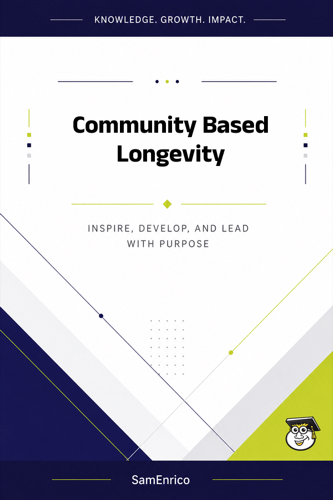
Community Based Longevity eBook
Build neighborhood connections like Blue Zone vill
Build neighborhood connections like Blue Zone villages for health.
Formats
Free sample
Chapter 1: The Longevity Lie--–- The $100,000 question arrived in my inbox on a Tuesday morning. A fifty-three-year-old executive named Sarah had spent the last decade optimizing everything—her diet (organic, Mediterranean-leaning), her fitness (Peloton, personal trainer twice a week), her supplements (a staggering thirty-seven pills per day, organized in a wooden caddy that cost more than my first car). She had done everything the wellness industry asked of her. She was also, by her own admission, “the loneliest I have ever been in my entire life.” Her blood pressure was creeping up. Her sleep was a disaster.
And her doctor, after running every test imaginable, had shrugged and said, “All your biomarkers are normal. You’re fine.” But Sarah did not feel fine. She felt like she was dying slowly, not from any disease she could name, but from something she couldn’t put her finger on. She wrote to me because she had read an article about the Blue Zones—those strange, remote places where people routinely live to one hundred without chronic disease—and she noticed something that her wellness influencers never mentioned. “In the Blue Zones,” she wrote, “nobody takes thirty-seven supplements.
Nobody has a Peloton. And nobody eats alone.” That last line stopped me cold. Nobody eats alone.Welcome to the great contradiction of modern longevity. We have more health technology, more nutrition science, more fitness gadgets, and more medical interventions than any civilization in human history. And yet, in many developed nations, we are living shorter healthspans—the number of years we spend free from chronic disease—than our parents’ generation.
Obesity rates have tripled since 1975. Depression and anxiety have become the leading causes of disability worldwide. And loneliness, which the Surgeon General has declared an epidemic, now kills more people than obesity, physical inactivity, and air pollution combined. We have optimized the body while starving the soul. We have turned exercise into a chore, food into fuel, and neighbors into strangers.
And we have been sold a lie—a trillion-dollar lie—that longevity can be bought in a bottle, a class, or an app.The truth is both simpler and harder to hear. The healthiest, longest-lived people in the world do not have better genes, better doctors, or better supplements. They have better environments. They live in places where they cannot avoid walking, talking, or being part of a tribe. They do not “make time” for social connection; connection is built into the architecture of their daily lives.
In Okinawa, Japan, five-year-old children join moais—committed friendship groups that last for life. In Sardinia, Italy, eighty-year-old men walk to the village square every afternoon because that is just what you do. In Ikaria, Greece, the concept of “alone time” barely exists; you eat, work, and nap in the presence of others. These are not disciplined people. They are not willpower machines.
They are ordinary humans who happen to live in extraordinary environments—environments that make healthy choices automatic and isolation impossible.This book is about building those environments on your own block. It is not a diet book, a fitness book, or a supplement guide. It is a practical, step-by-step playbook for retrofitting your street, your building, or your neighborhood into a modern-day Blue Zone village. You will not find a thirty-day juice cleanse here. You will find a thirty-day plan to knock on your neighbor’s door, build a bench, and start a weekly soup.
You will learn why a bench in the right location is more powerful than a gym membership, why a shared garden is more effective than a nutritionist, and why a committed group of five friends—a moai—adds more years to your life than any medication ever invented.But first, we have to understand how we got here. How did the wealthiest, most technologically advanced societies in history become the loneliest and most sedentary? And why does the solution have so little to do with the things we’ve been told to buy?The Paradox of Progress Let me give you a number that should terrify you: between 1985 and 2020, the average American’s social network shrank by nearly two-thirds. The number of people who reported having no close friends at all quadrupled. And during that same period, the health and wellness industry grew from a $10 billion sector to a $4.4 trillion behemoth.
We spent more money than ever on feeling better—and we got worse.How is this possible?The answer lies in what I call the Optimization Trap. The wellness industry has convinced us that health is a problem of individual inputs: eat this, not that; move this way, not that way; take this pill, meditate this many minutes, track these biomarkers. The implicit promise is that if you optimize enough variables, you can hack your way to longevity. The explicit result is a population that is simultaneously over-managed and under-connected.Consider the evidence. A 2023 study published in Nature Human Behaviour followed 458,000 participants over twelve years and found that social connection was the single strongest predictor of longevity—stronger than smoking, stronger than obesity, stronger than physical inactivity.
People with strong social ties had a 50% higher likelihood of survival than those with weak ties. The effect was so large that the researchers called it “the social equivalent of quitting smoking.” And yet, when was the last time your doctor asked you how many friends you have? When was the last time your health insurance reimbursed you for a neighborhood potluck? When was the last time a wellness influencer told you to stop optimizing your macros and start calling your neighbors?Never. Because there is no money in connection.
There is money in supplements, gym memberships, meal delivery kits, and meditation apps. There is no money in a bench on a street corner. There is no money in a shared garden. There is no money in a weekly Sunday soup. These things are free—or nearly free—and that is precisely why the trillion-dollar wellness industry ignores them.
The industry profits from your loneliness. It sells you substitutes: a Peloton instead of a walking partner, a meal kit instead of a potluck, a mindfulness app instead of a real conversation. These are not solutions. They are placebos for the soul.The Five Places Where Nobody Forgot How to Live To understand what we’ve lost, we have to look at what still exists. Between 2004 and 2009, Dan Buettner and a team of demographers, anthropologists, and epidemiologists set out to find the world’s longest-lived populations.
They identified five regions—Okinawa (Japan), Sardinia (Italy), Nicoya (Costa Rica), Ikaria (Greece), and Loma Linda (California)—where people routinely reach age one hundred without dementia, heart disease, diabetes, or cancer. These became known as the Blue Zones.The researchers expected to find a miracle diet, a secret exercise, or a rare genetic mutation. They found none of those things. Instead, they found environments that engineered healthy behavior into the fabric of daily life. Buettner distilled their findings into nine principles, which he called the Power 9.
They are:Move Naturally – No marathons, no gym memberships. Just walking, gardening, and climbing stairs because you have to.Purpose – Knowing why you wake up in the morning adds…
This is the end of the free sample. Get the eBook to keep going. Buy now
About this book
Details
- Author
- Mcgregor Gene
- Publisher
- SamEnrico
- Language
- English
- Genre
- Non-Fiction, Health & Wellness, Community, Neighborhood
- Released
- 2026-06-11
- Pages (approx.)
- 136
- Available as
- eBook, Audiobook

Read better in the ZLOADR app
Your eBooks on your phone or tablet. Sign in with your SamEnrico account and start reading.
More by Mcgregor Gene
 Dense Breast Mammogram GuideMcgregor Gene$11.99
 Carb Loading ProtocolMcgregor Gene$11.99
 Workplace Anger Control GuideMcgregor Gene$11.99
 The Anxiety Mastery WorkbookMcgregor Gene$11.99
 How to Start a Account and Conversion Business (Beginners Guide)Mcgregor Gene$11.99
 Rwanda Student ROI AnalysisMcgregor Gene$12.99
 Invoice Factoring Latin AmericaMcgregor Gene$12.99
 Understanding Rokitansky SequenceMcgregor Gene$17.99
 Mountain BikingMcgregor Gene$11.99