
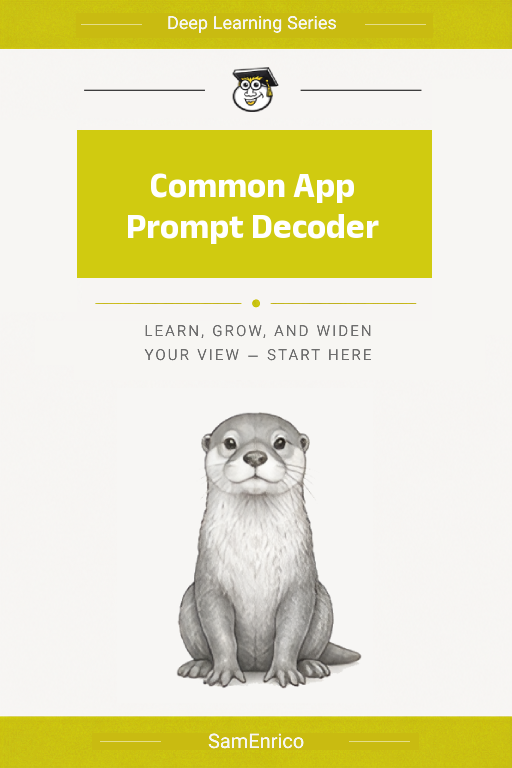
Non-FictionStudent's ShortcutCollege AdmissionsEssay Writing
Common App Prompt Decoder Audiobook
Translate vague essay prompts into concrete story
by Roden Malcom
Translate vague essay prompts into concrete story choices, then apply the showing-not-telling framework admissions officers love.
Formats
Free sample
Chapter 1: The 5-Minute Judgment--–- The smoke alarm was screaming before the cookies even hit the pan. That’s how my student, whom I’ll call Priya, opened her Common App essay. Not with a resume. Not with a list of accomplishments. Not with the words “passionate,” “dedicated,” or “I learned that failure is actually a gift.” She started with a smoke alarm and raw cookie dough.
And she got into a top-twenty university. Meanwhile, another student—let’s call him Marcus—opened his essay with “Winning the state debate championship taught me the value of perseverance.” Marcus had better grades than Priya. Higher test scores. More leadership positions. Marcus did not get in.
Priya did.This is not a coincidence. This is not luck. This is the difference between understanding how admissions readers actually think and writing the essay that 90% of applicants write.Let me tell you something that most college guides won’t: The Common Application essay is not graded. It is felt. There is no rubric.
No points for vocabulary. No bonus for using the word “myriad.” Your essay will be read by a human being who has already read forty-seven other essays that day, who has a headache, who needs coffee, and who will spend somewhere between three and five minutes on yours. Three to five minutes. That’s it. That’s the window you have to make someone care about you.And here’s the part that should terrify you: In that time, most essays are forgettable.
They blend together. They use the same words, the same structures, the same “lessons learned.” Admissions officers call it “essay fatigue.” They read “I learned that failure is a stepping stone to success” for the fifteenth time, and their brain does something remarkable—it stops processing. The words become wallpaper. The student becomes invisible.This chapter is about making sure that does not happen to you. It is about understanding the psychology of the person on the other side of the page.
It is about learning what they are actually looking for, which is not what they say they are looking for. And it is about the single most important question you will ever ask yourself while writing your essay: So what?The Brutal Math of Admissions Reading Let me give you the numbers, because numbers don’t lie. During peak reading season, a typical admissions officer at a competitive…
This is the end of the free sample. Get the Audiobook to keep going. Buy now
About this book
Details
- Author
- Roden Malcom
- Publisher
- SamEnrico
- Language
- English
- Genre
- Non-Fiction, Student's Shortcut, College Admissions, Essay Writing
- Released
- 2026-06-01
- Pages (approx.)
- 139
- Available as
- eBook, Audiobook

Listen in the VoxFlicks app
Audiobooks and audio dramas wherever you go. Sign in with your SamEnrico account and press play.
More by Roden Malcom
 Child Loss Support For MomsRoden Malcom$11.99
 Small Talk for Transgender IndividualsRoden Malcom$11.99
 Slack Teams Chat Management GuideRoden Malcom$11.99
 The Wedding Enslavement StoryRoden Malcom$11.99
 Spin Race Day PrepRoden Malcom$11.99
 Parenting EQ Skills HandbookRoden Malcom$11.99
 The Quit Smoking Food GuideRoden Malcom$11.99
 Samsung Galaxy Watch MemoryRoden Malcom$11.99
 The Silent Coup: How a Single Radio Broadcast Toppled a GovernmentRoden Malcom$11.99
 Neon Nights: The Untold Story of Diana Ross’s Private Island GetawayRoden Malcom$11.99
 Fafnir's Last Breath: The Dragon Who Became GoldRoden Malcom$11.99
 How to Start a Plastic Materials In Primary Forms (wholesale) Business (Beginners Guide)Roden Malcom$11.99
You may also like
 Hong Kong Handover 1997Dunn Johnnie$11.99
 Zumba For Postnatal Recovery CourseNeal Christian$11.99
 Zumba for BeginnersLadner Nikia$11.99
 YouTube Comment Mining GuideHumes Pandora$12.99
 Worry Box MeditationCarlin Rudy$11.99
 Workplace Stress MeditationNguyen Lynn$11.99
 Workplace Stress and Sleep RepairHawley Ivory$11.99
 Workplace Perfectionism CureDelaney Jeffry$11.99
 Workplace Injustice Anger GuideWallen Isabelle$11.99
 Work Addiction and Burnout LinkGreenwood Ester$11.99
 Women in Yoga and WellnessBeattie Galina$11.99
 Women in Stand Up ComedyChun Evangeline$11.99