
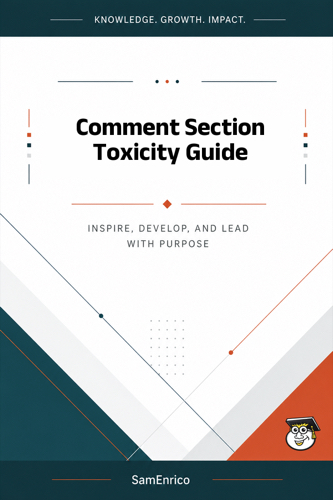
Comment Section Toxicity Guide eBook
Protect self esteem from negative feedback and tro
by Blair Ida
Protect self esteem from negative feedback and trolls online.
Formats
Free sample
Chapter 1: The 2 AM Math Problem--–- The screen glowed at 2:17 AM. Forty-seven kind messages sat in her inbox—heart emojis, thoughtful replies, a voice memo from a stranger saying her post had made them feel less alone. But she wasn't reading those. She was staring at the one. The comment that called her "embarrassing." The one with the toilet emoji.
The one that had arrived eight hours ago and somehow grown heavier with every passing minute.Her name is Maya. She is a real person, though her name has been changed here. Maya is a small business owner who sells handmade ceramics on Instagram. She posts videos of her glazing process—slow, hypnotic, imperfect. Two weeks before the toilet emoji comment, she had posted a particularly vulnerable video: a vase she had spent twelve hours on cracked in the kiln.
She showed herself crying, then laughing, then starting over. The video got 89,000 views. It got 312 comments. Three hundred and eleven of them were supportive. One said: "This is why women shouldn't quit their day jobs lol" followed by a toilet emoji.Maya told me she lay awake that night doing a kind of math.
She calculated the ratio of good to bad: 311 to 1. She calculated the percentage of people who were kind: 99.68 percent. And then she asked me a question that I have heard hundreds of times since I began researching this topic: "Why do I only feel the one?"This book is the answer to that question.The answer is not that you are weak. The answer is not that you are too sensitive. The answer is not that you should "grow a thicker skin" or "log off if you can't handle it." Those responses come from people who do not understand what is happening inside your body when you read a cruel sentence written by a stranger on the internet.The answer is evolutionary.
It is biological. It is neurological. And once you understand it, the toilet emoji loses its power. Not because you become numb—numbness is not the goal—but because you stop mistaking a biological reflex for a truthful assessment of your worth.This chapter is called The 2 AM Math Problem because that is what Maya was doing at 2:17 AM. She was doing math.
She was calculating whether 99.68 percent approval was enough to cancel out 0.32 percent disapproval. And her brain, doing exactly what it evolved to do, kept telling her: the 0.32 percent is the thing that matters.Her brain was wrong. But it was wrong for a very understandable reason.The Negativity Bias: Why Your Ancestors Survived and Your Sleep Didn't To understand why one cruel comment can erase ninety-nine kind ones, you have to travel backward. Way backward. Before the internet.
Before telephones. Before writing. Before language, even. You have to travel to a savanna, about 200,000 years ago, where your ancestors lived in small groups, hunted for food, and tried very hard not to get eaten.On that savanna, there were two kinds of events: rewards and threats. A reward was finding a berry bush full of ripe fruit.
A threat was hearing a rustle in the tall grass that could be a predator. Which event demanded more attention? Which event, if ignored, could end your life?The rustle, obviously.Your ancestors did not need to notice every single berry bush. Missing a berry bush meant a slightly smaller meal. Missing a rustle in the grass could mean death.
Over hundreds of thousands of years, the humans who survived were the ones whose brains were wired to prioritize threats over rewards. They heard the rustle. They ran. They lived. They had children who inherited that same hyper-vigilant threat-detection system.This is called the negativity bias.
It is one of the most well-documented phenomena in cognitive psychology. In academic terms, negative stimuli are processed more thoroughly than positive stimuli. Negative events are remembered more vividly. Negative feedback carries more weight than positive feedback. Losses hurt more than equivalent gains feel good.In practical terms: your brain is a rustle-detector.
It was not designed for the internet. It was designed for a world where ignoring a threat could get you killed.Now let us fast-forward to the present moment. You are not on a savanna. You are on a couch, or a bus, or in bed, holding a small glowing rectangle. A stranger writes: "This is dumb." Your brain does not know the difference between that sentence and a rustle in the grass.I want you to read that sentence again, because it is the most important sentence in this chapter: Your brain does not know the difference between a social threat and a physical threat.In the savanna, a social threat was a physical threat.
If your tribe rejected you, you were cast out. If you were cast out, you were alone. If you were alone, you were predator food. Rejection literally meant death. So your brain evolved to treat social rejection—criticism, exclusion, mockery—as a survival emergency.A toilet emoji is not a predator.
A comment calling you "embarrassing" is not a spear. But your amygdala—the part of your brain responsible for threat detection—cannot tell the difference. It processes the comment the same way it would process a rustle in the grass: as a threat to your survival.This is not a metaphor. This is biology.The Cortisol Spike: What Happens Inside Your Body Let me walk you through exactly what happens inside your body in the seconds after you read a toxic comment. I want you to understand this sequence because understanding it is the first step to disarming it.Step one: Your eyes scan the comment.
Your brain processes the words. Your amygdala, which has been waiting for a threat all day, sounds the alarm.Step two: Your adrenal glands release cortisol. Cortisol is often called the "stress hormone," but that is like calling a hurricane "some wind." Cortisol prepares your body for fight-or-flight. It does this by doing several things simultaneously:Your heart rate increases, pumping more blood to your large muscles so you can run or fight.Your breathing becomes shallower and faster.Your blood sugar spikes, providing emergency energy.Non-essential systems shut down: digestion, reproduction, immune response.Step three: Your prefrontal cortex—the part of your brain responsible for logic, planning, impulse control, and long-term thinking—begins to power down. This is the most important detail.
Your prefrontal cortex is the CEO of your brain. It is what separates you from a lizard. When cortisol floods your system, the CEO gets sidelined. The amygdala takes over.Step four: Your field of vision narrows. This is a physiological response.
Under threat, your brain focuses on the danger and blocks out peripheral information. That is why, after reading a cruel comment, you cannot see the forty-seven kind messages. Your brain has literally narrowed your vision.Step five: You react. Maybe you reply angrily. Maybe you cry.
Maybe you close the app and ruminate for hours. Maybe you delete the entire post. Whatever you do, you are doing it with a compromised prefrontal cortex. You are doing it from your amygdala.Let me say that again: In the minutes after…
This is the end of the free sample. Get the eBook to keep going. Buy now
About this book
Details
- Author
- Blair Ida
- Publisher
- SamEnrico
- Language
- English
- Genre
- Non-Fiction, Self-Help, Online Harassment
- Released
- 2026-06-08
- Pages (approx.)
- 126
- Available as
- eBook, Audiobook

Read better in the ZLOADR app
Your eBooks on your phone or tablet. Sign in with your SamEnrico account and start reading.
More by Blair Ida
 Memory Palace for Daily TasksBlair Ida$11.99
 Workaholic Self Care GuideBlair Ida$11.99
 Travel Friendly Morning PlanBlair Ida$11.99
 The Iron Deficiency WorkbookBlair Ida$11.99
 Surgeon Imposter GuideBlair Ida$11.99
 Burn Rehabilitation MilestonesBlair Ida$11.99
 Influence For ConsultantsBlair Ida$11.99
 The Last Letter: A Love That Spanned the HolocaustBlair Ida$11.99
 The Blood Feud of the Al-Husseini Clan: A Palestinian Dynasty’s Dark LegacyBlair Ida$11.99
 How to Start a Country Club BusinessBlair Ida$11.99
 How to Produce Flag and Windsock AccessoriesBlair Ida$11.99
 Dandie Dinmont Terrier: Independent & PluckyBlair Ida$11.99