
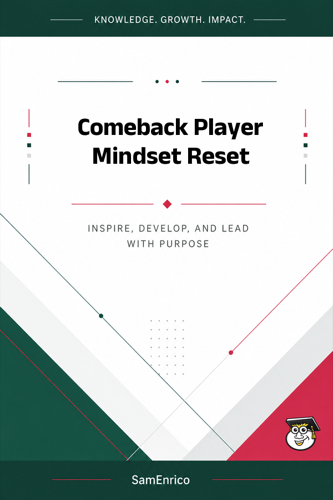
Non-FictionBiographyComeback Stories
Comeback Player Mindset Reset eBook
Rebuild your career after major failure using the
Rebuild your career after major failure using the comeback journeys of NFL stars.
Formats
Free sample
Chapter 1: The Demolition Principle--–- Most self-help books make a catastrophic error. They tell you to stay positive after failure. They instruct you to look on the bright side, to find the silver lining, to “manifest” your comeback through affirmations and vision boards. This is not merely unhelpful. It is dangerous.
When you have just lost your job, your reputation, or your life’s work, positivity is not a strategy—it is anesthesia. It numbs the pain without healing the wound. This chapter argues the opposite of everything you have been told. Before any comeback, before any mindset reset, before any hope of redemption, you must first stare directly into the abyss. You must conduct an unflinching, surgical audit of exactly how you arrived at your lowest point.
The pivot point—the moment everything changes—is not when you start feeling better. It is when you stop lying to yourself about what broke.The Anatomy of a Crash Every career failure follows a pattern. It is not random. It is not bad luck. It is not a conspiracy of enemies or the cruelty of a heartless universe.
Your crash has an anatomy, and understanding that anatomy is the difference between a temporary setback and a permanent collapse.Consider the typical trajectory. You were successful—perhaps very successful. You had a title, a salary, a corner office or a respected byline. You had momentum. Then something shifted.
Maybe you cut a corner that you had cut a hundred times before, but this time someone noticed. Maybe you ignored a warning sign because you were too busy winning. Maybe you isolated yourself, believing that vulnerability was weakness, that asking for help would expose you as a fraud. Maybe you started believing your own press, mistaking your organization’s success for your own infallibility.Then came the event. The missed deadline that spiraled.
The public mistake that went viral. The ethical lapse that became a lawsuit. The restructure that made you redundant. The scandal that burned your reputation to the ground.And now you are here. Reading this book.
Wondering if you will ever work again, if anyone will trust you again, if you will ever look at yourself in the mirror without flinching.Here is the truth that no one tells you: failure is not a detour. It is a demolition. You cannot rebuild on a cracked foundation. You cannot wallpaper over structural rot. The audit we are about to conduct will reveal which parts of your old mindset caused the crash—ego, secrecy, shortcuts, isolation, or some toxic combination of all four.
This will not be comfortable. It will not be positive. It will be the most honest conversation you have ever had with yourself.The NFL Blueprint: Kurt Warner’s Pivot Point Most books about resilience use the same handful of stories. They recycle Michael Vick or Tom Brady or some other overexposed athlete whose comeback has been told so many times it has lost all meaning. This book will not do that.
While Vick’s story has its place—and we will encounter him later in a chapter where he belongs—this chapter introduces you to a different kind of comeback. A quieter one. One that did not involve millions of dollars in rehab facilities or the backing of a powerful coach from the start. This is the comeback of a man who stocked groceries while everyone else told him he was finished.Kurt Warner was not supposed to be in the NFL. He was not drafted out of the University of Northern Iowa, a small school that rarely produced professional talent.
He was invited to training camp by the Green Bay Packers in 1994, a long-shot tryout for a team that already had Brett Favre. He was cut before the season started. No fanfare. No press conference. Just a quiet conversation with a coach who said, “We don’t think you have what it takes.”Warner went home to Iowa.
He took a job stocking shelves at a Hy-Vee grocery store for $5.50 an hour. He lived in his in-laws’ basement with his wife, Brenda, and their newborn daughter, who was blind and required constant medical care. At night, he would practice throwing a football into a mattress propped against the wall of the basement, trying to keep his arm alive while his daughter slept in the next room.This was not a temporary setback. This was a demolition. The dream of the NFL—the dream he had chased since childhood—was not on hold.
It was dead. If Warner had followed the advice of most self-help books, he would have been told to “stay positive” and “visualize success.” He might have repeated affirmations: “I am a quarterback. I belong in the NFL. The universe will provide.” Those affirmations would have been lies. He was not an NFL quarterback.
He was a grocery stocker. The universe was not providing; it was taking.Instead, Warner did something different. He conducted an unflinching audit of his failure. He later described it in interviews: “I had to be honest with myself. I wasn’t good enough—not yet.
I was too slow. My footwork was sloppy. I had no platform to showcase my arm because no one knew who I was. I had to stop pretending I deserved something and start earning it.”That audit was his pivot point. The moment he stopped denying the failure and started using it as data.Warner did not return to the NFL immediately.
He went to the Arena Football League, a minor-league indoor circuit where players earned a fraction of NFL salaries and played on a field half the size. He played for the Iowa Barnstormers, throwing passes in front of crowds that sometimes numbered in the hundreds. He did not complain about being “benched” or “demoted.” He treated every Arena Football game as data—another opportunity to fix his footwork, to speed up his reads, to prove that he was not the player who had been cut by the Packers.Then he got a second chance. The St. Louis Rams, a franchise mired in mediocrity, signed him as a backup.
He was third string behind Trent Green and Joe Germaine. He carried a clipboard. He ran the scout team. He did not demand to start. He did not tell reporters that he had been “misunderstood” in Green Bay.
He simply showed up every day, worked harder than anyone else, and waited.When Trent Green suffered a season-ending injury in the 1999 preseason, Warner stepped in. He threw for more than 4,000 yards and 41 touchdowns, won the NFL MVP award, and led the Rams to a Super Bowl victory. Two years later, he won another MVP. He was inducted into the Pro Football Hall of Fame in 2017. The grocery stocker became one of the greatest quarterbacks in history.But here is the detail that every other book gets wrong.
Warner’s comeback did not begin when he won the Super Bowl. It did not begin when he signed with the Rams. It began in that basement in Iowa, when he looked at himself in the mirror and said, “I am not good enough. Not yet. And I need to…
This is the end of the free sample. Get the eBook to keep going. Buy now
About this book
Details
- Author
- Muniz Eusebio
- Publisher
- SamEnrico
- Language
- English
- Genre
- Non-Fiction, Biography, Comeback Stories
- Released
- 2026-06-09
- Pages (approx.)
- 147
- Available as
- eBook, Audiobook

Read better in the ZLOADR app
Your eBooks on your phone or tablet. Sign in with your SamEnrico account and start reading.
More by Muniz Eusebio
 Net Promoter Score ValidationMuniz Eusebio$11.99
 Talking About Sexual BoundariesMuniz Eusebio$11.99
 Breaking Money Anxiety Cycle WorkbookMuniz Eusebio$11.99
 Wake Back To Bed TechniqueMuniz Eusebio$11.99
 Morning Habit StackMuniz Eusebio$11.99
 Thunberg Green New DealMuniz Eusebio$11.99
 People Pleasing Burnout CureMuniz Eusebio$11.99
 Daniel InouyeMuniz Eusebio$11.99
 The Stuxnet Saboteurs: How a Digital Weapon Changed War ForeverMuniz Eusebio$11.99The Stuxnet Saboteurs: How a Digital Weapon Changed War ForeverMuniz Eusebio$11.99
 The Amazon's Hidden Pulse: Mapping the World's Last Wild RiverMuniz Eusebio$11.99
 The Last Pharaoh's Curse: Cleopatra's Forgotten WarMuniz Eusebio$11.99
You may also like
 Hong Kong Handover 1997Dunn Johnnie$11.99
 Zumba For Postnatal Recovery CourseNeal Christian$11.99
 Zumba for BeginnersLadner Nikia$11.99
 YouTube Comment Mining GuideHumes Pandora$12.99
 Worry Box MeditationCarlin Rudy$11.99
 Workplace Stress MeditationNguyen Lynn$11.99
 Workplace Stress and Sleep RepairHawley Ivory$11.99
 Workplace Perfectionism CureDelaney Jeffry$11.99
 Workplace Injustice Anger GuideWallen Isabelle$11.99
 Work Addiction and Burnout LinkGreenwood Ester$11.99
 Women in Yoga and WellnessBeattie Galina$11.99
 Women in Stand Up ComedyChun Evangeline$11.99