
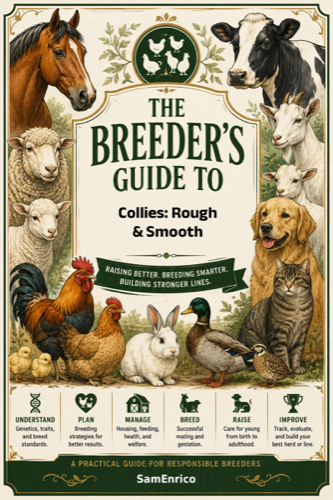
Non-FictionInformativeEducational
Collies: Rough & Smooth eBook
This wildlife publication, published by SamEnrico,
by Reyna Renate
This wildlife publication, published by SamEnrico, covers Collies: Rough & Smooth
Formats
Free sample
Chapter 1: The Puppy No One Wanted...--–- On a cold November morning in the Scottish Borders, a shepherd named Ian Mac Dougall walked into his barn and found something that should not have existed. His prize rough-coated Collie, a champion herder named Flora, had given birth to a litter of seven puppies the night before. Six of them were perfect, fluffy, rough-coated replicas of their mother. The seventh was different. Its coat lay flat against its skin, sleek and short like a working dog from another century.
Ian knelt down, picked up the puppy, and laughed out loud. He had been breeding Collies for thirty years, and in all that time, he had never seen a smooth coat appear from two rough parents.His neighbor, a show breeder from England, told him to drown the puppy. "It's a throwback," the neighbor said. "It will ruin your reputation. No one will buy a smooth from a rough line.
Just get rid of it and pretend it never happened."Ian did not drown the puppy. He named it Wee Sable, after the color of its coat and the brush where he found it. He kept it, trained it, and within two years, Wee Sable became the finest herding dog he had ever owned. Ian never showed the dog. He never registered it with a fancy kennel club.
He simply worked it, loved it, and told anyone who asked the same thing: "A Collie is a Collie. The coat is just the wrapping."This book is for Ian. It is for Wee Sable. And it is for every Collie owner, breeder, and enthusiast who has ever looked at a smooth-coated dog and recognized it for what it truly is: not a different breed, not a mistake, not an embarrassment, but a Collie in its most honest, functional, and historically authentic form.The Great Illusion: Two Breeds or One?Walk into any American Kennel Club dog show, and you will see two separate rings for two separate breeds. In one ring, the Rough Collies stand like statues—flowing manes, elegant profiles, hours of grooming visible in every strand of hair.
In another ring, often at the far end of the building as if to keep them out of sight, the Smooth Collies stand with their short, practical coats and their alert, businesslike expressions. The judges evaluate them against different breed standards. The winners receive different trophies. The breeders speak of them as if they were cousins rather than siblings.This separation is an illusion. It is a century-old habit dressed up as science, a convenience for show organizers that has no basis in biology, history, or function.
The truth—supported by genetics, documented by historians, and known by working shepherds for generations—is that the Rough Collie and the Smooth Collie are one breed. They share the same ancestry, the same instincts, the same health vulnerabilities, and the same essential nature. The only consistent difference between them is a single gene that controls hair length.Let me say that again because it bears repeating. The only consistent genetic difference between a Rough Collie and a Smooth Collie is one gene.This is not opinion. It is fact.
In 2009, a team of geneticists at the National Institutes of Health identified the specific mutation responsible for coat length in dozens of dog breeds, including the Collie. The mutation occurs in the FGF5 gene on canine chromosome 32. Dogs with two copies of the long-coat allele (which we will call "rough" for simplicity) grow long hair. Dogs with at least one copy of the short-coat allele (which we will call "smooth") grow short hair. That is it.
That is the entire genetic difference between the two "breeds" that the American Kennel Club keeps in separate rings.Now, to be precise, the two varieties are not genetically identical. They differ at the FGF5 locus, and they may differ at other modifier genes that affect coat texture, density, and shedding patterns. But these differences are trivial compared to what they share. A Rough Collie and a Smooth Collie are more closely related to each other than either is to any other breed. They are the same dog wearing different coats for different jobs.The Etymology of Erasure: Where the Word "Collie" Came From To understand how we arrived at this strange situation—two breeds from one dog—we must go back to the beginning.
And the beginning, for the Collie, is language.The word "Collie" first appears in written English in the late 17th century, though the dog itself is certainly much older. Most etymologists trace it to the Gaelic word coilean, which simply means "useful dog." In the Scottish Highlands and Lowlands, a coilean was not a breed but a type: a medium-sized, agile, intelligent herding dog with a pointed face, semi-erect ears, and an intense focus on livestock. These dogs came in all colors and, crucially, in both rough and smooth coats.An alternative etymology traces "Collie" to the Anglo-Saxon word colley, meaning "black-faced sheep." In this interpretation, the dog took its name from the animal it herded—a common pattern in working-dog nomenclature. The German Shepherd herds sheep. The Cattle Dog herds cattle.
The Collie, in this view, is simply the "sheep dog" of the British Isles.Notice what neither etymology includes: any reference to coat length. The original Collie was defined by its job, not its appearance. A shepherd in 1700 did not care whether his dog had long hair or short hair. He cared whether it could move a hundred sheep down a mountainside in a blizzard without losing a single animal. The coat was an adaptation to local conditions—long hair for the cold, dry highlands, short hair for the wet, brush-choked lowlands—but it was not the essence of the dog.This functional definition of "Collie" persisted for centuries.
As late as the 1860s, working shepherds in Scotland and northern England routinely bred rough to smooth, smooth to rough, without any sense that they were mixing "breeds." They were simply producing the best working dogs they could, and if a litter produced both coat types, they sold the smooths to lowland farmers and the roughs to highland farmers. Everyone understood that these were variations on a theme, not separate species.The Working Shadow: How Economics Separated the Coats If the rough and smooth were equally valued by working shepherds, how did they become so radically separated in the public imagination? The answer is not biology. It is economics.Imagine you are a shepherd in the Scottish Borders in the year 1840. You have a litter of eight Collie puppies.
Four are rough-coated. Four are smooth-coated. All eight have the same parents, the same instincts, the same health. You need to sell these puppies to feed your family. Which ones bring the highest price?The answer, then as now, is the rough-coated ones.
The shaggy dogs look more distinctive. They look more "wild." They look, to a wealthy gentleman farmer who has never worked a sheep in his life, like proper Highland dogs. The smooth-coated puppies—clean-lined, efficient, almost utilitarian in their simplicity—look like mutts. They look like Greyhounds crossed with something else. They look, in…
This is the end of the free sample. Get the eBook to keep going. Buy now
About this book
Details
- Author
- Reyna Renate
- Publisher
- SamEnrico
- Language
- English
- Genre
- Non-Fiction, Informative, Educational
- Released
- 2026-05-11
- Pages (approx.)
- 139
- Available as
- eBook, Audiobook

Read better in the ZLOADR app
Your eBooks on your phone or tablet. Sign in with your SamEnrico account and start reading.
More by Reyna Renate
 Meditation for Needle PhobiaReyna Renate$11.99
 Car Mindfulness Practice GuideReyna Renate$11.99
 Anticipatory Grief ReliefReyna Renate$11.99
 Postpartum Therapy OptionsReyna Renate$11.99
 Constraints for CoachesReyna Renate$11.99
 Tax Strategy NoteReyna Renate$11.99
 Oral Contraceptive Breast RiskReyna Renate$11.99
 Assertiveness for Nonprofit WorkersReyna Renate$11.99
 The Copycat Killers of Japan: The Aum Shinrikyo LegacyReyna Renate$11.99
 The Diamond Snatchers: How a Global Kidnapping Ring Shattered the Jewel Trade (1970s)Reyna Renate$11.99
 How to Start a Agricultural Hand Tools, Not Power-driven Business (Beginners Guide)Reyna Renate$11.99
 How to Produce Paella PansReyna Renate$11.99
You may also like
 Hong Kong Handover 1997Dunn Johnnie$11.99
 Zumba For Postnatal Recovery CourseNeal Christian$11.99
 Zumba for BeginnersLadner Nikia$11.99
 YouTube Comment Mining GuideHumes Pandora$12.99
 Worry Box MeditationCarlin Rudy$11.99
 Workplace Stress MeditationNguyen Lynn$11.99
 Workplace Stress and Sleep RepairHawley Ivory$11.99
 Workplace Perfectionism CureDelaney Jeffry$11.99
 Workplace Injustice Anger GuideWallen Isabelle$11.99
 Work Addiction and Burnout LinkGreenwood Ester$11.99
 Women in Yoga and WellnessBeattie Galina$11.99
 Women in Stand Up ComedyChun Evangeline$11.99