
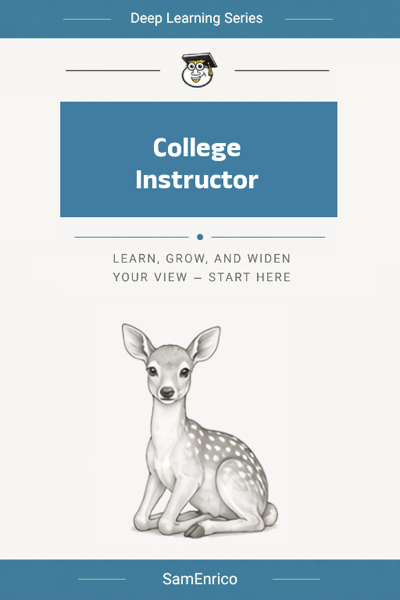
Non-FictionInformativeEducational
College Instructor eBook
A Coursebook on College Instructor
A Coursebook on College Instructor
Formats
Free sample
Chapter 1: The Syllabus Lie...--Most new college instructors believe a dangerous myth. They believe that if they write a clear, comprehensive syllabus—listing every policy, every deadline, every grading scale in meticulous detail—their students will read it, understand it, and follow it. They believe the syllabus is a contract. They believe clarity equals compliance.They are wrong.I learned this lesson in my third year of teaching, standing in front of a freshman composition class during the second week of the semester. A student raised his hand and asked, "Wait, we have to do peer review?
That wasn't in the syllabus."I pulled up the syllabus on the projector. There it was, bolded and underlined: "Week 4: Peer Review Workshop (required, counts for 15% of final grade).""Oh," the student said. "I didn't read that part."He was not being defiant. He was being honest. And his honesty exposed a truth that most faculty development workshops ignore: the traditional syllabus is a document designed for administrative compliance, not human learning.
It is a legalistic artifact from an era when students had fewer responsibilities, longer attention spans, and a different relationship to authority. That era is over.This chapter dismantles the syllabus lie and replaces it with something more honest, more useful, and far more effective: backward design. You will learn why your current syllabus probably fails before the semester even starts, how to distinguish between three essential planning documents (only one of which you hand to students), and how to reverse-engineer your course so that every assignment, every lecture, every discussion serves a single purpose: ensuring students can actually do something with what you teach.By the end of this chapter, you will never write a traditional syllabus again. And your students will thank you.The Syllabus as Security Blanket Let me describe a scene that plays out in faculty offices every August.An instructor—let's call her Dr. Chen—opens her laptop and begins drafting her syllabus.
She copies the required boilerplate from her department's template: academic integrity policy, disability accommodations statement, Title IX notification, emergency procedures. She adds her grading scale (90-80-70-60, like always). She lists her late policy ("No late work accepted without documented excuse"). She maps out sixteen weeks of topics, chapter by chapter. She saves the file, prints forty copies, and feels a wave of satisfaction.
Done, she thinks. Now I'm ready.Dr. Chen has just performed a ritual that has nothing to do with teaching and everything to do with anxiety management. The syllabus she created is not a learning tool. It is a security blanket.
It protects her from grade appeals, from administrative scrutiny, from the terrifying uncertainty of standing in front of thirty strangers and trying to change their minds. It says, "I did my job. I told you the rules. If you fail, that's on you."This is not Dr. Chen's fault.
She was trained to write this document. Her graduate program never taught her course design. Her department chair asked for a syllabus by Friday. She did what everyone else does.But the syllabus-as-security-blanket has a hidden cost. Research on syllabus tone (Harnish & Bridges, 2011) found that syllabi written with controlling, punitive language ("Students must attend every class," "No make-up exams for any reason") correlate with lower student evaluations, higher withdrawal rates, and reduced motivation compared to syllabi written with facilitative language ("You are expected to attend every class because participation builds community," "If you miss an exam, contact me within 48 hours to arrange a make-up").The problem is not that syllabi are unnecessary.
The problem is that the traditional syllabus tries to do three incompatible jobs at once. It tries to be a legal contract (protecting the instructor and institution), a logistical roadmap (listing dates and policies), and a motivational invitation (convincing students that the course matters). No single document can succeed at all three. The attempt produces something that fails at every job: too dense to read, too threatening to inspire, too generic to guide.The Three-Document Solution Throughout this book, I distinguish between three separate documents. You will create all three, but only two go to students.
The distinction resolves the contradictions that plague traditional syllabi.Document One: The Planning Blueprint (For You Only)This is your private working document. No student ever sees it. The Planning Blueprint is where you do the hard work of backward design (the subject of this chapter). It contains your raw learning outcomes, your assessment map, your week-by-week alignment notes, and your reflections on what worked and what didn't. It is messy.
It changes. It is yours. Think of it as an architect's blueprint before the house is built—full of measurements, calculations, and notes that only the builder needs.Document Two: The Student Syllabus (For Students)This is the document you distribute on day one (and post on your LMS). It is warm, transparent, and student-facing. It explains what students will learn, why it matters, and how they will demonstrate their learning.
It includes policies, but those policies are framed as commitments ("I commit to returning graded work within one week") rather than threats ("Late work will be penalized"). The Student Syllabus is what most people mean when they say "syllabus"—but now it has a clear purpose and a consistent tone. Chapter 3 provides a complete guide to writing the Student Syllabus as a warm demander.Document Three: The One-Page Graphic Syllabus (For First-Day Orientation)This is a visual summary of the course: the central question, the major assignments, the key deadlines, and the path from week one to week sixteen. It fits on a single page (front and back at most). You hand it out on day one alongside the full Student Syllabus.
Students keep the graphic syllabus taped to their wall, saved as a phone screenshot, or tucked into their notebook. It answers the question "What is this course about?" in sixty seconds. Chapter 4 explains how to design and use the graphic syllabus during the first fifteen minutes of class.From this point forward, when I use the word "syllabus" alone, I mean the Student Syllabus (Document Two). When I refer to the other documents, I name them explicitly: Planning Blueprint or Graphic Syllabus. This three-document framework solves the problem that has plagued syllabus design for decades: trying to cram three incompatible purposes into one doomed document.What Backward Design Is (And Why Forward Design Fails)Now we arrive at the heart of this chapter: backward design.
The term comes from educators Grant Wiggins and Jay Mc Tighe, whose book Understanding by Design (1998) transformed curriculum planning in K-12 education. But backward design has never fully penetrated college teaching, where "forward design" remains the default.Forward design looks like this:Choose a textbook or list of topics.Schedule topics week by week.Add assessments (tests, papers, projects) where they seem to fit.Write the syllabus.Teach.Grade.Repeat.Forward design is intuitive. It is how most of us were taught. It is also backward.Here is why forward design fails. When you start with topics, you prioritize coverage over competence.
Your implicit goal becomes "get through the material" rather than "ensure students can do something." Assessments become afterthoughts, tacked onto…
This is the end of the free sample. Get the eBook to keep going. Buy now
About this book
Details
- Author
- Dailey Tomoko
- Publisher
- SamEnrico
- Language
- English
- Genre
- Non-Fiction, Informative, Educational
- Released
- 2026-05-11
- Pages (approx.)
- 151
- Available as
- eBook, Audiobook

Read better in the ZLOADR app
Your eBooks on your phone or tablet. Sign in with your SamEnrico account and start reading.
More by Dailey Tomoko
 Sugar Freedom PlanDailey Tomoko$11.99
 Emotional Intelligence In JournalismDailey Tomoko$11.99
 SEAL Mike Boat TeamDailey Tomoko$11.99
 Martina Navratilova Tennis RevolutionaryDailey Tomoko$11.99
 Yahoo Billion Account HackDailey Tomoko$11.99
 Anansi's Web of Wisdom: The Spider Trickster’s Endless SchemesDailey Tomoko$11.99
 The Frozen Cartographer: Mapping Antarctica’s Hidden Rivers in the Medieval WorldDailey Tomoko$11.99
 ESL Payment Processing GuideDailey Tomoko$12.99
 African Remote Tech Worker WorkbookDailey Tomoko$12.99
 Understanding GangliosidosisDailey Tomoko$17.99
 How to Become a Jewel-hole DrillerDailey Tomoko$11.99
You may also like
 Hong Kong Handover 1997Dunn Johnnie$11.99
 Zumba For Postnatal Recovery CourseNeal Christian$11.99
 Zumba for BeginnersLadner Nikia$11.99
 YouTube Comment Mining GuideHumes Pandora$12.99
 Worry Box MeditationCarlin Rudy$11.99
 Workplace Stress MeditationNguyen Lynn$11.99
 Workplace Stress and Sleep RepairHawley Ivory$11.99
 Workplace Perfectionism CureDelaney Jeffry$11.99
 Workplace Injustice Anger GuideWallen Isabelle$11.99
 Work Addiction and Burnout LinkGreenwood Ester$11.99
 Women in Yoga and WellnessBeattie Galina$11.99
 Women in Stand Up ComedyChun Evangeline$11.99