
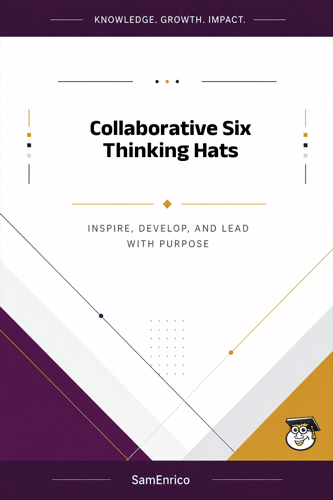
Non-FictionSelf-HelpThinking Frameworks
Collaborative Six Thinking Hats eBook
Applies de Bono's parallel thinking method to grou
Applies de Bono's parallel thinking method to group decision making and creativity.
Formats
Free sample
Chapter 1: The Meeting Cemetery...–- Mark glanced around the conference table. Eleven people stared back at him. Three scrolled through emails. One was clearly still finishing slides from another meeting. Two looked like they had already decided the outcome before walking in.
The agenda on the whiteboard had not changed in three weeks. The same problem. The same arguments. The same raised voices followed by the same exhausted silence. Mark sighed.
This was going to be another hour of his life he would never get back.Ninety minutes later, the meeting ended exactly where it began: nowhere. They had debated. They had defended. They had attacked, retreated, and attacked again from different angles. The marketing director had called the operations lead "naive." The operations lead had called the marketing director "reckless." The CFO had stayed silent, which everyone interpreted as disapproval.
The junior product manager had spoken exactly once, been interrupted, and never tried again. And the problem—whether to launch the feature in Q3 or delay to Q4—remained unresolved. Mark walked back to his desk with the familiar feeling of having run a marathon only to discover he had been on a treadmill.This scene plays out thousands of times every day, in every industry, on every continent. Teams gather to solve problems. They have data.
They have expertise. They have good intentions. And yet, they leave with the same problems, deeper frustrations, and a little less trust in one another. The meeting did not fail because people were lazy or stupid. It failed because the structure of thinking was broken.The Adversarial Trap: Why Smart People Make Dumb Teams The human brain evolved to argue.
When a caveman saw another caveman approach, the brain did not say, "Let me gather all perspectives and synthesize a balanced view." The brain said, "Friend or enemy? Fight or flee?" This is the origin of adversarial thinking. It is fast. It is protective. And it is disastrous for modern teamwork.What most people call "discussion" is actually structured combat.
One person proposes an idea. Another person attacks it. The first person defends it. The second person finds a new angle of attack. Round and round they go.
This is the Adversarial Trap, and it has three devastating consequences that no amount of talent or good will can overcome.First, the trap turns meetings into zero-sum games. If my idea wins, you lose. If your risk assessment is accepted, my optimistic timeline looks foolish. This binary logic—winner and loser—activates every defensive instinct in the human nervous system. Heart rates rise.
Pupils dilate. Blood flows away from the prefrontal cortex (responsible for reasoning) and toward the amygdala (responsible for threat detection). The meeting becomes a cage match, not a workshop.Second, the trap confuses position with identity. When someone attacks my proposal, I do not hear criticism of an idea. I hear criticism of me.
This is because we invest our egos in our opinions. The longer I have held a view, the more publicly I have stated it, the more it becomes part of who I am. To change my mind is to admit I was wrong. And in adversarial cultures, being wrong is shameful. So I double down.
I find new evidence to support my position. I ignore evidence that contradicts it. This is not stubbornness. This is neuroscience. The brain literally processes threats to beliefs the same way it processes physical threats.Third, the trap silences the people you most need to hear.
In every meeting, there is a distribution of personality types. A few people are assertive, quick to speak, comfortable with conflict. Many more are reflective, cautious, or conflict-averse. In an adversarial meeting, the loudest voices dominate not because they have the best ideas but because they have the highest tolerance for verbal combat. The quietest people—who often have the most valuable insights because they have been quietly observing patterns everyone else misses—learn to stay quiet.
They calculate the cost of speaking (interruption, dismissal, social friction) and decide it is not worth it. The organization loses their wisdom. No one even knows it was on the table.The result is what one Fortune 500 executive called "the meeting cemetery"—a graveyard of good ideas killed by bad process, of smart people made stupid by adversarial dynamics, of time that could have built something new spent instead on defending old ground.The Cost of Ego: Why Defending Positions Replaces Solving Problems Consider a simple experiment. A team of six people is given a problem: a factory produces widgets. The defect rate is 5%.
The team must decide whether to invest $100,000 in a new quality control system that would reduce defects to 2%. The finance person calculates a payback period. The operations person worries about production downtime during installation. The quality person points out that 2% is still too high. The sales person says customers are already complaining.
The CEO wants a decision by Friday.In a traditional meeting, this scenario unfolds predictably. Each person advocates for their functional area's priorities. The finance person says, "We cannot spend that much for such a small improvement." The operations person says, "Downtime would cost us another $50,000." The quality person says, "If we do nothing, we risk losing our ISO certification." The sales person says, "If we lose one more major client, the cost is $500,000." The CEO listens, growing more frustrated by the minute. Everyone is right. Everyone is also wrong, because they are each holding only one piece of a larger puzzle and refusing to let go.This is the Ego Tax.
It is the hidden cost of adversarial thinking. When people are locked into defending their positions, they stop listening. They stop synthesizing. They stop asking, "What am I missing?" Instead, they ask, "How can I prove I am right?" The organization pays the Ego Tax in three currencies: time, trust, and quality.Time is the most obvious. Meetings that could take thirty minutes take ninety.
Decisions that could be made in one session drag across three. The hidden cost is not just the hour on the calendar but the hour of recovery afterward—the time people spend venting to colleagues, replaying arguments in their heads, and mentally preparing for the next round.Trust is more expensive. Each adversarial exchange chips away at the social fabric. "She dismissed my concern without even considering it." "He twisted my words to make me look foolish." "They made a decision and then asked for our input as an afterthought." Over months and years, these micro-injuries accumulate. Psychological safety collapses.
People stop sharing real concerns. They stop proposing novel ideas. They comply silently and disengage internally. The organization becomes a place where nothing terrible happens and nothing wonderful happens either.Quality is the ultimate casualty. When teams argue rather than explore, they converge on the least objectionable option, not the best option.
They choose the safe path, the familiar path, the path that has been used before. Innovation requires exploring the unknown. The unknown is risky. In an adversarial culture, proposing something new is like waving a red flag at a bull. Better to keep your head down and your mouth shut.Beyond Debate: The Map-Making…
This is the end of the free sample. Get the eBook to keep going. Buy now
About this book
Details
- Author
- Holley Florene
- Publisher
- SamEnrico
- Language
- English
- Genre
- Non-Fiction, Self-Help, Thinking Frameworks
- Released
- 2026-06-10
- Pages (approx.)
- 155
- Available as
- eBook, Audiobook

Read better in the ZLOADR app
Your eBooks on your phone or tablet. Sign in with your SamEnrico account and start reading.
More by Holley Florene
 Archer Self Hypnosis GuideHolley Florene$11.99
 Self Hypnosis for Phantom Limb PainHolley Florene$11.99
 Aerophobia Flight Fear GuideHolley Florene$11.99
 Nap Before Interview GuideHolley Florene$11.99
 Canva Font Pairing GuideHolley Florene$11.99
 Acupuncture for Plantar FasciitisHolley Florene$11.99
 Digital Workplace CommunicationHolley Florene$11.99
 The Lion’s Wisdom: The Royal Hunters of the Kingdom of KongoHolley Florene$11.99
 The Baby Farmers of Victorian England: The Dark Trade in InfanticideHolley Florene$11.99
 How to Produce Pinball MachinesHolley Florene$11.99
 South African Business Funding AccessHolley Florene$12.99
 Social Media Audit SheetHolley Florene$12.99
You may also like
 Hong Kong Handover 1997Dunn Johnnie$11.99
 Zumba For Postnatal Recovery CourseNeal Christian$11.99
 Zumba for BeginnersLadner Nikia$11.99
 YouTube Comment Mining GuideHumes Pandora$12.99
 Worry Box MeditationCarlin Rudy$11.99
 Workplace Stress MeditationNguyen Lynn$11.99
 Workplace Stress and Sleep RepairHawley Ivory$11.99
 Workplace Perfectionism CureDelaney Jeffry$11.99
 Workplace Injustice Anger GuideWallen Isabelle$11.99
 Work Addiction and Burnout LinkGreenwood Ester$11.99
 Women in Yoga and WellnessBeattie Galina$11.99
 Women in Stand Up ComedyChun Evangeline$11.99