
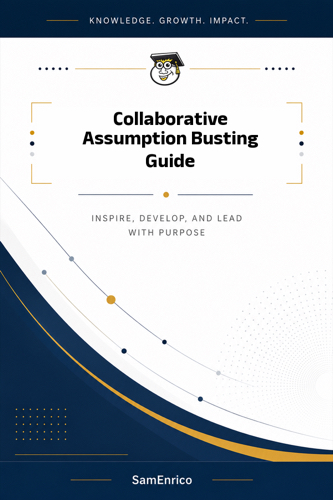
Collaborative Assumption Busting Guide eBook
Identifies and challenges hidden beliefs that cons
Identifies and challenges hidden beliefs that constrain team creativity.
Formats
Free sample
Chapter 1: The Invisible Water--Every team you have ever been on has been lying to you. Not maliciously. Not even consciously. But lying nonetheless. The lie sounds like this: "We are thinking freely.
All options are on the table. No idea is too crazy."This is almost never true.What is actually happening inside your team meetings is far more constrained. There are invisible walls around every conversation, silent gatekeepers that decide which ideas live and which die before they are even spoken aloud. These walls are not made of policy or budget or physical reality. They are made of assumptions—beliefs so deeply embedded in your team's daily life that no one remembers to question them.You assume that the manager must approve every decision.
You assume that customers won't pay for that feature. You assume that the competitor across town is smarter than you. You assume that meetings need agendas. You assume that the junior person should speak last. You assume that failure is bad.None of these are facts.
They are cages. And you have been living inside them for so long that you have forgotten you are in a cage at all.This chapter is about learning to see those cages for the first time. By the time you finish reading, you will have a name for every invisible wall your team has been bumping against. More importantly, you will have a tool to measure exactly which cages are holding your team back—and a clear path to start breaking them open.The Fish Does Not Know It Is in Water There is a famous metaphor that appears across cultures and traditions. Two young fish are swimming along when an older fish passes them and says, "Morning, boys.
How's the water?" The two young fish swim on for a bit, and then one turns to the other and asks, "What the hell is water?"The water is the most obvious, most pervasive, most important reality of the fish's existence. And it is completely invisible to them.Your team's water is its assumptions. You swim through them every day. You breathe them in. They shape every decision, every conversation, every creative possibility.
And you never see them because they are always there.A product team assumes that their users read release notes. They design their entire communication strategy around this belief. They pour hours into writing detailed changelogs. They wonder why adoption of new features is so low. Not once does anyone ask: "What if our users never read release notes?" That question would take three seconds.
It would open an entirely new set of possibilities—in-app tutorials, video walkthroughs, even old-fashioned printed cards in the shipping box. But no one asks it because the assumption is water. It is simply true because it has always been true.A hospital administration team assumes that patients want quiet hallways. They enforce strict noise policies. They punish nurses for talking too loudly.
They never consider that patients might actually feel safer when they hear active communication among staff—the sound of a team that is awake, alert, and coordinating. The assumption is water. It is invisible.A software engineering team assumes that code reviews must be thorough and slow. They have a three-day review window. They have checklists and signoffs.
They never ask: "What if we did code reviews in fifteen minutes?" That question is too simple. It feels naive. So it never gets asked.This is the tragedy of teams. Not that they lack smart people. Not that they lack resources.
But that they cannot see the water they are swimming in.The Hidden Cost of Unseen Beliefs Before we learn to name the cages, we need to understand what they cost. The numbers are staggering, though you will not find them on any balance sheet.Every team suffers from what researchers call "assumption drag"—the hidden friction created by unexamined beliefs. A study published in the Journal of Creative Behavior found that teams that explicitly identified and challenged their assumptions generated 78 percent more novel solutions than teams that did not. Seventy-eight percent. That is not a marginal improvement.
That is the difference between a team that survives and a team that transforms an industry.But the cost goes beyond lost ideas. Assumptions also create what organizational psychologist Chris Argyris called "skilled incompetence"—the phenomenon where highly capable people become experts at avoiding the very conversations that would make them more effective. They learn to navigate around the cages rather than asking why the cages exist in the first place.Consider the following scenarios. In each case, an invisible assumption is doing real damage:A marketing team spends six weeks developing a campaign around a new product feature. The feature flops.
In the post-mortem, someone finally says: "We assumed customers wanted this feature." No one had ever asked the customer. The assumption was so obvious—we built it, so of course they want it—that it never occurred to anyone to verify it. Six weeks of work. Thousands of dollars. All because of water.A nonprofit board debates for three hours whether to apply for a government grant.
The debate centers on paperwork requirements, reporting timelines, and staffing constraints. Finally, the executive director says: "We're assuming we'll get the grant. What if we assume we won't?" The room goes silent. They redesign their entire strategy around self-funded initiatives and discover a new revenue stream that outlasts any grant ever could. The original assumption—"grants are how we grow"—had been water for fifteen years.A family running a small restaurant assumes that lunch customers want speed above all else.
They optimize every process for fast turnaround. They pre-make sandwiches. They streamline the menu. Their lunch business grows. But their dinner business collapses because the same customers now associate the restaurant with rushed, impersonal service.
The assumption—"speed is what matters"—was never questioned because it produced short-term wins. The long-term cost was invisible.These stories share a common structure. A team holds a belief. The belief goes unexamined. The team acts on the belief.
The belief turns out to be incomplete or wrong. The team suffers. And no one in the room ever said, "Wait, is that actually true?"The Four Cages That Trap Your Team To help you see your team's water, we need a shared language. This book organizes all assumptions into four categories called the Four Cages. Every invisible wall your team encounters will fit into one of these cages.
Once you can name the cage, you can start breaking it.Cage One: The Individual Cage The Individual Cage contains assumptions rooted in personal fear, self-doubt, and risk aversion. These are the voices in your own head that tell you to stay quiet, play it safe, and avoid looking stupid.Common Individual Cage assumptions include: "I'm not creative enough to contribute here." "If I ask a question, everyone will think I'm slow." "My idea is probably obvious, so I won't share it." "I need permission before trying something new." "Mistakes will ruin my reputation."The Individual Cage is the most personal and often the most painful because it feels like truth. When you believe you are not creative, that…
This is the end of the free sample. Get the eBook to keep going. Buy now
About this book
Details
- Author
- Stanfield Clemmie
- Publisher
- SamEnrico
- Language
- English
- Genre
- Non-Fiction, Self-Help, Critical Thinking
- Released
- 2026-06-08
- Pages (approx.)
- 139
- Available as
- eBook, Audiobook

Read better in the ZLOADR app
Your eBooks on your phone or tablet. Sign in with your SamEnrico account and start reading.
More by Stanfield Clemmie
 SMART For Work Life BalanceStanfield Clemmie$11.99
 Morning Flow RoutineStanfield Clemmie$11.99
 Student Mental HealthStanfield Clemmie$11.99
 Stretch Break HabitStanfield Clemmie$11.99
 Acupuncture for FatigueStanfield Clemmie$11.99
 Self Hypnosis for Control AnxietyStanfield Clemmie$11.99
 Massage CEU HoursStanfield Clemmie$11.99
 The Great New Zealand Prison Break: The Escape of Martin CrimminsStanfield Clemmie$11.99
 Starlight Betrayal: The Cosmonaut Who VanishedStanfield Clemmie$11.99
 How to Produce Picture FramesStanfield Clemmie$11.99
 How to Produce Dental EquipmentStanfield Clemmie$11.99
 A Collector's Handbook to the Volvo 262c CoupeStanfield Clemmie$11.99
You may also like
 Team Assumption BustingHook Ina$11.99
 Real vs Reel Social MediaKruger Norberto$11.99
 Chunking for Critical ThinkingMarino Darleen$11.99
 Mindfulness for Beginner NaysayersAlonso Palma$11.99
 Elaborative Interrogation MethodBruce Holley$11.99
 Critical Listening for Debates and ArgumentsPrather Candy$11.99
 The Logical Fallacy Persuasion GuideLink Cordell$11.99
 Devil Advocate Role AssignmentCurran Kym$11.99
 Critical Thinking in Teams GuideRoark Elroy$11.99
 The Eisenhower Matrix Critical DistinctionCasas Sandee$11.99
 Red Teaming Creative IdeasWhitley Reta$11.99
 Elaboration Study GuideKuykendall Fay$11.99