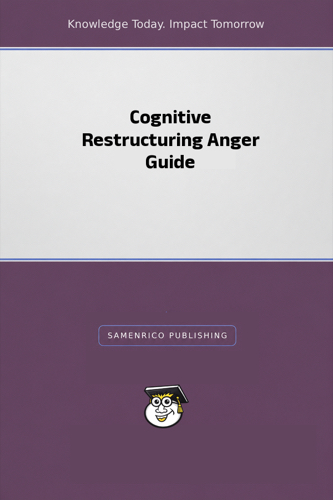
Cognitive Restructuring Anger Guide eBook
Teaches CBT techniques to identify and reframe ang
by Libby Cheree
Teaches CBT techniques to identify and reframe anger-triggering thoughts before they escalate.
Formats
Free sample
Chapter 1: The 90-Second Lie--–- You are about to discover something that will change how you see every argument, every traffic jam, and every moment someone pushes your buttons. But first, I need you to forget almost everything you think you know about anger.The lie begins like this: You’re driving home after a long day. You’re tired, hungry, and already running late. Suddenly, a car swerves into your lane without a signal, missing your front bumper by inches. Your hands grip the steering wheel.
Your jaw clenches. Heat floods your chest and climbs up your neck. And before you can take a single breath, a voice inside your head screams: “You idiot! Are you trying to kill me?!”You honk. You tailgate.
You roll down your window and yell something you’ll regret before you reach the next red light. And later, when you’re telling the story to your partner or a friend, you say the words that billions of people have said before you: “He made me so angry.”That phrase—he made me angry—is the most dangerous lie you believe about yourself.Not because you’re dishonest. But because that single sentence hands the keys to your emotional life over to every stranger, every careless driver, every rude coworker, and every family member who knows exactly which buttons to push. If someone else can make you angry, then someone else controls you. And you have been walking around believing that lie for so long that it feels like gravity.This chapter is going to shatter that lie.
But more importantly, it is going to replace it with something that actually works: a precise, neurological understanding of what happens inside your brain during the 90 seconds after a trigger, and a roadmap for taking back control without becoming a doormat.Let’s start with the truth.The Evolutionary Gift You’ve Been Misusing Anger did not evolve to ruin your relationships. It evolved to save your life.Imagine your distant ancestor, let’s call her Rana, living on the savanna 100,000 years ago. She hears a rustle in the grass. A saber-toothed cat is crouching nearby. In that moment, Rana’s brain does not pause to consider the cat’s childhood or the philosophical nature of predation.
Her amygdala—an almond-shaped cluster of neurons deep in the brain’s temporal lobe—fires like a starting pistol. Adrenaline floods her bloodstream. Her heart rate doubles. Blood rushes to her large muscle groups. Her peripheral vision sharpens.
And she feels a surge of what we now call anger—not the brooding, resentful kind, but the clean, explosive energy of self-preservation.That anger does one thing extremely well: it mobilizes her to act. She either fights the cat or flees. Either way, she survives.This is the original purpose of anger. It is a boundary signal and a mobilization system. It says: Something is wrong.
Something is threatening you or what you value. Now move.Fast-forward 100,000 years. You are not facing a saber-toothed cat. You are facing a slow internet connection, a critical email from your boss, a child who spilled juice on the carpet, or a partner who forgot to take out the trash. Your amygdala, however, has not received the memo.
It still reacts to social threats—disrespect, exclusion, unfairness, criticism—as if they were physical predators. And so you feel that same surge: the clenched jaw, the racing heart, the hot flush of fury.Here is what most self-help books get wrong: They tell you that anger is bad. That you should eliminate it, suppress it, or meditate it away. That is not only impossible—it is dangerous. A person who cannot feel anger is a person who cannot defend their own boundaries.
They tolerate abuse. They accept mistreatment. They mistake passivity for virtue.The goal of this book is not to make you less angry. The goal is to make you the pilot of your anger instead of its passenger.Healthy Anger vs. Problematic Anger: The One Question That Changes Everything Not all anger is created equal.
There is a world of difference between the flash of irritation that tells you a boundary has been crossed and the volcanic eruption that leaves your relationships in ashes.Healthy anger has four characteristics:It is brief. It rises quickly but also falls quickly, usually within seconds or minutes.It is proportionate. The intensity matches the trigger. A spilled drink produces mild annoyance, not a screaming fit.It motivates constructive action. It pushes you to speak up, set a limit, or solve a problem—not to punish, humiliate, or destroy.It leaves no residue.
Once the situation is resolved, the anger dissolves. You do not carry it into the next conversation or the next day.Problematic anger looks very different:It is prolonged. It lingers for hours, days, or even years as resentment.It is disproportionate. A small trigger produces an explosive reaction. Or a large trigger produces no visible reaction (brooding), only to explode later.It motivates destructive action.
It drives you to yell, insult, withdraw, slam doors, throw things, or plot revenge.It leaves residue. The anger hardens into grudges, patterns of blame, and a general sense that the world is against you.Here is the single question that separates healthy from problematic anger: Is my anger helping me or hurting me right now?That is not a rhetorical question. It is a diagnostic tool. When you feel anger rising, pause (we will teach you exactly how in Chapter 8) and ask yourself honestly: Is this anger, in this moment, helping me protect a boundary, solve a problem, or communicate a need? Or is it already hurting my body, my relationships, or my ability to think clearly?If the answer is “helping,” your anger is doing its job.
Listen to it. Act on it—calmly and assertively (Chapter 9). If the answer is “hurting,” your anger has turned against you. It is no longer a tool. It is a wildfire.
And you need to put it out before it burns down the house.The Four Faces of Anger: Which One Is Yours?Before you can change your anger, you need to recognize your personal pattern. Most people assume there is only one way to be angry—the classic explosive outburst. But clinical research has identified at least four distinct anger profiles. Take a moment to read each one honestly.The Explosive. You blow up quickly, often over small things.
Your anger feels like a geyser: pressure builds, and then suddenly you erupt. You yell, slam doors, say things you regret, and then feel ashamed afterward. You might tell yourself, “I just have a short fuse.” The cost: damaged relationships, professional consequences, and a cycle of explosion followed by guilt.The Brooder. You do not explode. You simmer.
Someone offends you, and you replay the scene in your head for hours or days. You rehearse what you should have said. You fantasize about revenge or confrontation. On the outside, you look calm. On the inside, you are eating yourself alive.
The cost: chronic stress, high blood pressure, depression, and eventual explosive outbursts when the simmering boils over.The Passive-Aggressive. You cannot…
This is the end of the free sample. Get the eBook to keep going. Buy now
About this book
Details
- Author
- Libby Cheree
- Publisher
- SamEnrico
- Language
- English
- Genre
- Non-Fiction, Self-Help / Anger Management
- Released
- 2026-06-07
- Pages (approx.)
- 128
- Available as
- eBook, Audiobook

Read better in the ZLOADR app
Your eBooks on your phone or tablet. Sign in with your SamEnrico account and start reading.
More by Libby Cheree
 The Elouise Cobell StoryLibby Cheree$11.99
 Sober Career Change GuideLibby Cheree$11.99
 Morning MIT Task RoutineLibby Cheree$11.99
 Future Self VisualizationLibby Cheree$11.99
 Short Chain Fatty AcidsLibby Cheree$11.99
 Self Talk For Health ChallengesLibby Cheree$11.99
 Fortnite Gaming Addiction HelpLibby Cheree$11.99
 The Forgotten Code of the Dead Sea Scrolls: A Lost Language RevealedLibby Cheree$11.99
 The Hollow Throne: When Kings Were Cast Out by the PeopleLibby Cheree$11.99
 The Essential Guide to RockabillyLibby Cheree$11.99
 How to Produce ReinsLibby Cheree$11.99
 Promotion Timeline Planning GuideLibby Cheree$12.99