
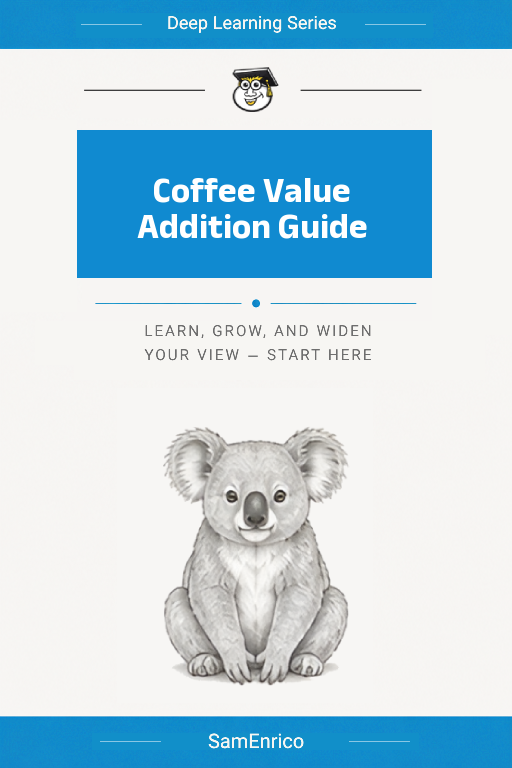
Non-FictionBusiness BriefAgricultural Trade
Coffee Value Addition Guide eBook
Add value to coffee before export. Roasting, grind
Add value to coffee before export. Roasting, grinding, and specialty processing.
Formats
Free sample
Chapter 1: The 80% Funeral--–- The old men of the cooperative called it “the funeral of green.” Every January, when the buyers came down from the capital, they would stand at the edge of the drying patios and watch their year’s work being weighed, valued, and taken away for a price that barely covered the fertilizer and the school fees. They knew, in the way that farmers always know, that something was being lost between their calloused hands and the steaming cup that someone in Berlin or Seoul would pay seven dollars for. They just couldn’t prove it on paper. They couldn’t measure the ghost of value that slipped through their fingers the moment the green beans left their gates.This chapter is the reckoning with that ghost. It is the cold, hard, mathematical confession that most coffee producers—especially smallholders, the backbone of the entire industry—are selling their birthright for a fraction of what it is worth.
And the tragedy is not that the market is cruel. The tragedy is that the market is predictable. The value you are losing can be calculated, traced, and, most importantly, recaptured. But first, you have to stop treating green coffee as your final product. You have to see it for what it is: unfinished business.The Arithmetic of Loss: Why 1.80Doesn’t Stay1.80 Doesn’t Stay 1.80Doesn’t Stay1.80Let us begin with a single kilogram of green Arabica coffee, parchment removed, screen size 15+, grown at 1,600 meters, picked at the peak of the harvest.
In 2024, that kilogram sold for an average of 2.10onthe New York“C”market,thoughspecialtypremiumscouldpushitto2.10 on the New York “C” market, though specialty premiums could push it to 2.10onthe New York“C”market,thoughspecialtypremiumscouldpushitto3.50 for exceptional lots. Let us be generous and say you are a skilled producer. You receive $2.50 per pound for your green beans. You are proud of this. You should be.
You are beating the commodity price.Now watch what happens to that same coffee after it leaves your warehouse.The buyer—an importer in Hamburg or Oakland—takes your green beans and sells them to a roaster for 4.00perpound.Theroaster,usingthetechniqueswewillexplorein Chapter7,appliesheatandtime,transformingthosegrassy,vegetalseedsintosomethingfragrantandbrown.Buthereisthefirstknifeinthegut:theroastingprocessitselfburnsaway15to20percentoftheweight.That4.00 per pound. The roaster, using the techniques we will explore in Chapter 7, applies heat and time, transforming those grassy, vegetal seeds into something fragrant and brown. But here is the first knife in the gut: the roasting process itself burns away 15 to 20 percent of the weight. That 4.00perpound.Theroaster,usingthetechniqueswewillexplorein Chapter7,appliesheatandtime,transformingthosegrassy,vegetalseedsintosomethingfragrantandbrown.Buthereisthefirstknifeinthegut:theroastingprocessitselfburnsaway15to20percentoftheweight.That4.00 green pound becomes 0.82 pounds of roasted coffee. To break even on the green purchase alone, the roaster must now price that roasted coffee at 4.88perpound.Buttheydonotbreakeven.Theythrive.Thatsameroastedcoffee,packagedinabeautifulbagwithaone−wayvalveandastoryaboutyourmountain,sellsfor4.88 per pound.
But they do not break even. They thrive. That same roasted coffee, packaged in a beautiful bag with a one-way valve and a story about your mountain, sells for 4.88perpound.Buttheydonotbreakeven.Theythrive.Thatsameroastedcoffee,packagedinabeautifulbagwithaone−wayvalveandastoryaboutyourmountain,sellsfor12.00 to 18.00perpoundwholesale,and18.00 per pound wholesale, and 18.00perpoundwholesale,and25.00 to $40.00 per pound retail.Do the math. Your 2.50greenpound,afterroasting,packaging,andbranding,generatesbetween2.50 green pound, after roasting, packaging, and branding, generates between 2.50greenpound,afterroasting,packaging,andbranding,generatesbetween12.00 and 40.00infinalvalue.You,theproducer,captured40.00 in final value. You, the producer, captured 40.00infinalvalue.You,theproducer,captured2.50.
That is between 6 and 20 percent of the final value. In other words, you left between 80 and 94 percent on the table.This is not an anomaly. This is the standard architecture of the coffee value chain. And the most painful part is that the largest single leap in value—from green to roasted—happens after the coffee has left your country. It happens in a roasting facility in a consuming nation, using a machine that costs $28,000, a machine that you could own.
The value addition is not magic. It is not inaccessible technology. It is simply separation. You are separated from the roaster by geography, by capital, but most of all, by a mindset that tells you that your job ends when the cherry is dry.The Deep-Processing Revolution: What Vietnam and Brazil Already Know If this arithmetic sounds like a trap, you are correct. But traps can be dismantled.
Two major coffee-producing nations have already begun dismantling it, not through charity or fair trade premiums, but through cold economic strategy.Vietnam, the world’s second-largest coffee producer, built its industry on robusta—the bitter, high-caffeine bean that was long considered inferior to Arabica. For decades, Vietnamese farmers sold green robusta at commodity prices, watching as European and American companies transformed their beans into instant coffee and espresso blends that sold for ten times the green price. Then something shifted. In the early 2010s, Vietnamese state-owned enterprises and private cooperatives began investing in domestic roasting and grinding facilities. They did not stop at soluble coffee.
They began producing roasted ground robusta, packaging it in branded bags, and exporting it directly to Asian and African markets. By 2020, Vietnam had increased its domestic value addition rate—the percentage of exported coffee that is processed beyond the green stage—from less than 5 percent to nearly 25 percent.Brazil went further. As the world’s largest coffee producer, Brazil had the scale to make deep processing economically viable. But scale alone was not enough. Brazilian cooperatives realized that the real profit lay not in selling roasted beans to consumers in Sāo Paulo, but in exporting roasted coffee to demanding markets like the United States and Japan.
They invested in industrial roasters, automated packaging lines, and, crucially, the logistics infrastructure to ship roasted coffee without staling. By 2025, Brazil is projected to export more roasted coffee than any other origin country, effectively capturing the margin that once belonged entirely to German, Italian, and American roasters.What do Vietnam and Brazil know that you do not? They know that the green bean is a commodity, but the roasted bean is a product. A commodity is priced by the market. A product is priced by its producer.
When you sell green beans, the buyer tells you what they are worth. When you sell roasted beans, you tell the buyer what they are worth.The Value Leakage Calculator: Your First Tool for Profit Recovery Before you can fix a leak, you have to measure it. This chapter introduces the first of several practical tools that will appear throughout this book: the Value Leakage Calculator. This is not a theoretical exercise. It is a spreadsheet-based model that you can replicate on paper, in a notebook, or in free software like Google Sheets.
It answers one question: How much money am I losing by selling green instead of roasted?Here is how to build it.Step One: Calculate Your Green Bean Revenue Start with your most recent export lot. Record:Total weight exported in pounds (green, not parchment)Price per pound received (in USD)Total revenue = weight × price For example: 10,000 lbs × 2.10/lb=2.10/lb = 2.10/lb=21,000Step Two: Estimate Roasted Weight Multiply your green weight by 0.82 (assuming 18 percent average weight loss during roasting). This is conservative; some roasters lose up to 22 percent.10,000 lbs × 0.82 = 8,200 lbs roasted weight Step Three: Determine Wholesale Roasted Price in Destination Market Research the wholesale price of roasted…
This is the end of the free sample. Get the eBook to keep going. Buy now
About this book
Details
- Author
- Stegall Obdulia
- Publisher
- SamEnrico
- Language
- English
- Genre
- Non-Fiction, Business Brief, Agricultural Trade
- Released
- 2026-05-30
- Pages (approx.)
- 131
- Available as
- eBook, Audiobook

Read better in the ZLOADR app
Your eBooks on your phone or tablet. Sign in with your SamEnrico account and start reading.
More by Stegall Obdulia
 Reddit Upvote Validation HandbookStegall Obdulia$11.99
 Nauru Phosphate BrokerStegall Obdulia$11.99
 Marty Robbins Gunfighter BalladsStegall Obdulia$11.99
 Burnout Recovery Emotional ReleaseStegall Obdulia$11.99
 The Physical Exercise Memory GuideStegall Obdulia$11.99
 Soul Rebels: The Birth of Nigerian Afrobeat and the Cult Film That Ignited a RevolutionStegall Obdulia$11.99
 Japanese Scholarship EligibilityStegall Obdulia$12.99
 SculleryStegall Obdulia$11.99
 Understanding Shellfish PoisoningStegall Obdulia$17.99
You may also like
 Hong Kong Handover 1997Dunn Johnnie$11.99
 Zumba For Postnatal Recovery CourseNeal Christian$11.99
 Zumba for BeginnersLadner Nikia$11.99
 YouTube Comment Mining GuideHumes Pandora$12.99
 Worry Box MeditationCarlin Rudy$11.99
 Workplace Stress MeditationNguyen Lynn$11.99
 Workplace Stress and Sleep RepairHawley Ivory$11.99
 Workplace Perfectionism CureDelaney Jeffry$11.99
 Workplace Injustice Anger GuideWallen Isabelle$11.99
 Work Addiction and Burnout LinkGreenwood Ester$11.99
 Women in Yoga and WellnessBeattie Galina$11.99
 Women in Stand Up ComedyChun Evangeline$11.99