
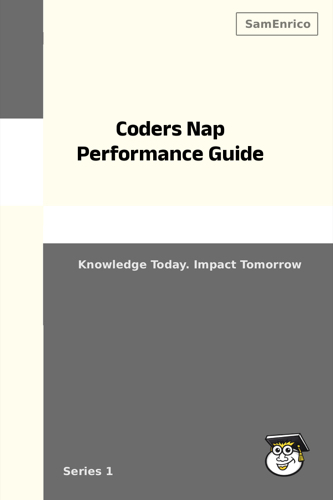
Non-FictionHealth & WellnessProgramming
Coders Nap Performance Guide eBook
Debugs brain with strategic breaks.
Debugs brain with strategic breaks.
Formats
Free sample
Chapter 1: The Leak You Never See--–- At 2:47 PM on a Tuesday, a senior engineer at Google named Sarah had been staring at the same eleven-line function for four hours. She had rewritten it three times. She had added seventeen log statements. She had stepped through it in the debugger so many times that she could recite the memory addresses. The bug remained.
At 7:52 PM, she gave up, closed her laptop, and drove home. She ate dinner, watched twenty minutes of a show she would not remember, and fell asleep. At 3:14 AM, she sat bolt upright in bed. The answer was there, fully formed, complete with the single line of code that would fix the problem. She emailed it to herself, went back to sleep, and fixed the bug in eleven seconds the next morning.This is not a story about hard work.
It is not a story about grit, or persistence, or staying late. It is a story about the strange, overlooked, almost embarrassing power of stopping.Every working programmer knows the feeling. You are deep in a problem. The variables are lined up in your head like a house of cards. You are certain that if you just push a little further, turn one more corner, add one more conditional, the answer will reveal itself.
So you push. And the house of cards collapses. You retrace your steps. You push again. The afternoon dissolves.
Your vision blurs. Your frustration rises. And somewhere around the fourth hour, you are no longer debugging. You are performing a grim, desperate ritual of typing things that do not work, erasing them, and typing them again slightly differently. The machine is waiting.
The bug is winning. And your brain has become a liability.This chapter is about why that happens. Not the surface reason—the bug is tricky, the codebase is legacy, the requirements were ambiguous. The deep reason. The reason that has nothing to do with your skill, your experience, or the quality of your tools.
The reason lives in the architecture of your own brain, in a design flaw that evolution left behind because evolution never had to debug a distributed system at 4 PM on a Friday.The Memory Leak You Didn't Know You Had Every time you switch contexts, you pay a toll. You might not feel it. The toll is not measured in obvious fatigue or visible strain. It is measured in something more insidious: the slow, cumulative degradation of your brain's ability to distinguish signal from noise.Cognitive neuroscience has a name for this. It is called vigilance decrement.
First described in the 1940s by Norman Mackworth, who studied radar operators watching screens for enemy submarines, vigilance decrement is the predictable, measurable decline in detection accuracy and reaction time that occurs after thirty to sixty minutes of continuous monitoring or problem-solving. The radar operators did not feel themselves getting worse. They felt alert, focused, committed. But the data showed otherwise. After an hour, they were missing one out of every four blips.
After two hours, nearly half. Their brains had quietly, invisibly, stopped reporting the truth.Here is what makes vigilance decrement so dangerous for programmers: it does not feel like failure. It feels like effort. The harder your brain works to compensate for its declining accuracy, the more it generates the subjective experience of trying. You feel engaged.
You feel determined. You feel like you are making progress. But the objective measures—the number of correct lines written per hour, the ratio of bugs introduced to bugs fixed, the time to solve novel problems—are all dropping. You are running faster, but you are moving backward.This is the memory leak of modern coding. Not a leak of memory in the computer.
A leak in you.The Stack Overflow of the Mind To understand why this happens, we need a mental model of how your brain processes information during complex problem-solving. The most useful model is also the most familiar to anyone who has written code: the stack and the heap.Your working memory is the stack. It is fast, small, and volatile. It holds the variables you are actively manipulating right now: the value of user.id, the state of the loop counter, the name of the function you just called. It can hold roughly four to seven discrete chunks of information at once.
That is it. No amount of training or coffee increases this limit. It is a physical constraint of the prefrontal cortex, like the maximum volume of a teacup.Your long-term memory is the heap. It is vast, persistent, and slow. It holds every programming language you have ever learned, every bug you have ever solved, every pattern you have ever recognized.
Retrieving something from the heap requires a pointer—a cue, an association, a partial match. And pointers take time to resolve.Here is what happens when you context switch. You are deep in a function, holding its invariants, its edge cases, its callers and callees. Your stack is full but stable. Then Slack notifies you.
Or your phone buzzes. Or a teammate taps you on the shoulder. You shift attention. The contents of your stack are not saved. They are not moved to the heap.
They are simply dropped. The pointer to the heap location where they might be restored is also dropped. When you return to the function, you cannot simply reload the stack. You have to reconstruct it from scratch, by retrieving fragments from the heap, reassembling them, and hoping you did not lose anything critical in the crash.This is not multitasking. Multitasking is a myth.
The brain does not do two things at once. It switches between them, paying the stack overflow penalty on every transition. Researchers at the University of California, Irvine, found that after a typical three-second interruption—a glance at a notification, a quick answer to a question—it takes an average of twenty-three minutes to return to the original task with the same depth of focus. Twenty-three minutes. A three-second interruption costs twenty-three minutes of cognitive recovery.Now multiply that by the average programmer's day.
Slack pings. Email chimes. Jira updates. Builds complete. Tests pass or fail.
Coworkers ask questions. Meetings start late or end early. Each interruption is a tiny, invisible memory leak. Each leak consumes a few cycles of mental RAM. And at the end of the day, you have not run out of effort.
You have run out of stack.The 2+5+7 Protocol Knowing the problem is not the same as solving it. You cannot simply declare that you will stop context switching. The modern workplace is designed to interrupt you. The tools are built to demand attention. The culture rewards responsiveness.
To fight the memory leak, you need a system that does not rely on willpower alone. You need a protocol that makes the right behavior automatic, visible, and self-reinforcing.The 2+5+7 Protocol is that system. It was developed not in a laboratory but in the field, by observing the work patterns of highly productive programmers across dozens of companies, from early-stage startups to FAANG-scale engineering organizations. It distills their common practices into a daily framework that limits cognitive fragmentation without…
This is the end of the free sample. Get the eBook to keep going. Buy now
About this book
Details
- Author
- Lincoln Columbus
- Publisher
- SamEnrico
- Language
- English
- Genre
- Non-Fiction, Health & Wellness, Programming
- Released
- 2026-06-11
- Pages (approx.)
- 140
- Available as
- eBook, Audiobook

Read better in the ZLOADR app
Your eBooks on your phone or tablet. Sign in with your SamEnrico account and start reading.
More by Lincoln Columbus
 Fibromyalgia Mindfulness Based Stress ReductionLincoln Columbus$11.99
 Anger and Shame LinkLincoln Columbus$11.99
 The Soloist Syndrome SolutionLincoln Columbus$11.99
 Pet Loss And TravelLincoln Columbus$11.99
 Property Management PortfolioLincoln Columbus$11.99
 Liver Donor RecipientLincoln Columbus$11.99
 Caregiver Home Care Aide GuideLincoln Columbus$11.99
 The Quantum Tsars: Russia's Golden Age of Science and SplendorLincoln Columbus$11.99
 The Forgotten Hero of Gallipoli: Mustafa Kemal's Stand at Anzac CoveLincoln Columbus$11.99
 The Billionaire’s Ghostwriter: How One Man Penned the Secrets of the Ultra-WealthyLincoln Columbus$11.99
 How to Become a Mill OperatorLincoln Columbus$11.99
 Canadian Scholarships African GuideLincoln Columbus$12.99
You may also like
 Hong Kong Handover 1997Dunn Johnnie$11.99
 Zumba For Postnatal Recovery CourseNeal Christian$11.99
 Zumba for BeginnersLadner Nikia$11.99
 YouTube Comment Mining GuideHumes Pandora$12.99
 Worry Box MeditationCarlin Rudy$11.99
 Workplace Stress MeditationNguyen Lynn$11.99
 Workplace Stress and Sleep RepairHawley Ivory$11.99
 Workplace Perfectionism CureDelaney Jeffry$11.99
 Workplace Injustice Anger GuideWallen Isabelle$11.99
 Work Addiction and Burnout LinkGreenwood Ester$11.99
 Women in Yoga and WellnessBeattie Galina$11.99
 Women in Stand Up ComedyChun Evangeline$11.99