
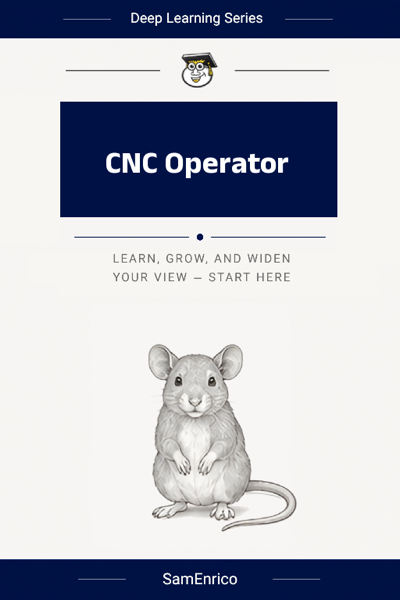
CNC Operator eBook
A Coursebook on CNC Operator
A Coursebook on CNC Operator
Formats
Free sample
Chapter 1: The Digital Awakening--– The first time Jose Ramirez watched a CNC machining center run unattended, he thought someone had played a cruel joke on him. He had spent ten years on manual lathes and Bridgeport mills, where his hands never stopped moving. Every cut required his full attention, every measurement demanded his touch, and every completed part carried the subtle evidence of his unique technique. When his shop foreman walked him over to a Haas VF-2SS and said, “This is your new machine,” Jose literally laughed. “Where are the handwheels?” he asked.
The foreman pointed to a small remote pendant. “There,” he said, “but you won’t use them much. You’re going to learn to talk to this machine.”That was five years ago. Today, Jose programs five-axis machines that run lights-out through entire weekends. He earns three times his old salary, and his body no longer aches from fighting levers and cranking handles.
But the most important change, he says, was not in his paycheck or his fatigue level. “The machine didn’t replace me,” he explains. “It forced me to become smarter. I stopped being a pair of hands and started being a brain.”This chapter is about that transformation. It is about why CNC exists, what it demands from you, and how the role of a machinist has evolved from physical skill to digital literacy.
By the time you finish this chapter, you will understand not just how CNC machines work, but why they matter—and where you fit into the modern factory.The Great Shift: From Manual to Computer Control To understand CNC, you must first understand what came before. Manual machining is a beautiful, tactile craft. A manual lathe operator feels the cut through the handwheel. They listen to the pitch of the chip breaking. They watch the color of the tool tip to judge temperature.
A skilled manual machinist is a musician performing a live concert—every performance is slightly different, and the quality depends entirely on the artist.But manual machining has brutal limitations. The most obvious is human endurance. No one can crank handwheels for ten hours without fatigue, and fatigue leads to mistakes. A manual machinist might produce perfect parts for the first hour, acceptable parts for the next three, and scrap parts after lunch. The second limitation is speed.
A human hand cannot turn a handwheel at 200 revolutions per minute. The third limitation is complexity. A manual machinist cannot cut a true three-dimensional contour—the hand simply cannot move in three axes simultaneously with mathematical precision.Enter Numerical Control (NC) in the 1950s. The United States Air Force funded the first NC machines to machine complex aircraft components that were impossible to make manually. These early machines used punched paper tape to store instructions.
An operator would load the tape, and the machine would read each line of code, move an axis, then stop and wait for the next line. It was slow, but it worked.By the 1970s, computers had become small and cheap enough to be embedded directly into machine tools. This was the birth of Computer Numerical Control (CNC). Instead of reading punched tape line by line, a CNC machine could store entire programs in memory, execute them at high speed, and even perform calculations (like cutter compensation) on the fly.Today, a typical CNC machining center is a marvel of mechatronics—the integration of mechanical systems, electronics, and software. The machine frame is rigid cast iron or polymer concrete.
The spindle spins at 15,000 RPM or more. The axes move on linear guideways driven by ballscrews and servo motors with sub-micron resolution. And the control—the brain—is a specialized industrial computer running real-time operating software.But here is the crucial insight: a CNC machine is not an "automatic" machine. It does not think. It does not adapt.
It follows instructions literally, stupidly, and with terrifying speed. If you tell a CNC machine to drive a 2-inch endmill through a vise at 500 inches per minute, it will do exactly that—once—right before destroying itself. The intelligence is not in the machine. The intelligence is in the program. And the program comes from you.The Three Pillars of CNC Manufacturing Before we dive into the details of programming and operation, you need to understand the three interconnected systems that make CNC work.
Every successful part depends on all three. Failure in any one pillar means failure overall.Pillar One: The Machine Tool The machine tool is the physical hardware. It includes the frame (which must be rigid enough to resist cutting forces without deflecting), the spindle (which holds and rotates the cutting tool or workpiece), the axes (which position the tool relative to the part), the tool changer (which swaps tools automatically), the coolant system (which floods the cutting zone with lubricant and cooling fluid), and the chip conveyor (which removes the swarf from the work envelope).Machine tools come in many varieties. Vertical machining centers (VMCs) have a vertical spindle and are the workhorses of most job shops. Horizontal machining centers (HMCs) have a horizontal spindle and are better for parts that require machining on multiple sides.
Lathes (CNC turning centers) rotate the workpiece instead of the tool and are used for cylindrical parts. Multi-tasking machines combine milling and turning in one envelope. Five-axis machines can orient the tool or part in five axes simultaneously, allowing complex undercuts and contoured surfaces that would require multiple setups on a three-axis machine.As an operator, you do not need to design or repair the machine tool. But you must understand its capabilities and limitations. You must know how much spindle power is available, how fast the axes can accelerate, what the thermal behavior is (machines grow as they warm up), and what the maximum workpiece size is.
A machine is not a black box. It is a partner with known strengths and weaknesses.Pillar Two: The Control System The control is the computer that interprets G-code and moves the axes, spindle, and auxiliary functions. It is the "dashboard" you interact with. Different machine builders use different controls. Haas uses its own proprietary control.
Fanuc controls dominate the Japanese market. Siemens Sinumerik controls are common on European machines. Heidenhain controls excel at five-axis and high-speed machining.Each control has its own personality. Haas controls are intuitive and user-friendly, with large color graphics and conversational programming that allows you to input dimensions and let the control write the G-code for you. Fanuc controls are more text-based and less forgiving, but they are fast and reliable, and they are the standard that most other controls imitate.
Siemens controls are powerful and flexible but have a steeper learning curve.As an operator, you will likely encounter all of these controls over your career. Do not let brand loyalty limit you. The best operators are control-agnostic—they can walk up to any machine and be productive within minutes because they understand the underlying concepts, not just the button locations.Pillar Three: The Program The program is the sequence of instructions that tells the machine what to do. Programs are written in G-code (also called RS-274), a language developed in the 1960s and still…
This is the end of the free sample. Get the eBook to keep going. Buy now
About this book
Details
- Author
- Barrios Matilda
- Publisher
- SamEnrico
- Language
- English
- Genre
- Non-Fiction, Informative, Educational
- Released
- 2026-05-04
- Pages (approx.)
- 136
- Available as
- eBook, Audiobook

Read better in the ZLOADR app
Your eBooks on your phone or tablet. Sign in with your SamEnrico account and start reading.
More by Barrios Matilda
 Operation Car Wash UN SanctionsBarrios Matilda$11.99
 Declining Invitations GracefullyBarrios Matilda$11.99
 Phobia Journal WorkbookBarrios Matilda$11.99
 Action Plan Breakdown WorkbookBarrios Matilda$11.99
 The Sober Creative Unblocking WorkbookBarrios Matilda$11.99
 The Troll King's Last Oath: A Nordic Arthurian SagaBarrios Matilda$11.99
 A Beginners Guide to Biribol (Volume 1)Barrios Matilda$11.99
 Consumer Confidence Index GuideBarrios Matilda$12.99
 Social Comparison Reset ManualBarrios Matilda$12.99
 Understanding Inhalant Abuse, NitritesBarrios Matilda$17.99