
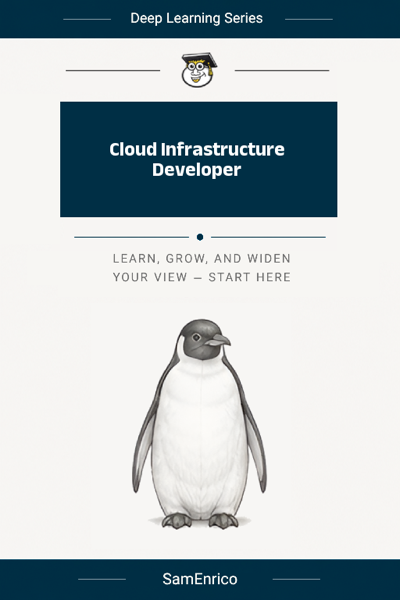
Non-FictionInformativeEducational
Cloud Infrastructure Developer eBook
A Coursebook on Cloud Infrastructure Developer
A Coursebook on Cloud Infrastructure Developer
Formats
Free sample
Chapter 1: The Click-Ops Graveyard--–- In the basement of a Fortune 500 company, buried beneath layers of abandoned cubicles and the faint smell of stale coffee, there sat a server that had not been rebooted in 1,847 days. The IT team called it “Old Unreliable.” They had lost the root password, nobody knew which applications still depended on it, and every engineer had a standing rule: never, under any circumstances, restart that machine. The server had become a pet—a cherished, terrified, snowflake of a system that nobody understood but everyone feared.That server is not an outlier. It is the natural conclusion of manual infrastructure management. And it is the single greatest argument for why you are about to learn cloud infrastructure development.This book is not about becoming a better system administrator. It is about becoming an infrastructure developer—someone who treats networks, servers, and databases as code to be written, tested, versioned, and deployed. By the end of this chapter, you will understand why the old way of managing infrastructure is dying, why the cloud demands a fundamentally different mindset, and how your role is about to change forever.The Anatomy of Manual Infrastructure Failure Before we can understand where we are going, we must understand where we have been. For two decades, the standard model of infrastructure management looked something like this: a company bought physical servers, racked them in a data center, installed an operating system by hand, and then spent the rest of eternity logging into those servers to apply patches, restart services, and fix whatever broke at 2 AM.This model, which we will call Click-Ops or SSH-Ops, has three fatal flaws that no amount of process improvement can fix.Flaw One: The Audit Trail Is Your Memory When an engineer logs into a server and runs vim /etc/nginx/nginx.conf, there is no record of that change unless someone remembers to document it. Most teams do not remember. Over time, the server becomes a black box: running, but nobody knows why or how. Compliance audits become scavenger hunts. Security incidents become root-cause-analysis nightmares because the root cause was a change that nobody wrote down.Consider the 2017 breach of a major credit bureau. Attackers exploited a known vulnerability in a web application framework. The patch had been available for months. But the server was manually managed, the security team had no visibility into whether the patch was applied, and the engineer responsible for that server was on vacation. The breach exposed 147 million records. The root cause was not a sophisticated zero-day exploit. The root cause was manual infrastructure.Flaw Two: Inconsistency Is Inevitable If you have ten servers and you configure each one by hand, you will end up with ten slightly different servers. One will have an extra log rotation script. Another will have a different version of Open SSL. A third will have a firewall rule that the others lack. These differences—called configuration drift—are the breeding ground for “works on my machine” failures.A request that succeeds on server A fails on server B. Nobody knows why. Engineers spend hours comparing configuration files. Eventually, someone discovers that server B has an older version of a library. The fix? Copy the library from server A. But now server B is slightly different again. The drift accelerates.Flaw Three: Disaster Recovery Is a Hope, Not a Plan What happens when Old Unreliable finally dies? If you cannot reproduce a server from scratch, you do not actually have disaster recovery. You have a prayer. Many organizations discover this only after the disaster has struck. Their backup strategy consists of “we have backups somewhere,” and their restore strategy consists of “we will figure it out.” They rarely figure it out.The cloud changes everything about this model. But to understand how, you must first understand what the cloud actually is.What the Cloud Actually Is (And Is Not)The term “cloud” has been so thoroughly marketing-washed that it has lost much of its meaning. Let us strip away the buzzwords. The cloud is not a place. It is not magic. It is not “someone else’s computer,” though that is the cynical and incomplete answer.The cloud is an API-driven abstraction layer over commodity infrastructure. That sentence contains the entire revolution. Let us unpack it.The Abstraction In a traditional data center, if you need a server, you submit a request to operations. Someone procures hardware, racks it, cables it, installs a hypervisor, and eventually—days or weeks later—hands you credentials. The infrastructure is physical, slow, and finite.In the cloud, a server is an API call. You send a JSON payload to ec2.run Instances (AWS), az vm create (Azure), or gcloud compute instances create (GCP), and seconds later, you have a server. The underlying physical hardware is abstracted away. You do not care which physical machine your VM runs on, because the abstraction guarantees consistent behavior regardless.This abstraction extends to every infrastructure component: networks, storage, load balancers, databases, message queues. Everything is an API call.The API-Driven Nature Because everything is an API call, everything is automatable. You can write code that provisions a database, waits for it to be ready, runs migrations, and then deploys an application—all without human intervention. This is the difference between infrastructure management and infrastructure development. The former is a series of manual tasks. The latter is a program.The Commodity Infrastructure The cloud runs on standard, replaceable hardware. A VM on AWS is not fundamentally different from a VM on Azure or GCP or a well-managed Open Stack cluster. The hardware is disposable because the abstraction makes it so. If a physical server fails, the cloud provider replaces it without you noticing. Your VM is automatically restarted on healthy hardware.This disposability is the key insight. In the old model, servers were pets. In the cloud, servers are cattle.The Shared Responsibility Model: Who Owns What?One of the most common sources of security breaches in the cloud is confusion about who is responsible for what. Cloud providers publish a Shared Responsibility Model that draws a clear line. But many engineers never read it.Let us make it simple.The Provider’s Responsibility The cloud provider is responsible for the security of the cloud. This includes:Physical data centers (guards, fences, biometric access)Hypervisors (the software that runs VMs)Network hardware (switches, routers, cables)The control plane (the APIs that let you manage resources)If a power supply fails in a data center, the provider fixes it. If a hypervisor has a security vulnerability, the provider patches it. If a network switch fails, the provider replaces it. You never see any of this.Your Responsibility You are responsible for security in the cloud. This includes:Your data (encryption, access controls, backup)Your operating system (patching, user management, configuration)Your applications (vulnerabilities, authentication, authorization)Your network configuration (firewall rules, routing, VPNs)Your access policies (who can do what)The most common mistake new cloud engineers make is assuming that “the cloud is secure” means they do not need to worry about patching their operating systems. This is wrong. The cloud provider secures the hypervisor. You secure the VM running on that hypervisor.Why the Line Matters In 2019, a misconfigured database at a major corporation exposed 300 million customer records. The database was running on a cloud provider. The cloud provider had done everything correctly: the hypervisor was secure…
This is the end of the free sample. Get the eBook to keep going. Buy now
About this book
Details
- Author
- Burnett Latarsha
- Publisher
- SamEnrico
- Language
- English
- Genre
- Non-Fiction, Informative, Educational
- Released
- 2026-06-02
- Pages (approx.)
- 158
- Available as
- eBook, Audiobook

Read better in the ZLOADR app
Your eBooks on your phone or tablet. Sign in with your SamEnrico account and start reading.
More by Burnett Latarsha
 Unscreen Pro Background GuideBurnett Latarsha$11.99
 The Car Wash Lula Verdict OverturnedBurnett Latarsha$11.99
 Phobia in Older Adults GuideBurnett Latarsha$11.99
 Lawyers and Judges Alcohol Recovery GuideBurnett Latarsha$11.99
 Daily Goal Action Planning GuideBurnett Latarsha$11.99
 Whispers Beneath the Waves: The Lost City of DwarkaBurnett Latarsha$11.99
 Money Scarcity Rewire GuideBurnett Latarsha$12.99
 Inflation Impact Spending GuideBurnett Latarsha$12.99Inflation Impact Spending GuideBurnett Latarsha$12.99Inflation Impact Spending GuideBurnett Latarsha$12.99Inflation Impact Spending GuideBurnett Latarsha$12.99
 Understanding Inhalant Abuse, HaloalkanesBurnett Latarsha$17.99
You may also like
 Hong Kong Handover 1997Dunn Johnnie$11.99
 Zumba For Postnatal Recovery CourseNeal Christian$11.99
 Zumba for BeginnersLadner Nikia$11.99
 YouTube Comment Mining GuideHumes Pandora$12.99
 Worry Box MeditationCarlin Rudy$11.99
 Workplace Stress MeditationNguyen Lynn$11.99
 Workplace Stress and Sleep RepairHawley Ivory$11.99
 Workplace Perfectionism CureDelaney Jeffry$11.99
 Workplace Injustice Anger GuideWallen Isabelle$11.99
 Work Addiction and Burnout LinkGreenwood Ester$11.99
 Women in Yoga and WellnessBeattie Galina$11.99
 Women in Stand Up ComedyChun Evangeline$11.99