
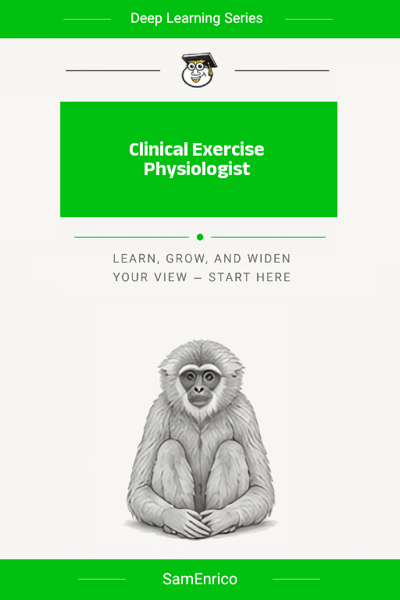
Non-FictionInformativeEducational
Clinical Exercise Physiologist eBook
A Coursebook on Clinical Exercise Physiologist
A Coursebook on Clinical Exercise Physiologist
Formats
Free sample
Chapter 1: The Thousand-Dollar Chair...--A thirty-four-year-old man sits in a waiting room, scrolling through his phone. He has just been discharged from cardiac rehabilitation after a myocardial infarction six months earlier. His cardiologist told him he was “stable.” His physical therapist discharged him because he could walk a quarter mile without chest pain. His primary care physician added a second blood pressure medication and scheduled a follow-up in eight months.No one has asked him about his job, which requires climbing ladders. No one has asked about his two young children, whom he cannot lift without shortness of breath.
No one has asked about the anxiety that wakes him at three in the morning, convinced that every twinge in his chest is another heart attack.He is not broken. He is not failing. He is simply sitting in the gap between what medicine treats and what health requires.That gap is where the Clinical Exercise Physiologist works.The Silent Epidemic That Medicine Created Modern healthcare has accomplished something extraordinary. In the past fifty years, mortality from cardiovascular disease has dropped by more than sixty percent. Cancer survival rates have doubled.
People with HIV now have near-normal life expectancies. The operating rooms, chemotherapy infusion bays, and intensive care units of wealthy nations have become places of genuine rescue.But rescue is not recovery. Survival is not thriving. And the absence of disease is not the presence of health.Here is what the data actually shows. Among patients discharged after a heart attack, nearly half will be readmitted within six months for a preventable complication.
Among those diagnosed with Type 2 diabetes, fewer than fifteen percent will achieve the recommended levels of physical activity. Among patients with chronic obstructive pulmonary disease, the average time from diagnosis to severe disability is just seven years, not because the disease is untreatable but because the treatment—exercise—is systematically underprescribed.The problem is not malice or incompetence. The problem is structural. Physicians have seven to twelve minutes per patient. Physical therapists are reimbursed for restoring function after acute injury, not for managing chronic disease over years.
Nurses are overstretched handling medications, wounds, and vital signs. The system is designed for episodes of illness, not for the long slog of living with a chronic condition.And yet, chronic diseases now account for seven of every ten deaths in developed nations. Heart disease, diabetes, chronic lung disease, arthritis, depression, cognitive decline—these are not events. They are trajectories. They unfold over years and decades.
They are shaped not by heroic interventions delivered once, but by daily choices, daily habits, and daily physiological responses to movement, food, sleep, and stress.The medical system is brilliant at the acute event. It is failing at the chronic trajectory. And that failure has created an entirely new profession, one that most patients have never heard of and most physicians do not know how to use.Defining the Clinical Exercise Physiologist A Clinical Exercise Physiologist is an allied health professional who uses precisely prescribed physical activity to prevent, manage, and treat chronic disease. That definition sounds simple. Its implications are radical.Unlike a personal trainer, who works with generally healthy people seeking general fitness, the CEP works with people who have diagnosed medical conditions.
The personal trainer designs workouts. The CEP designs treatment plans. The personal trainer stops at the first sign of chest pain and sends the client to a doctor. The CEP recognizes that chest pain may be angina, understands its significance in the context of the patient's medications and history, knows when to stop and when to modify, and communicates findings back to the referring physician in clinical language.Unlike a physical therapist, who focuses on restoring specific functional deficits after injury or surgery, the CEP focuses on the global physiological responses to chronic disease. The physical therapist might teach a post-stroke patient to walk again.
The CEP will prescribe an exercise program that simultaneously addresses cardiovascular fitness, blood pressure, glucose control, bone density, fall risk, and mood—all in the same session. The physical therapist discharges when the immediate functional goal is met. The CEP follows the patient for months or years, adjusting the prescription as the disease progresses or improves.Unlike a physician, the CEP does not diagnose disease and does not prescribe medication. But the CEP understands pharmacology better than most nurses. A CEP knows that a beta-blocker will blunt the heart rate response to exercise, making heart rate targets useless and rating of perceived exertion mandatory.
A CEP knows that an SGLT2 inhibitor for diabetes combined with intense exercise can trigger euglycemic diabetic ketoacidosis, a rare but life-threatening emergency. A CEP knows that anticoagulants and contact sports do not mix, and that a patient on an aromatase inhibitor for breast cancer will need joint protection strategies before they start reporting pain.The CEP sits at the intersection of medicine and movement. To the left, a deep understanding of pathophysiology, pharmacology, and clinical monitoring. To the right, a mastery of exercise physiology, behavioral psychology, and program design. In the middle, the patient, whose disease does not care about professional boundaries.A Brief History of an Invisible Profession The field began, as many useful things do, in cardiac rehabilitation.
In the 1970s, a small group of exercise physiologists and cardiologists noticed something strange. Patients who participated in supervised exercise programs after a heart attack had lower death rates than those who did not. This was not obvious at the time. The conventional wisdom was that rest was good for a damaged heart. The early exercise programs were considered mildly dangerous, prescribed despite concern rather than because of evidence.The evidence eventually won.
By the 1980s, cardiac rehabilitation was standard of care. Exercise testing became a routine part of post-MI evaluation. The professionals conducting those tests and prescribing those exercise programs were not physicians or physical therapists. They were a new kind of practitioner: the clinical exercise physiologist.From that starting point, the profession expanded. Diabetes programs began hiring exercise physiologists to teach patients how to use physical activity alongside insulin and oral medications.
Pulmonary rehabilitation programs followed, recognizing that patients with COPD needed exercise to improve muscle function and reduce dyspnea, even when their lung disease itself was irreversible. Cancer centers started adding exercise oncology services, discovering that patients who exercised during chemotherapy had fewer dose reductions, fewer hospitalizations, and better quality of life. Mental health clinics began referring patients with depression and anxiety to exercise programs, generating outcomes comparable to antidepressant medications without the side effects.Today, the CEP works in hospitals, outpatient clinics, corporate wellness centers, academic research settings, and private practice. But the profession remains oddly invisible. Most medical schools devote fewer than two hours to exercise prescription across four years of training.
Most patients have never heard of a CEP. Most insurers do not recognize the profession for reimbursement, forcing CEPs to bill under other codes or operate on cash-pay models.This invisibility is not sustainable. The demand is too great. The need is too urgent. And the evidence is too clear.What This Book Will Teach You This is not an academic textbook, though it contains all the science you need.
It is not a certification exam review, though it will prepare you for the ACSM-CEP, CEP-UK, and ESSA-AEP examinations. It…
This is the end of the free sample. Get the eBook to keep going. Buy now
About this book
Details
- Author
- Lawrence Gretchen
- Publisher
- SamEnrico
- Language
- English
- Genre
- Non-Fiction, Informative, Educational
- Released
- 2026-05-11
- Pages (approx.)
- 137
- Available as
- eBook, Audiobook

Read better in the ZLOADR app
Your eBooks on your phone or tablet. Sign in with your SamEnrico account and start reading.
More by Lawrence Gretchen
 The Autonomy Motivation GuideLawrence Gretchen$11.99
 Resume Gap Cover LetterLawrence Gretchen$11.99
 Diaphragmatic Breathing PelvicLawrence Gretchen$11.99
 Stress Mitochondrial HealthLawrence Gretchen$11.99
 Fermented Foods Longevity GuideLawrence Gretchen$11.99
 The Poisoner's Garden: A Victorian Venomologist's Dark LegacyLawrence Gretchen$11.99
 Nairobi vs Kigali StartupsLawrence Gretchen$12.99
 Facebook Ads Manager Mobile AppLawrence Gretchen$12.99Facebook Ads Manager Mobile AppLawrence Gretchen$12.99Facebook Ads Manager Mobile AppLawrence Gretchen$12.99Facebook Ads Manager Mobile AppLawrence Gretchen$12.99
 The Breeder's Guide to Brahma ChickensLawrence Gretchen$11.99
You may also like
 Hong Kong Handover 1997Dunn Johnnie$11.99
 Zumba For Postnatal Recovery CourseNeal Christian$11.99
 Zumba for BeginnersLadner Nikia$11.99
 YouTube Comment Mining GuideHumes Pandora$12.99
 Worry Box MeditationCarlin Rudy$11.99
 Workplace Stress MeditationNguyen Lynn$11.99
 Workplace Stress and Sleep RepairHawley Ivory$11.99
 Workplace Perfectionism CureDelaney Jeffry$11.99
 Workplace Injustice Anger GuideWallen Isabelle$11.99
 Work Addiction and Burnout LinkGreenwood Ester$11.99
 Women in Yoga and WellnessBeattie Galina$11.99
 Women in Stand Up ComedyChun Evangeline$11.99