
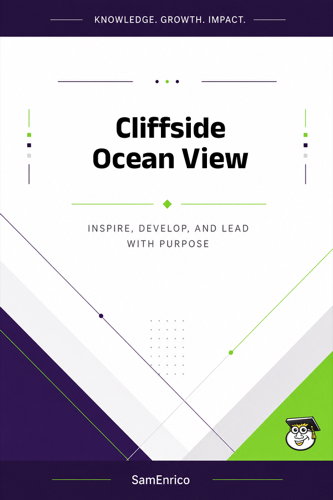
Cliffside Ocean View eBook
Sit on grassy cliffs above crashing waves and feel
Sit on grassy cliffs above crashing waves and feel perspective on your problems.
Formats
Free sample
Chapter 1: The Geology of Now...--–- The first time Sarah sat on the cliff, she wasn't looking for wisdom. She was looking for a place to cry where no one could hear her. Her husband had left three months earlier. Her mother's dementia had accelerated. Her boss had suggested a "performance improvement plan" that everyone knew was the first step toward termination.
At forty-two, Sarah found herself sitting on damp grass six hundred feet above the Pacific Ocean, watching waves the size of houses collapse into foam, and waiting for something—anything—to feel different.Nothing felt different. Not at first. The wind was cold. The grass soaked through her jeans. The waves were loud, then quiet, then loud again.
She cried for twenty minutes. Then she sat for another twenty, empty. Then she drove home. But something had shifted without her permission. On the drive back to her apartment, the voice in her head—the one that had been listing her failures on a continuous loop for ninety days—was quieter.
Not gone. Just... at a lower volume. As if the ocean had absorbed some of its frequency.Sarah didn't know it yet, but she had stumbled upon the central mechanism of this book: distance. Not escape.
Not denial. Not positive thinking. Just distance. She had placed physical space between herself and her problems by climbing six hundred feet above them. And that physical distance had created psychological distance.
From the cliff, her divorce was still real, her mother was still sick, her job was still precarious. But those facts no longer occupied her entire field of vision. She could see them as objects among other objects, rather than as the whole sky.This chapter is about that distance. It is about the geology of now—the practice of locating the solid, unchanging bedrock beneath the shifting sediments of daily anxiety. Most self-help books begin with action: change your habits, reframe your thoughts, rewrite your story.
This book begins with something more basic and more difficult: stopping. Before you can change anything, you must know what does not need to change. Before you can fix what is broken, you must know what is already whole.The Layered Self: Why You Feel Like a Contradiction Geologists understand that cliffs are not uniform. They are composed of layers—some soft, some hard, some deposited millions of years apart. A cliff face reveals time in vertical stripes: a layer of sandstone from an ancient beach, a layer of shale from a deep ocean floor, a layer of limestone from a coral reef that existed before flowers evolved.
Each layer tells a different story. Each layer has a different consistency. And beneath all of them, sometimes thousands of feet down, is the bedrock—the igneous or metamorphic rock that forms the continent's stable foundation.Your mind is no different. You are not a single, consistent self. You are a stack of layers.The surface layer is where you live most of the time.
This layer contains your daily habits, your reactive emotions, your social masks, your to-do lists, and your unedited thoughts. "I'm so disorganized." "I can't believe I said that." "Why am I like this?" These are surface statements. They are real, but they are also temporary. A footprint on a sandy beach is real. It is also erased by the next high tide.Below the surface lies the sedimentary layer.
This is where your learned patterns, family scripts, cultural conditioning, and past traumas accumulate over years. Your father's voice telling you that you're lazy. The second-grade teacher who said you weren't "math material." The decade you spent in a job you hated because your family expected stability. These are not your fault, but they are your inheritance. Like sedimentary rock, these layers can be thick and heavy.
They can feel like identity. They are not. They are accumulated experience—real, influential, but still deposited, not intrinsic.And beneath both lies the bedrock. This is the layer that does not change. It is not earned, not learned, and not lost.
Bedrock values are the non-negotiable truths about what matters to you when no one is watching, when you have nothing to prove, and when all the surface noise has been stripped away.Here is the problem most people make: they mistake the surface for the bedrock. They say "I am anxious" as if anxiety were a permanent feature of their geology, rather than a weather pattern passing over it. They say "I am a failure" as if failure were a layer of rock, rather than a single event that happened on a single Tuesday. They live their entire lives reacting to surface conditions—today's bad mood, this hour's critical email, this minute's intrusive thought—as if those conditions were the foundation of who they are.The cliff teaches a different lesson. From six hundred feet up, you can see the difference between the green grass on top of the cliff (surface), the exposed layers of sediment in the cliff face (accumulated experience), and the dark, unbroken rock at the base (bedrock).
One is fragile. One is layered. One is eternal. This chapter helps you identify which is which—in your life, right now.The Erosion Fallacy: Why the Past and Future Steal Your Present Before you can find your bedrock, you must understand what obscures it. Two forces erode the cliff face constantly: the past and the future.
Neither is solid. Both can be mistaken for bedrock if you stare at them long enough.The past erodes through regret. Sarah, the woman on the cliff, spent most of her waking hours replaying conversations from her marriage. What if she had spoken up sooner? What if she had been more patient?
What if she had seen the signs? These questions had no answers. They were not inquiries; they were rituals. Each replay was a small act of self-punishment disguised as problem-solving. The past cannot be changed, but it can be re-lived.
And re-living it feels like doing something when in fact it is the opposite of action.The future erodes through worry. Sarah also spent hours constructing catastrophic scenarios. She would lose her job. Then she would lose her apartment. Then she would have to move in with her mother, who wouldn't recognize her anyway.
Then she would die alone in a Medicaid facility. None of these things had happened. Most would not happen. But her brain treated them as if they were already real, flooding her body with cortisol as if the catastrophe were occurring in this moment.Between the past (which no longer exists) and the future (which does not yet exist), where is the present? It is a vanishingly thin slice—a few seconds of now before the next wave of memory or forecast crashes over it.The cliff does not erase the past or the future.
From the cliff, Sarah could still remember her marriage. She could still worry about her job. But the past and future no longer occupied all of her attention. They became objects she could look at rather than weather she was drowning in. That is the difference between erosion and observation.
Erosion is the past and future wearing you down without your consent. Observation is you looking at the past and…
This is the end of the free sample. Get the eBook to keep going. Buy now
About this book
Details
- Author
- Nicholas Hyacinth
- Publisher
- SamEnrico
- Language
- English
- Genre
- Non-Fiction, Self-Help
- Released
- 2026-06-08
- Pages (approx.)
- 106
- Available as
- eBook, Audiobook

Read better in the ZLOADR app
Your eBooks on your phone or tablet. Sign in with your SamEnrico account and start reading.
More by Nicholas Hyacinth
 Senior Conversation ConfidenceNicholas Hyacinth$11.99
 Digital Communication for Remote BoardsNicholas Hyacinth$11.99
 Tennis Player's HypnosisNicholas Hyacinth$11.99
 Flow in EngineeringNicholas Hyacinth$11.99
 The Executive Deep WorkNicholas Hyacinth$11.99
 Hot Spring Soak GuideNicholas Hyacinth$11.99
 Affirmations for Morning RoutineNicholas Hyacinth$11.99
 The Last Wyrm of the Black ForestNicholas Hyacinth$11.99
 The Golden Calculators: Timbuktu's Mathematical MarvelsNicholas Hyacinth$11.99
 How to Produce Diaper OrganizersNicholas Hyacinth$11.99
 Vampire Bats: Blood-feederNicholas Hyacinth$11.99
 Business Credit for Technology StartupsNicholas Hyacinth$12.99
You may also like
 Hong Kong Handover 1997Dunn Johnnie$11.99
 Zumba For Postnatal Recovery CourseNeal Christian$11.99
 Zumba for BeginnersLadner Nikia$11.99
 YouTube Comment Mining GuideHumes Pandora$12.99
 Worry Box MeditationCarlin Rudy$11.99
 Workplace Stress MeditationNguyen Lynn$11.99
 Workplace Stress and Sleep RepairHawley Ivory$11.99
 Workplace Perfectionism CureDelaney Jeffry$11.99
 Workplace Injustice Anger GuideWallen Isabelle$11.99
 Work Addiction and Burnout LinkGreenwood Ester$11.99
 Women in Yoga and WellnessBeattie Galina$11.99
 Women in Stand Up ComedyChun Evangeline$11.99