
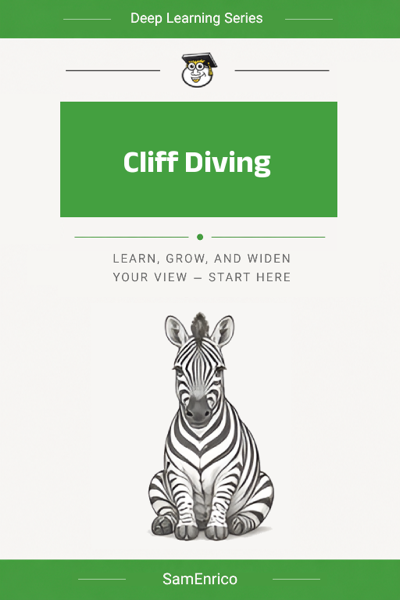
Cliff Diving eBook
A Coursebook on Cliff Diving
by Kemp Margo
A Coursebook on Cliff Diving
Formats
Free sample
Chapter 1: The First Leap--The moment your toes curl over the edge of a cliff, something ancient wakes up inside you. It doesn’t matter whether the drop is three meters or thirty—your body doesn’t know the difference. What it knows is height. What it knows is the sudden, primal certainty that one small movement forward will change everything. Your breath catches.
Your calves tighten. The water below looks impossibly far away and impossibly hard, even though you know, intellectually, that it is neither. This is the edge. And every cliff diver, from the teenagers throwing careless backflips off Acapulco’s La Quebrada to the world champions rotating through triple somersaults at twenty-seven meters, has stood exactly where you are standing now. The difference between watching and jumping is not athleticism.
It is not strength or flexibility or even courage, exactly. It is something more fundamental: the decision to treat fear as information rather than as an order.This book exists because cliff diving is not a stunt and never has been. It is one of the oldest human rituals, a practice found on every continent where there is water and rock, and it has survived centuries not because people are reckless but because people are seeking something. That something is not adrenaline, though adrenaline comes with the territory. What cliff divers chase is the split second of perfect alignment—body straight, mind quiet, water rising—when every doubt falls away and there is only the dive.
That moment is brief. It is also, for those who have felt it, unforgettable. This chapter tells the story of how that moment became a discipline, how a handful of fearless divers turned a death-defying spectacle into a sport, and how you—reading this book on solid ground—can begin to understand what it takes to leave your feet.The Hawaiian Origins: Jumping With Purpose Before there were world records and sponsorship deals, there was lele kawa. The term comes from the Hawaiian language: lele means to jump or fly, and kawa means splash or, in some contexts, the edge of a reef. Early accounts, some written by missionaries and explorers in the eighteenth and nineteenth centuries, describe a practice in which Hawaiian warriors and fishermen would leap from sea cliffs into the ocean below.
Contrary to a popular myth that has crept into adventure writing, lele kawa did not require a splashless entry. The goal was not silence. The goal was control. A diver who entered the water cleanly, with feet together and body vertical, demonstrated not only fearlessness but also mastery over their own body. The splash was not hidden; it was earned.These jumps were not casual.
Cliff diving in ancient Hawaii carried spiritual weight. Certain cliffs were considered sacred, and jumps were performed as offerings to the gods or as rites of passage for young men entering adulthood. A failed dive—one where the diver lost orientation, entered sideways, or injured themselves—was seen as more than a physical mistake. It was a sign of spiritual unpreparedness. In this way, the earliest cliff divers understood something that modern sports psychology has only recently begun to articulate: the mind and the body do not perform separately.
Fear, doubt, and hesitation are not just feelings; they are physical events that disrupt alignment, delay the tuck, and flatten the entry. The Hawaiians could not have named the amygdala or measured cortisol spikes, but they knew that a diver who was not ready would not dive well. That knowledge is the oldest tradition in the sport.Similar traditions emerged independently around the world. In Mexico, the cliff divers of La Quebrada in Acapulco began performing in the 1930s, though the site had been used for generations before that. The Quebrada canyon is a narrow chasm only seven meters wide at its narrowest point, with waves that surge in from the Pacific Ocean.
Divers climb to ledges as high as forty meters, wait for a wave to deepen the water, and then launch themselves into the void. Their dives are timed not by a stopwatch but by the rhythm of the sea. A diver who jumps too early lands in shallow water. A diver who jumps too late lands on rock. The margin for error is measured in fractions of a second, and yet the divers of La Quebrada have performed daily for nearly a century with remarkably few serious injuries.
Their secret is not recklessness. It is preparation, repetition, and a profound respect for the site.In the South Pacific, young men on the island of Pentecost in Vanuatu developed land diving, a ritual that involves jumping from wooden towers with vines tied to the ankles. While not strictly cliff diving—the landing surface is earth, not water—land diving shares the same psychological architecture: height, risk, and the need for total focus. Anthropologists have documented land diving as a coming-of-age ceremony for centuries, and modern bungee jumping is a direct descendant. The lesson here is that humans have always been drawn to edges.
We have always sought ways to test ourselves against gravity and survive. Cliff diving is simply the most elegant version of that test—no ropes, no harnesses, no backup. Just you and the water.The Wild Boys of Acapulco: Spectacle Becomes Sport If the ancient traditions gave cliff diving its soul, the twentieth century gave it a stage. La Quebrada became internationally famous in the 1930s when a group of local divers began performing for tourists. These men, known colloquially as Los Clavadistas de Quebrada, turned the ancient practice into a public spectacle.
They climbed higher, added flips, competed with one another for the most daring jump. By the 1950s, La Quebrada was a must-see destination for Hollywood stars and world leaders, and the divers were celebrities in their own right.Among them, a group emerged who would become legends: the Wild Boys of Acapulco. This nickname was given to a generation of divers who pushed the limits of what seemed possible. They dove from forty meters—the height of a ten-story building—into water that was sometimes only four meters deep at low tide. They performed triple flips and backward twists without the benefit of video analysis or sports science.
They learned by watching each other, by failing, by getting up and climbing the cliff again. One of the most famous Wild Boys was a diver named Raúl García, who began jumping at La Quebrada as a teenager in the 1960s and continued performing into his seventies. When asked why he still dove, he said simply, "Because the water is still there."The Wild Boys were not reckless in the way that term is usually used. Recklessness implies ignorance or disregard for consequences. What the Wild Boys possessed was something closer to intimate familiarity with risk.
They knew exactly how dangerous their dives were. They had seen friends break bones, suffer concussions, come dangerously close to drowning. But they also knew that with proper technique, proper site assessment, and proper mental preparation, a forty-meter dive was survivable. They were not gambling. They were calculating—not with formulas and spreadsheets but with bodies that had made the…
This is the end of the free sample. Get the eBook to keep going. Buy now
About this book
Details
- Author
- Kemp Margo
- Publisher
- SamEnrico
- Language
- English
- Genre
- Non-Fiction, Informative, Educational
- Released
- 2026-05-06
- Pages (approx.)
- 148
- Available as
- eBook, Audiobook

Read better in the ZLOADR app
Your eBooks on your phone or tablet. Sign in with your SamEnrico account and start reading.
More by Kemp Margo
 Breaking Binge Eating CycleKemp Margo$11.99Breaking Binge Eating CycleKemp Margo$11.99
 Caffeine Anger SensitivityKemp Margo$11.99
 Menopause Vision Changes GuideKemp Margo$11.99
 SAS Arctic Warfare CourseKemp Margo$11.99
 Idea Parking Lot Management GuideKemp Margo$11.99
 The Green Book of Gold: The Untold Wealth of Black America's Hidden MogulsKemp Margo$11.99
 The Cursed Crown of the Aztecs: Mexico’s 1970 World Cup RedemptionKemp Margo$11.99
 Understanding GalactocoeleKemp Margo$17.99
 How to Start a Azoic Dye Business (Beginners Guide)Kemp Margo$11.99
 Group ESL Teaching ChinaKemp Margo$12.99
 Google AI for Agriculture WorkbookKemp Margo$12.99