
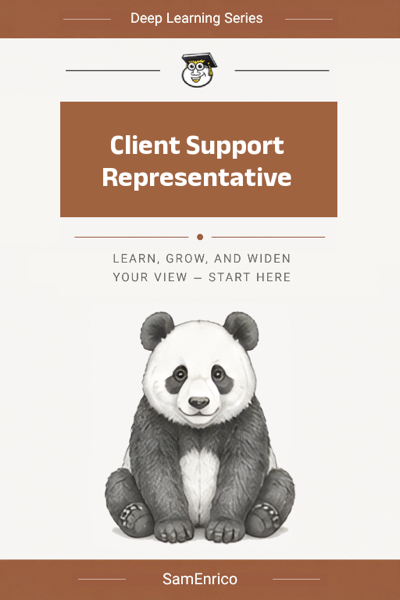
Client Support Representative eBook
A Coursebook on Client Support Representative
by Lemay Micha
A Coursebook on Client Support Representative
Formats
Free sample
Chapter 1: The Service Delusion--–- Most people enter the world of client support carrying a heavy, invisible backpack. Inside that backpack are slogans they have heard since childhood, warnings from well-meaning friends, and memories of every bad service interaction they have ever endured as a customer. At the very bottom of that backpack, weighing more than all the others combined, is a single dangerous sentence: "The customer is always right."This chapter is not going to tell you that the customer is wrong. That would be equally useless. The customer is often confused, sometimes misinformed, frequently emotional, and occasionally unreasonable.
But right? Right is a judgment that has no place in the resolution process. The customer is the customer. Your job is not to determine their moral or factual correctness. Your job is to solve their problem while protecting your company's interests and your own sanity.
That mission is impossible as long as you believe you must agree with the customer to serve them well.The Service Delusion is the mistaken belief that high-quality support means saying yes to everything, absorbing any amount of emotional abuse, and treating the customer as an infallible authority figure. This delusion burns out good representatives, rewards bad customer behavior, and ultimately damages the very relationships it claims to protect. In this chapter, we will dismantle that delusion and replace it with a functional, sustainable definition of what it means to be a modern Client Support Representative.The Myth and Its Origins Where did "the customer is always right" come from? The phrase is most often attributed to Harry Gordon Selfridge, Marshall Field, and Cesar Ritz—retail and hospitality pioneers of the early twentieth century. Each of these men built empires by insisting that their staff treat customers with deference and prioritize their satisfaction above rigid rules.
In the context of 1909, when a customer had few alternatives and word-of-mouth traveled slowly, this philosophy made commercial sense.But we are not running a 1909 department store. We are operating in an era of instant reviews, social media outrage cycles, and customers who have been trained by years of corporate deference to believe that volume and threat are the most effective tools for getting what they want. The original intent of the phrase was not to declare customers infallible. It was to remind staff not to argue with customers about trivial matters of taste. "The customer is always right" originally meant: if they want the blue hat instead of the red hat, do not fight them.
It never meant: the customer is correct about your policies, your product limitations, or the basic facts of your interaction.Somewhere along the way, the meaning mutated. Managers began using it to shut down employee concerns about abusive behavior. Customers began weaponizing it to demand things that were unreasonable, impossible, or contradictory to the company's stated terms. The phrase transformed from a sensible rule about not bickering over preferences into a cudgel used to beat representatives into submission.Redefining the Modern CSRIf "the customer is always right" is an unusable relic, what replaces it? The modern Client Support Representative operates from a different foundation: the customer is the customer.
That sentence sounds simple until you unpack its implications.A customer brings a problem. They bring an emotional state. They bring a history with your company, accurate or not. They do not bring infallibility. When you release yourself from the obligation to agree with the customer, you free yourself to actually help them.
You can acknowledge their frustration without endorsing their version of events. You can enforce a policy without apologizing for its existence. You can end a conversation that has turned abusive without feeling like a failure.The modern CSR is a consultant, not a servant. A consultant brings expertise. A consultant diagnoses before prescribing.
A consultant maintains professional boundaries. A consultant knows that the best outcome is not the one that makes the customer happiest in the moment, but the one that solves their underlying problem most effectively over time.Consider two versions of the same interaction. In Version A, the customer demands a refund for a product they broke through misuse. The CSR, operating under the Service Delusion, apologizes profusely, processes the refund against policy, and hangs up feeling resentful and compromised. The customer learns that breaking products leads to refunds.
The company loses money. The CSR burns out. In Version B, the same customer makes the same demand. The CSR, operating as a consultant, says: "I cannot offer a refund for damage caused by misuse—our warranty explicitly excludes that. What I can do is offer you a replacement at half price, which is our standard accommodation for this situation." The customer may be unhappy.
They may escalate. But they have received a clear, professional boundary and a fair alternative. The CSR has not violated policy, has not absorbed blame for something that was not their fault, and has offered a genuine solution.Which version produces better long-term outcomes? The data is clear. Customers who receive boundaries along with solutions have lower rates of repeat problematic behavior.
Companies that allow representatives to say no within policy have lower employee turnover. And representatives who understand their role as consultative rather than subservient have dramatically lower rates of burnout.Customer Service vs. Customer Experience One of the most important distinctions in this entire book is the difference between Customer Service and Customer Experience. These terms are often used interchangeably, but they describe fundamentally different activities, and confusing the two leads to misplaced effort and misaligned priorities.Customer Service is transactional. It is reactive.
It is the set of activities that occur when a customer has a problem and reaches out for help. Processing a return. Answering a billing question. Resetting a password. Tracking a shipment.
Customer Service is what most people think of when they imagine this job. It is necessary, valuable, and measurable. But it is only half of the picture.Customer Experience is strategic. It is the emotional journey the customer undergoes from their first interaction with your company to their last. Customer Experience includes the ease of using your website, the clarity of your instructions, the tone of your emails, the hold time on your phone line, and the feeling they are left with after speaking to you.
Customer Experience is the cumulative result of every touchpoint, not just the support interaction.Here is why this distinction matters for you as a CSR. If you believe your job is only Customer Service, you will focus on closing tickets quickly and moving to the next call. You will see your role as reactive and transactional. You will miss opportunities to improve the broader Experience because you are not looking for them. But if you understand that every single interaction is a moment of Customer Experience creation, you will behave differently.
You will notice when a customer is confused by an email template and flag it for revision. You will document when fifty people ask the same question so the knowledge base can be updated. You will treat each call not as an interruption to your day but as a data point about how your company is performing.The best CSRs…
This is the end of the free sample. Get the eBook to keep going. Buy now
About this book
Details
- Author
- Lemay Micha
- Publisher
- SamEnrico
- Language
- English
- Genre
- Non-Fiction, Informative, Educational
- Released
- 2026-06-02
- Pages (approx.)
- 141
- Available as
- eBook, Audiobook

Read better in the ZLOADR app
Your eBooks on your phone or tablet. Sign in with your SamEnrico account and start reading.
More by Lemay Micha
 The Productive Struggle GuideLemay Micha$11.99The Productive Struggle GuideLemay Micha$11.99
 Finance Creative Problem SolvingLemay Micha$11.99
 Active Participation InfluenceLemay Micha$11.99
 Setting Boundaries for Lasting FreedomLemay Micha$11.99
 The France Interview Attire GuideLemay Micha$11.99
 Hildegard of Bingen: The Visionary Voice of the Middle AgesLemay Micha$11.99
 International Franchise ConferenceLemay Micha$12.99
 African Logistics YC GuideLemay Micha$12.99
 Understanding Trisomy 1 MosaicismLemay Micha$17.99
 How to Start a Dome Lights Made of Plastic Business (Beginners Guide)Lemay Micha$11.99